Lijiang
After an hour’s delay at Jinghong airport I arrived in Lijang after midnight with the requirement that I call the hostel if I was to arrive after 1am. I then discovered that my Chinese SIM card had run out of credit. I have no independent capacity of knowing its status & I’d thought it was OK. I couldn’t get the Aussie one to co-operate either though it was more likely operator error than anything else. So that’s how I spent the bus trip from the airport to the drop off point; fiddling with phones in the dark. At the drop off point in the middle of nowhere I asked one of passengers if he would call the hostel. He not only did that but put me in a taxi with instructions to the driver. When we arrived at the next drop off point a hostel employee was there to meet me. The hostel was in a car free zone of the old city. He then took me through dark but interesting streets by the light of a flashlight.
The hostel had good staff but my room was rather run down. The worst I’ve encountered.
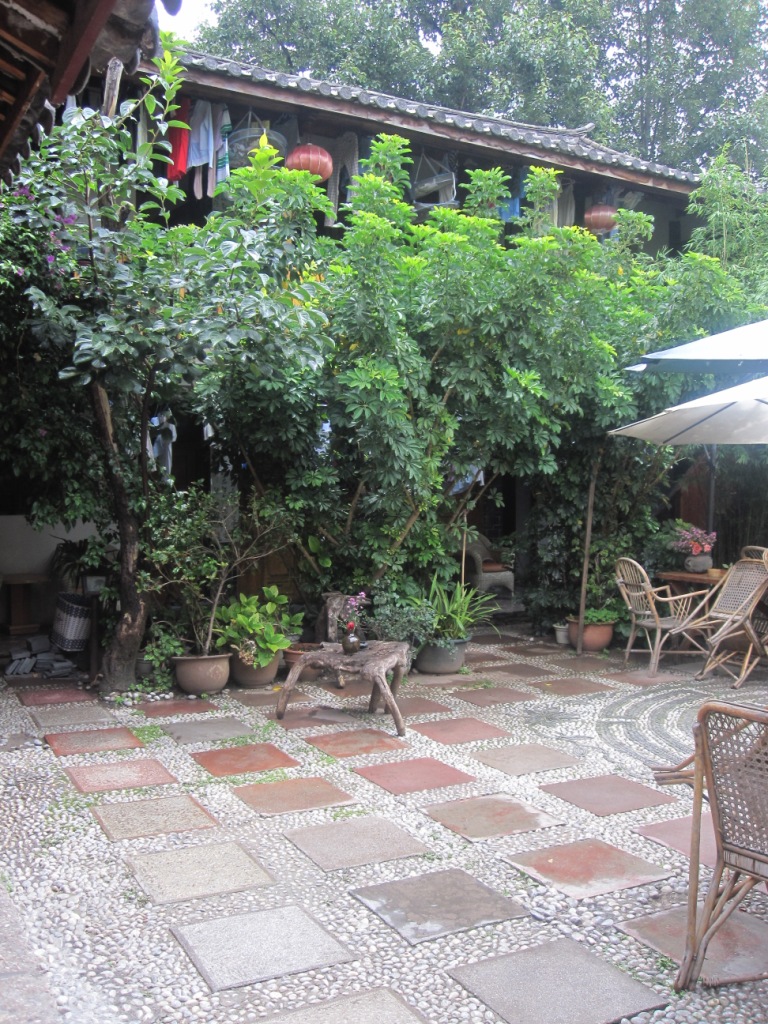
The next day a couple of men appeared and started chipping away at the pavers to give them an “ancient” appearance. The room I booked was not available as the area outside it was having a paver makerover too. Grey pavers were being placed over the shiny white tiles.
I then spent the next few days getting lost in the torturous streets and laneways.
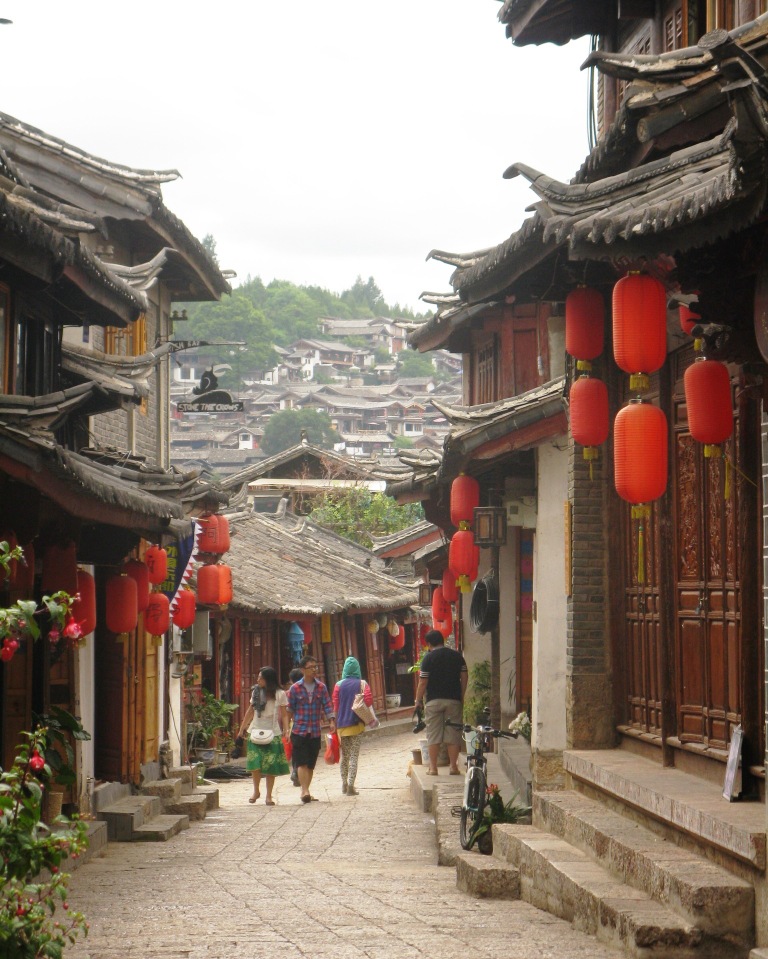
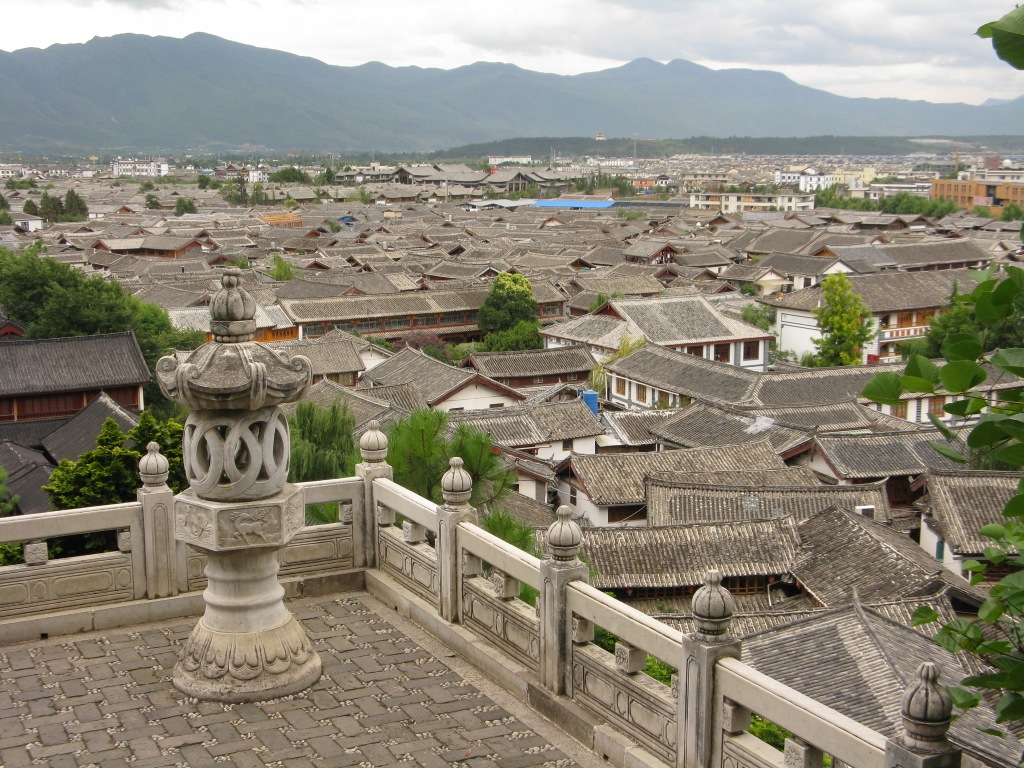 This view of rooftops of Lijiang was taken from a place called Mu’s Mansion, the home of several centuries of local notables.
The main areas which were infested with tourists had You are Here type maps which sometimes helped. The hostel had a rudimentary map on the back of its card and in the end I bought a map. However, it didn’t help a great deal as the streets weren’t marked in English. I did advise me of a few interesting places to visit which weren’t tourist infested. Usually it was only me and a handful of students who were drawing old buildings.
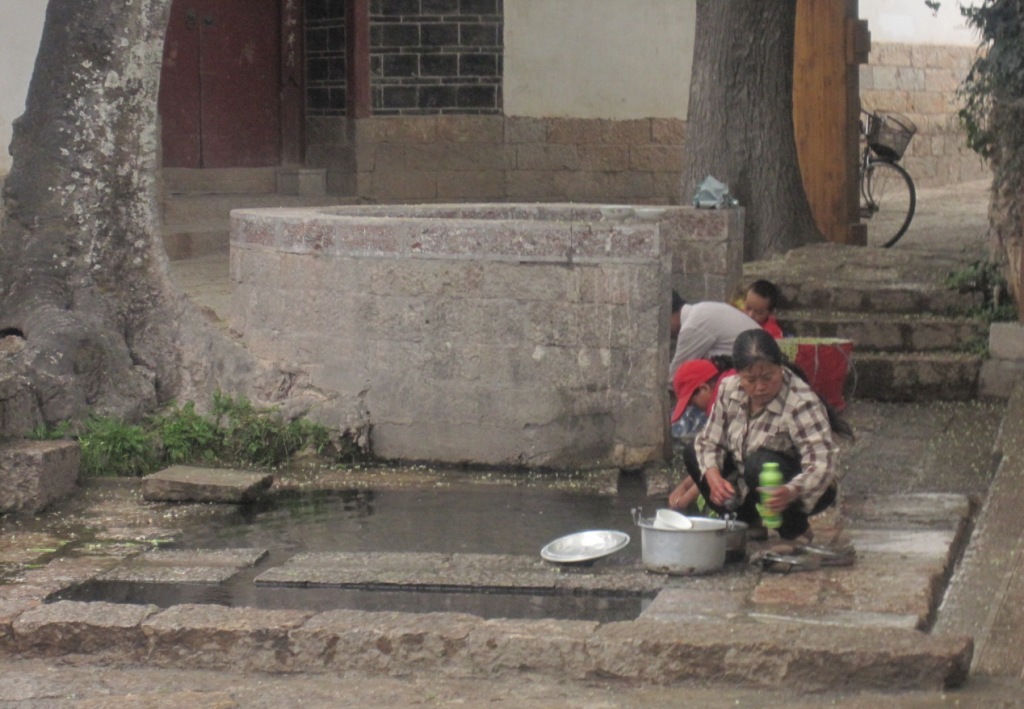
This is one of the out of the way places. It is a well. This isn’t clear, but there are three different water sources here. The one at the top with the small wall is for drinking water & 2 people are collecting water. The 2nd is for washing vegetables and one woman is doing that. The 3rd is for washing and a woman is washing dishes.
The hostel arranged a tour to a nearby old town which used to be the centre of the local culture. There were 7 of us in a small mini-van. Baioshi had an embroidery workshop with some magnificent embroideries and a couple of young women working on large pieces.
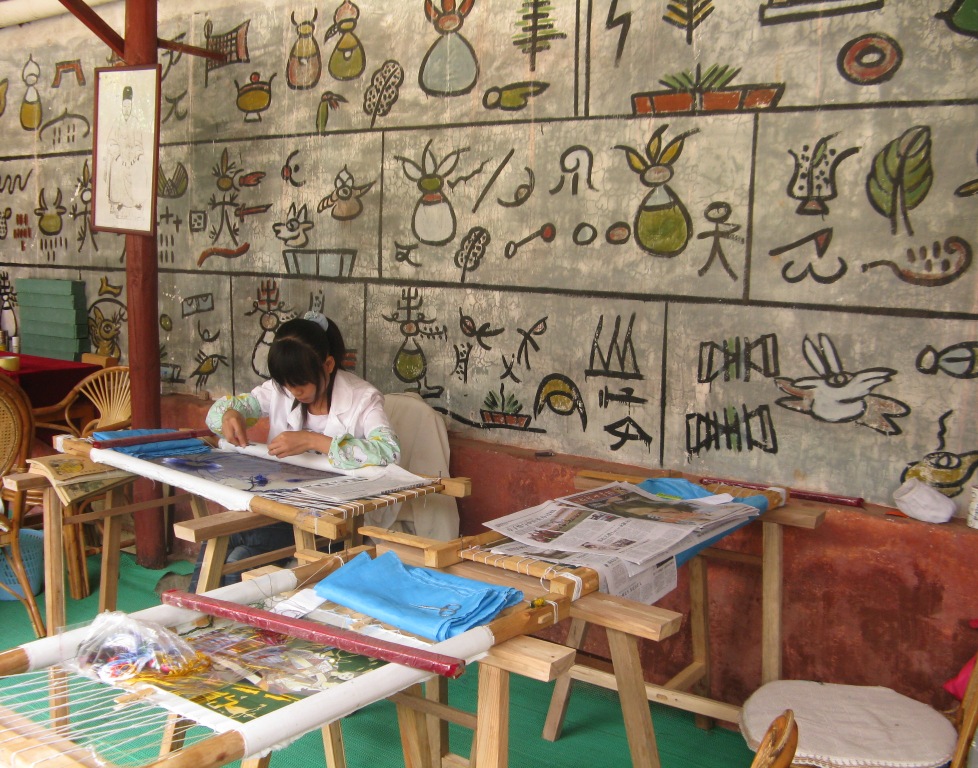 This is some of the embroidery under way. The pictures on the wall are some of the pictographs of the Naxi language, the only one with such symbols still in use.
I ended up wandering in the old part of town where people lived instead of where they sold things to visitors until the driver found me and hauled me into the approved section.
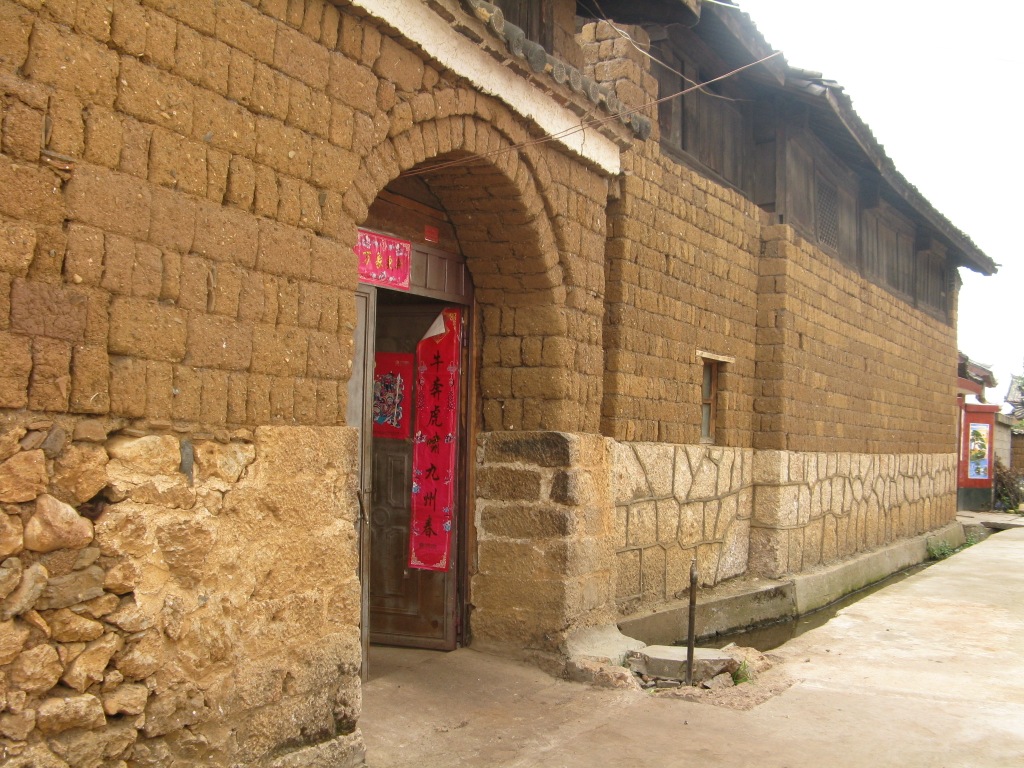 The buildings seem to have a base of stone followed by mud bricks which usually are plastered and painted followed by a wooden layer.
A young man showed me his family’s beautiful textile heritage along with some more modern items. It wasn’t clear what was for sale and what wasn’t and when I asked the price of a bag was told, “too much.” I could have had another of much lesser quality, which I didn’t want, for a very large amount of money. So the luggage problem was saved yet again.
After travelling along an unpaved road we then reached a small lake and large meadow and got to wander among the critters and wild flowers. (see next post) This was followed by a BBQ late lunch, eaten with chopsticks. After dropping two small pieces of rib I gave up and used my fingers. The young Chinese girl, about 10 years old, also with us then appeared and demonstrated how to do it. You use chopsticks and fingers to steady the meat/bone. She had limited English and was the liaison between the driver and myself and the 2 Finns also on the trip. We got to have a few more interesting experiences including walking in village fields looking for fruit for tea and a visit to another old town less tourist infested than Lijiang.
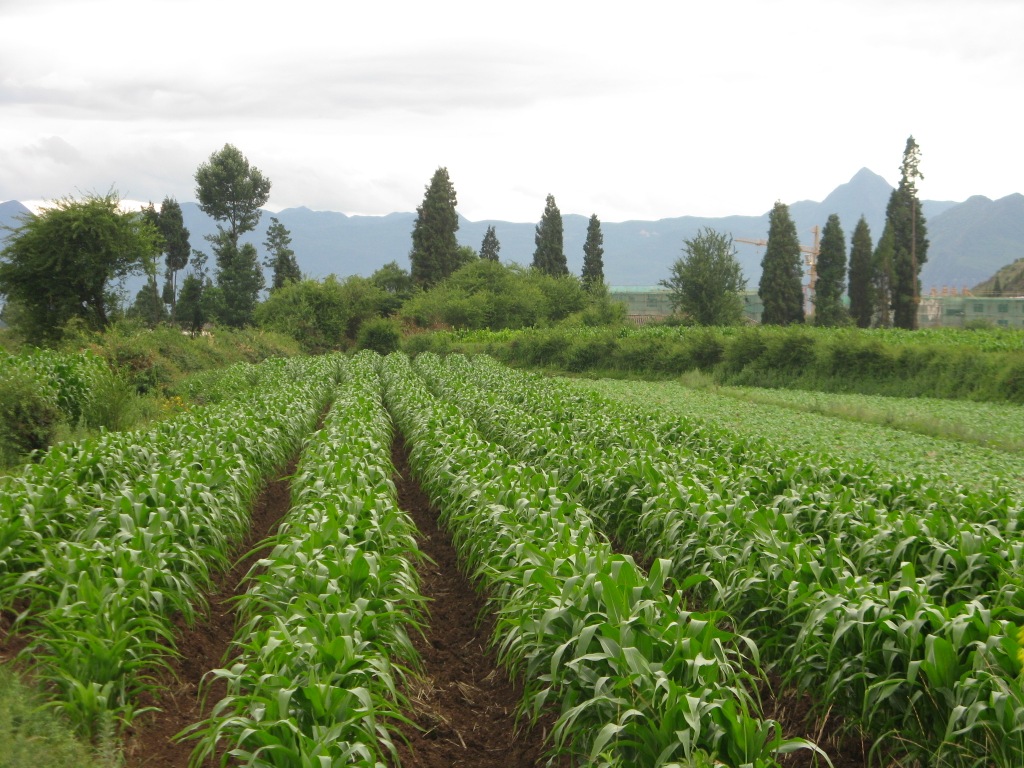 Some of the fields and mountains in the distance. More magnificant mountains were to another direction.
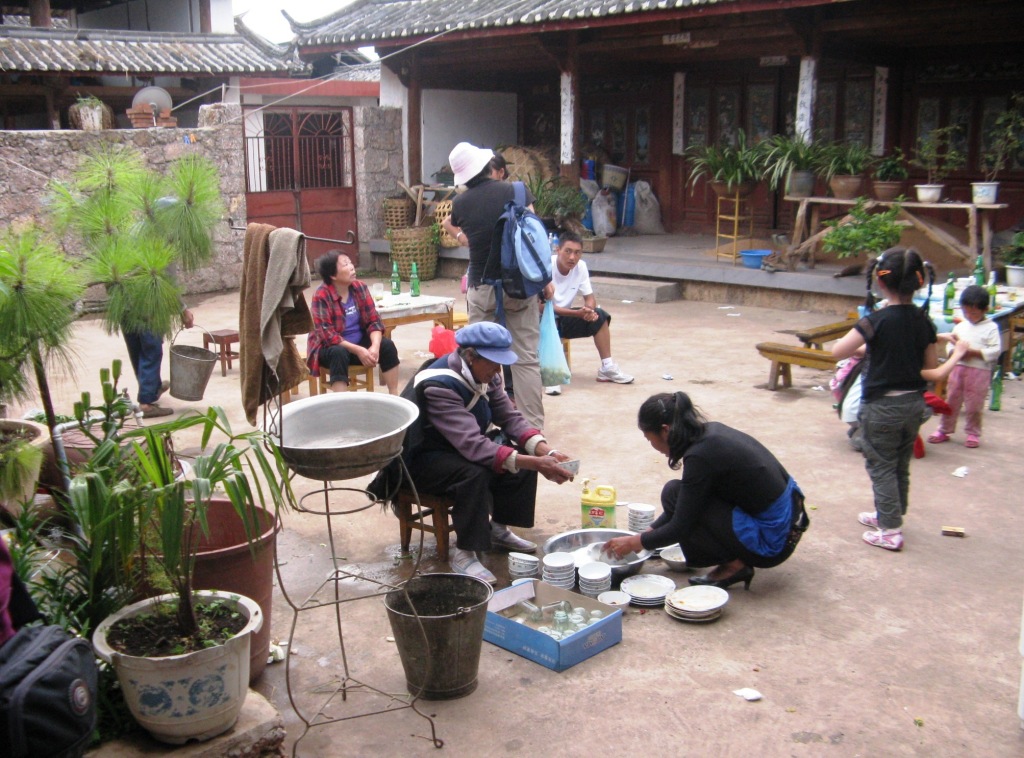 This is where we had dinner at a Naxi household. It was at the home of the hostel manager. Her mother and a grandmother are washing dishes in the foreground. The table used by a noisy group of young Chinese is on the right and at the back left is the small table we used plus a coupleof people from my group plus a couple of hangers on. The smallest kid lives next door but spends a lot of time there.
I only saw a bit of Shuhe in the dark and am planning to stay there after I return to Lijiang.

