• Home
  • About
  • Work
  • Contact Me
  • Blog Visitors

Kerry's Blog

Feed
  • Hello and Welcome

    Hello and thanks for visiting my blog. Please have a look around, and if you would like to leave a comment on any posts please click HERE to register.
  • Subscribe


  • Recent Comments

    • sandra mosley on The Update
    • sandra mosley on The Carpentry and the Return
    • sandra mosley on Two onto One does Go
    • sandra mosley on Spring has Sprung
    • grazer on A singing waiter and a travelling cat
  • Pages

    • About
    • Work
    • Contact Me
    • Blog Visitors
  • Categories

    • Abbot's Leigh
    • Animals
    • Australia
    • Beijing
    • Brecon
    • Bristol
    • bunbeg
    • Castle Carey
    • Chaddesden and Breadsall
    • China
    • Churches
    • Clifton Bridge
    • Copenhagen
    • Culross
    • Dali
    • Derby
    • Easton in Gordano
    • Edinburgh
    • Elmore
    • Family History
    • Gloucester
    • Home
    • Inverkeithing
    • Jinghong
    • Kent
    • Kunming
    • Lake Lugu
    • Ledbury and Colwall
    • Lijiang
    • London
    • Lydney Harbour
    • Melbourne
    • Other
    • Portbury
    • Qingdao
    • Tadcaster and Newton Kyme
    • UK
    • Uncategorized
    • Wells
    • Work
    • Xingtai
    • York
    • Yunnan
  • Favourite Websites

    • David's Blog
    • Webmail
  • Site

    • Register
    • Log in
    • Entries feed
    • Comments feed
    • WordPress.org
  • Tags

    agriculture animals architecture art and craft Australia baby carriers Behai Park Beijing bus China college computer culture Dali Dashalan dogs Education ethnic minorities Fashion Parade Food games guanxi Health holidays hostels Kumning lake Lake Lugo Lijiang maps markets matriarchial society medicine military training park performance plants Qianmen religion shops taxis teaching temple transportation Xingtai
  • Archives

    • April 2018
    • December 2015
    • November 2015
    • October 2015
    • September 2015
    • November 2014
    • October 2014
    • September 2014
    • August 2014
    • July 2014
    • June 2011
    • January 2011
    • December 2010
    • November 2010
    • October 2010
    • September 2010
    • August 2010
    • July 2010
    • June 2010
  • Forbidden City

    Nov 18th 2010

    By: Kerry

    No comments

    Forbidden City

    The Forbidden City, aka as the Palace Museum or Imperial Palace is an enormous city built during the early part of the 15th century for the Chinese Emperor and his retinue, thus it’s name  Forbidden as it excluded all but a select few.  It has been rebuilt and restored during its lifetime.  More information can be found at sites such as http://museumca.org/exhibit/exhib_fc2.html

    or http://factsanddetails.com/china.php?itemid=429&catid=15&subcatid=94

    It has now been open to the public for 85 years and a display of treasures in a room atop the Wumen/Meridian Gate had free entry to celebrate this fact.


    Tiananamen Gate  on Saturday.

    Tiananmen Gate three weeks earlier.  The flowers were present to celebrate China’s National Day on October 1.

    Most people enter the Forbidden City from Tiananmen Square in the south.  However, three gates and accompanying courtyards must be traversed before arriving within the Forbidden City.  The first gate encountered from the south is Tiananmen, followed by Duan and then Wumen or Meridian Gate, the largest gate to the city.  There are buildings and gardens in large walled spaces on either side of these gates and courtyards which apart from a brief visit as part of a scam, I was taken to a painting exhibition with the hope that I would purchase and I didn’t because I was well and truly lied to, I haven’t yet visited.  Such scams are extremely common in such historical areas.


    One of the entrances in Tiananmen Gate.  Portraits of Mao are ready for replacement whenever necessary.

    Tiananmen Square from Tiananmen Gate showing  Monument to the Peoples Heroes and Mao Zedong’s Mausoleum.

    Tourists on the review area used by senior leaders.  Entry required an additional fee.  Entry fees to many tourist sites and accommodation in Beijing dropped from November 1st in recognition of cold weather. 

    View from Tiananmen Gate showing  part of the square and a museum closed for renovation. 

    Guards being reviewed near the Duan Gate.
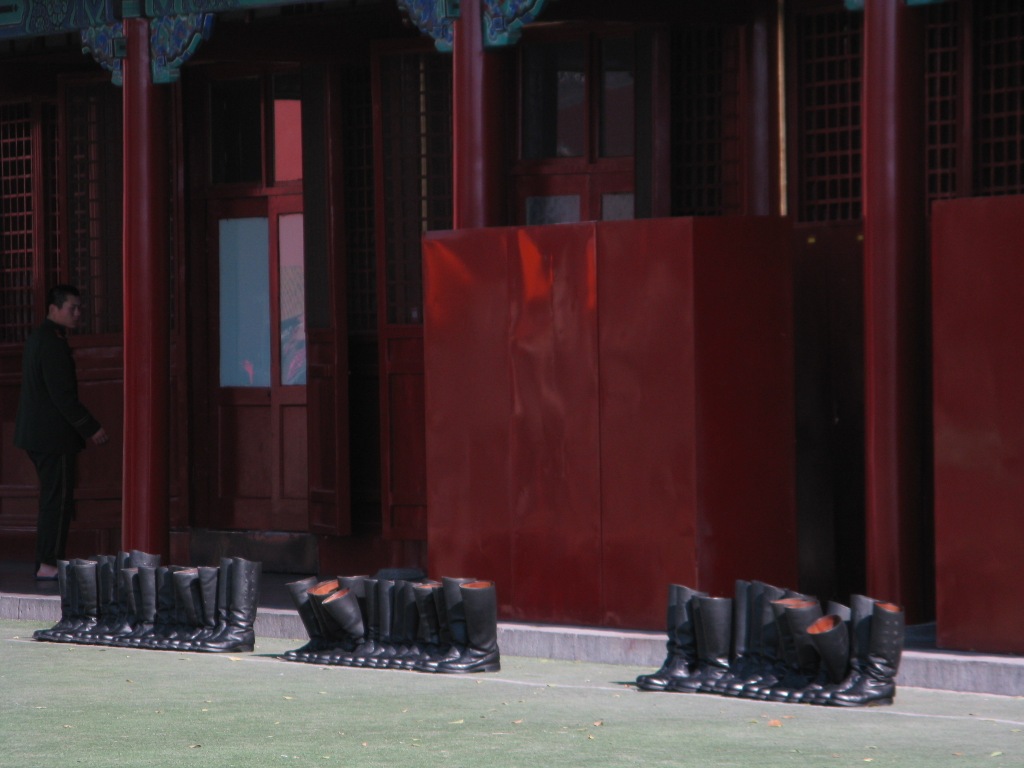
    Guards boots lined up outside accommodation near the Meridian Gate.  There was a row of black shoes too.  They had a basketball court and a small building used as a laundry.

    View from the Meridian Gate, which is u shaped, back towards the Duan Gate.

    National Center of the Performing Arts just visible from the Meridian Gate.  It is constructed from glass and titanium with a man made watercourse around it.  It was controversial and requires government subsidy.

    The pagoda and temple at Behai Park visible from Meridian Gate.

    Back of the Meridian Gate

    After exiting Meridian Gate the vista is of a huge enclosed courtyard having a channeled stream with five bridges atop it.   Behind it is a wooden gate flanked by bronze lions leading to a large rectangular building atop three layers of marble.  This building was used for important state occasions.  Behind it is a small square building and another rectangular building.  These buildings had various functions but were for formal state occasions.  Behind the last building is a large marble stone carved with dragons and clouds.  It is 600 years old and famous for its size.  There are many smaller such ramps alongside steps in the city.  The emperor was carried over them in his sedan chair.  Gates lead to other parts of the city much of which is not open to the public.  However, there is enough to keep an interested visitor engaged for days.   The level of restoration and style of restoration varies.  Some of it hasn’t lasted long with a 2005 restoration already losing gold paint or gilding.
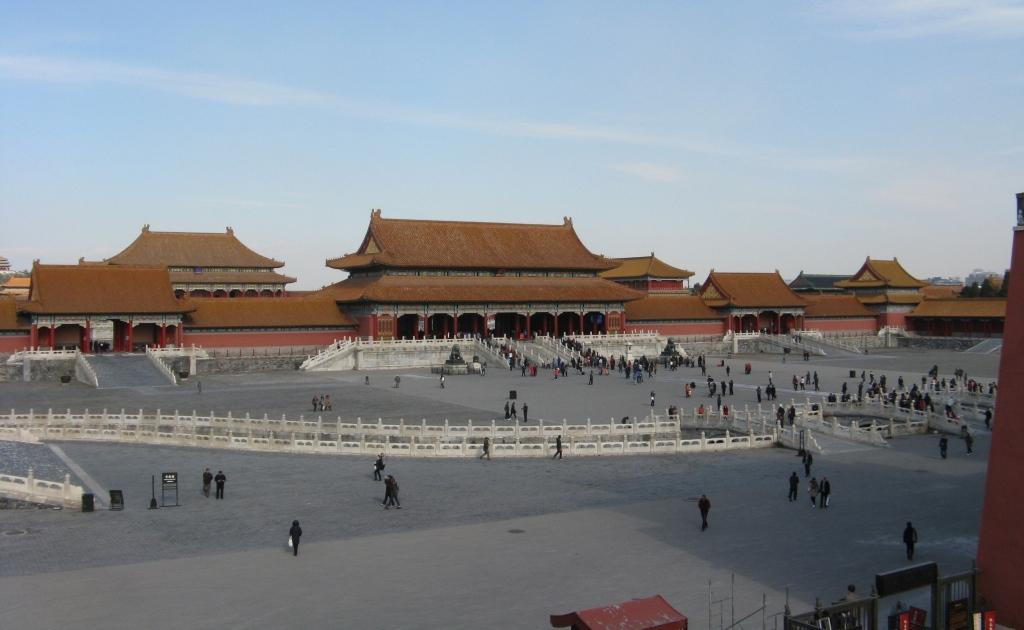
    View from Meridian Gate of hugh courtyard showing stream, bridges and wooden gate in the centre.

    Hall of Supreme Harmony, the first of the three halls for affairs of state.

    The next two halls.


    An old building in the left hand side of the city.

    Roof restoration.

    An unexpected area of trees in a no go area.

    One of the 300 odd bronze cauldrons scattered around the city.   Their original function was as a water source in case of fire.  They were covered during winter to prevent freezing.  Some of the palaces within the city did burn during its history.

    One of the lesser areas.

    Nine Dragon Screen on the right hand side of the city. 

    What appears to be a pigeon loft  tucked away in the back right hand section of the city.

     Many buildings have been modified to display treasures from the past including gold, jade, lacquer, paintings and calligraphy.

    Some of the numerous treasures.

    Gold and jewel encrusted cup used by the imperial family.

    An ancient pass time and game of skill.  The aim was to throw the stick and have it land in the tall cylinder.  My book about the last eunuch in China reports how his first wife, who had never gained favour with her husband, was lonely and bored and required her attendants to play the children’s game, drop the hanky for her.

    Further north are the areas where city inhabitants lived.  Some of the buildings show something of how they lived being furnished with furniture and decorations.  However, I still find it hard to imagine how they really lived.  
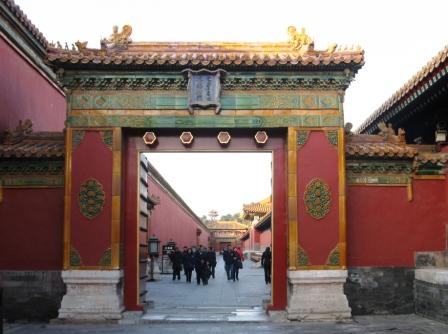
    Road and entrance in a residential area.

    Another narrow roadway and entrance gate to another area.

    “Small” gate.

    One of the  furnished residential buildings.

    Another one.

    The interior of one of the rooms.

    Another

    Another ‘corner’ of the city.

    The well where the concubine Zhen Fei was thrust during a period of political and military instability early last century.   She was the favourite concubine of the then emperor and she encouraged his reformist ideas.  Cixi, the Empresss Dowager, and the real power in the land objected to her role, imprisoned her and had her murdered just before she and the emperor escaped to Xian at the time of the Boxer Rebellion.   Her sister was also a concubine and established the memorial room in the background.

    View from a residential area.

    Another interesting structure.  Pity it was taken into the setting sun.

    The imperial garden consisting of pavilions and stone is further north.   The exit is via the Shenmen Gate opposite Jinshin Park which I visited in January.  The city has a wide moat on four sides interrupted by the Meridian Gate on its southern edge.

    Building in garden where Pu Yi, the last emperor, used to have English lessons.

    Pavillion in garden.  It has a square shape with a round roof.

    One of the ancient cypresses which has been preserved.

    A gateway into the garden and a large natural stone monument behind it.

    Looking down a narrow road between different sections of the city.

    There were several Palace Museum shops scattered around.  This one included a display of small glass bottles painted from the inside.
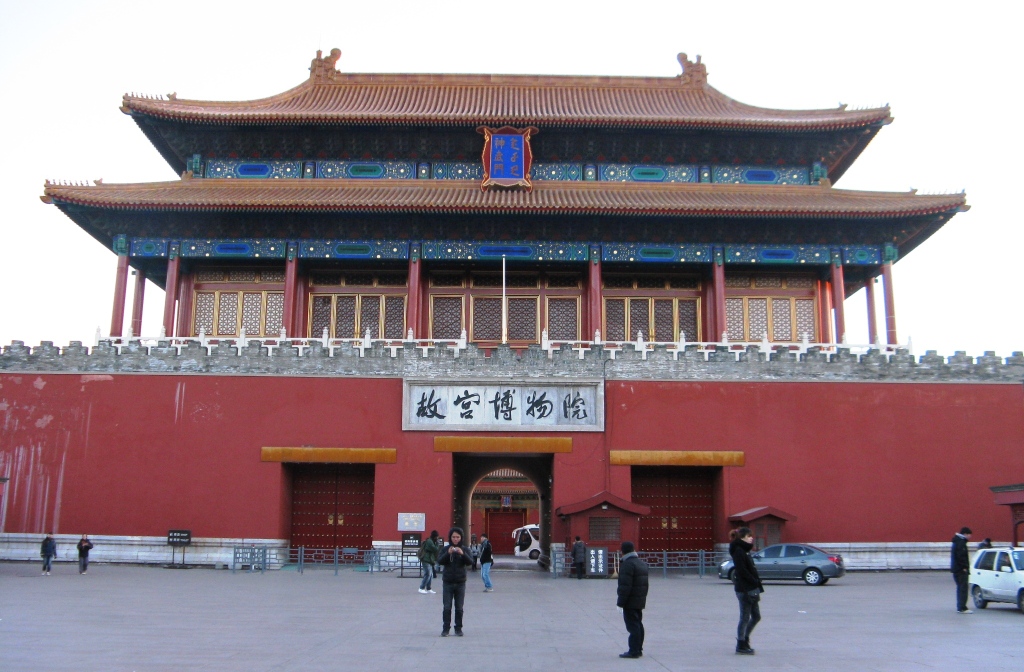
    The northern gateway, the Shenmen Gate.

    Sunset over the moat.

    The north western guard tower and moat the following day. 

    Beijing, China

    architecture, art and craft, Beijing, China, culture

  • Street scenes in Beijing

    Nov 18th 2010

    By: Kerry

    No comments

    Below are a few of the street scenes I observed during my last visit to Beijing.

    The Monument to the Peoples Heroes in Tiananmen Square. It was created to recognise those who gave their lives to change China’s political and social environment.  It was built during the last years of the 1950s.  It is enormous and sits in the middle of the square with Mao Zedong’s mausoleum to the south, Tiananmen Gate to the north and an enormous museum and the People’s Hall on each side.  It is cordoned off so that people are not allowed to get too close to it.

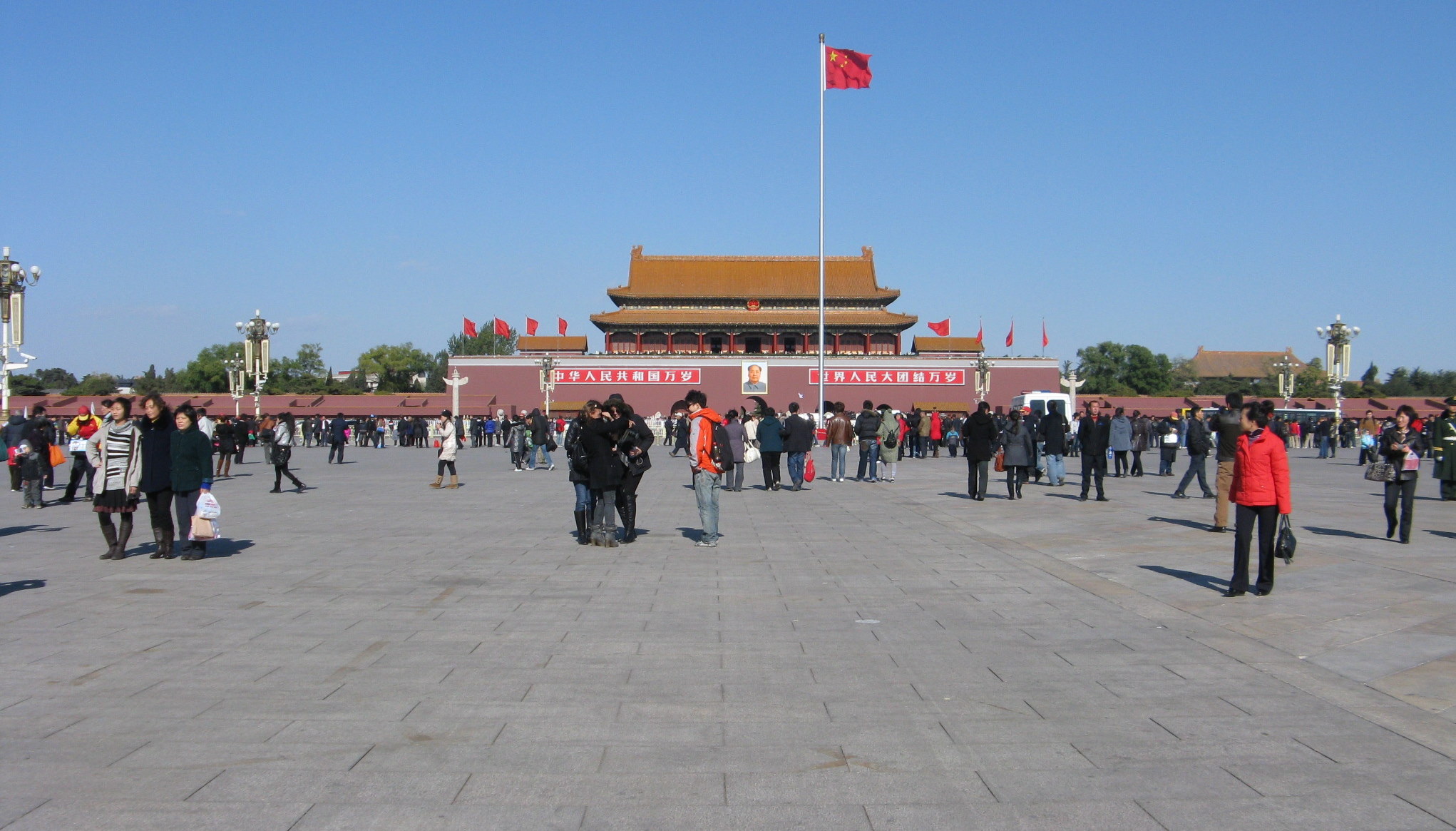
    Tiananmen Gate and the national flag flying in a breeze.  There is a ceremony to erect and remove it each day.  I was there at the time of  the evening removal once but there were too many tourists to engage my interest.  Tiananamen Square is a must see for domestic tourists and they can be seen everywhere posing for photos. It is 800 metres long and I walked it twice during the weekend along with the walking to reach there and around the Forbidden City.
    I posted this photo a couple of weeks ago.  It is in a street adjacent to the Forbidden City.  On Saturday I bought a book which showed this photo, minus the air conditioner, and talked about its past.  It was a temple, known as the Temple of Prosperity and became a refuge for many eunuchs  after they left the Forbidden City.  It had quiet a past being much more than a temple but also like a hotel for many eunuchs and their families.    According to the book some eunuchs did have families including wife and children.  Many also  adopted a child to  continue their name.

    This is a cute little street sweeper parked in Dashalan St.  It is the first motorised one I’ve seen anywhere but Xingtai which has a few along with an army of human sweepers.

    This is the Yongding Gate and I took it from a bus down south near the Temple of Heaven Park.  Another book I have started reading said that it was built in 2004.  There used to be a gate there in previous times but it along with most of the others was demolished during the 1950s and 1960s.  From memory it stands alone amidst a tangle of roadways.

    A residential street and apartment block near the southern entrance to the Temple of Heaven Park. Some trees have lost their leaves while others are just starting to change colour.

    An apartment block on the way to the railway.

    Beijing, China

    architecture, Beijing, bus, China, culture

  • Beijing Hostel and its surroundings

    Nov 17th 2010

    By: Kerry

    No comments

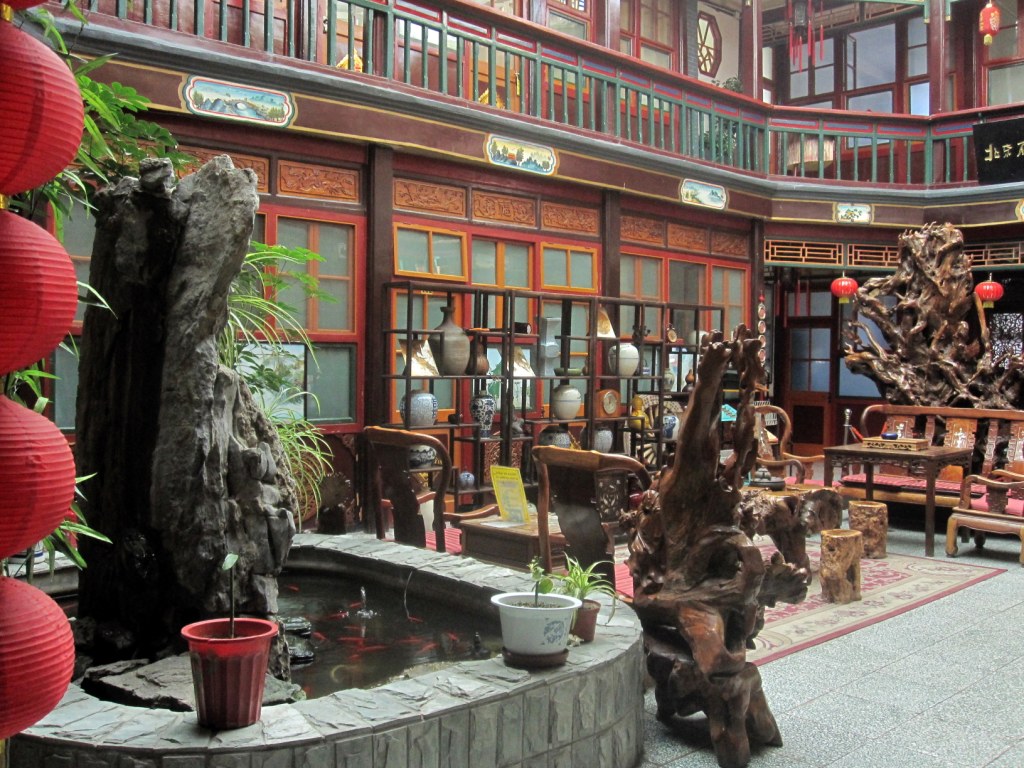
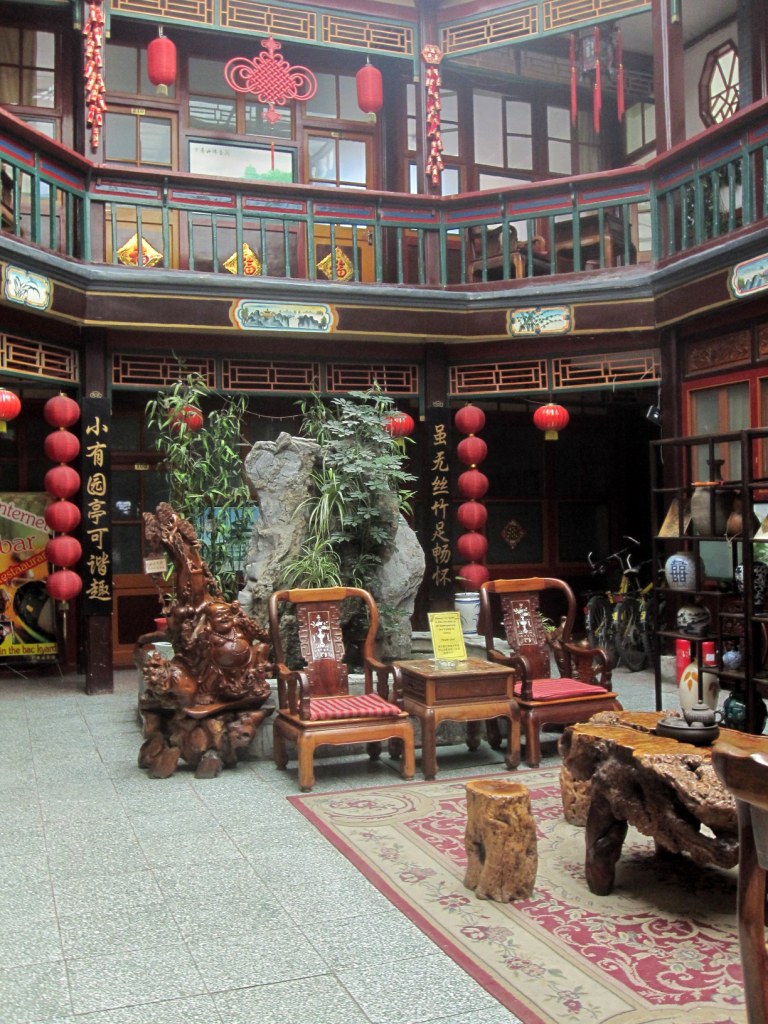
    Last weekend I had a 3 day weekend in Beijing and tried yet another hostel in the Qianamen area.  This one was close to the one I stayed at in October which had  the friendly cat and lots of local food and colour.   It’s part of a chain of 3 and I prefer it to the others.  It had more atmosphere and the staff were excellent.  While my room could have used a facelift it was perfectly servicable and the public areas  were in good condition.  The building was several hundred years old and served as a gentlemen’s club in the bad old days of the latter part of the Qing Dynasty.  No doubt it was well imbued with sex, opium and scandal.

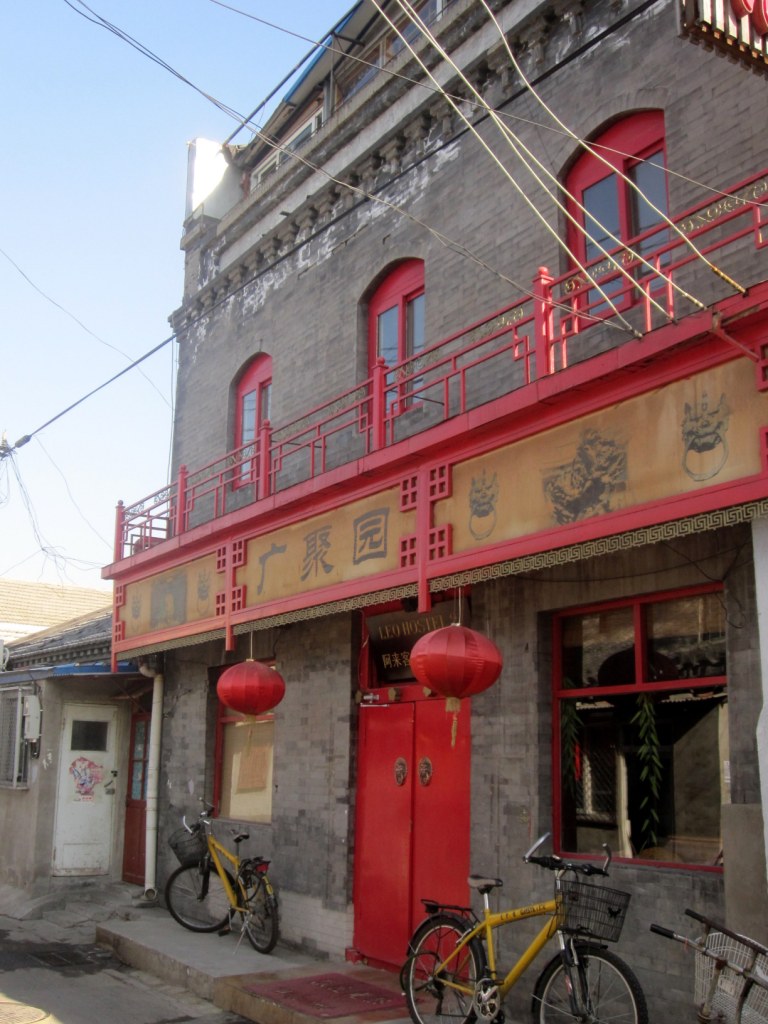
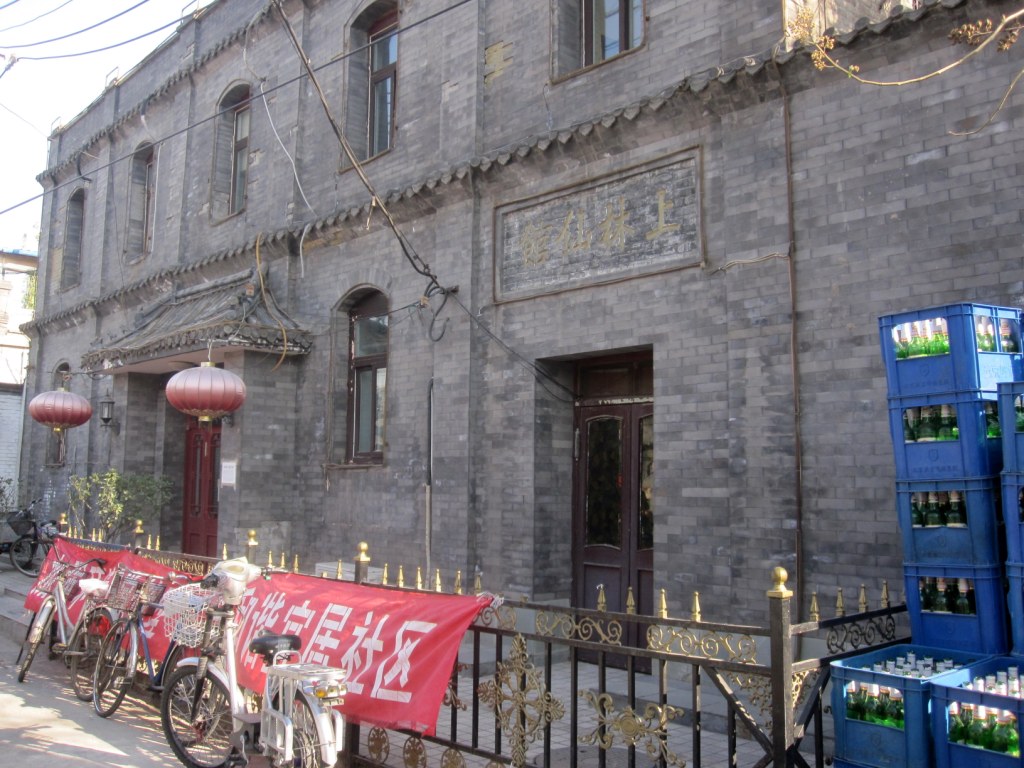
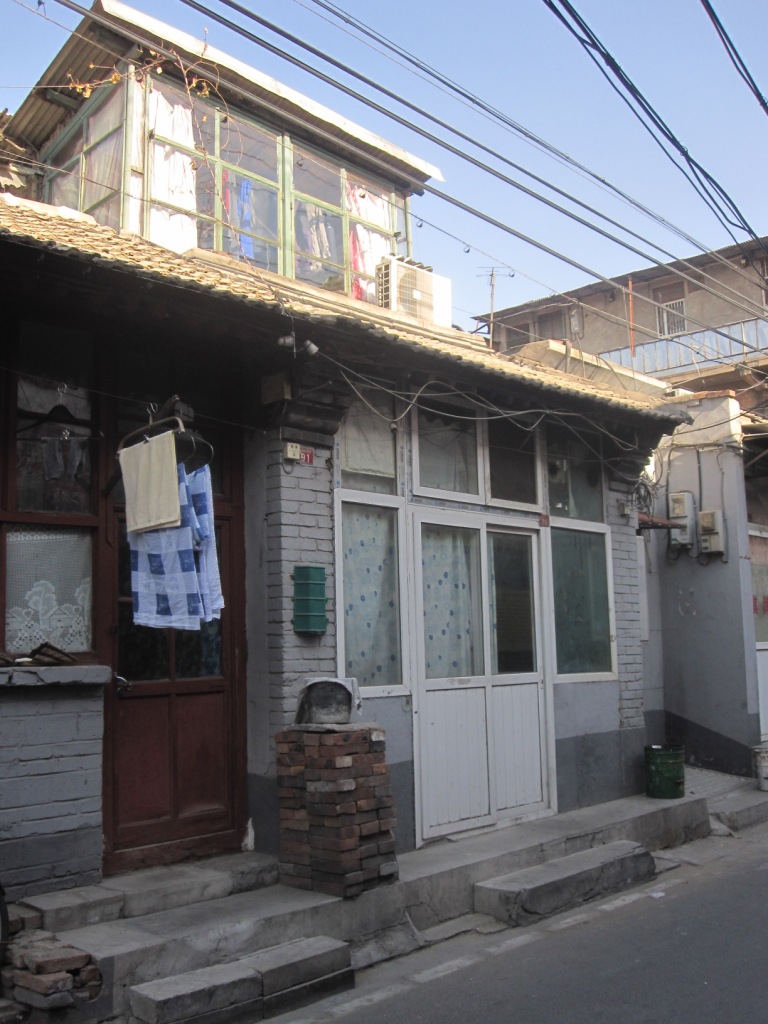
    This is one entrance.  The next is separated from it by some small rooms just like the one to the left of the first bike.

    This is the other front entrance.

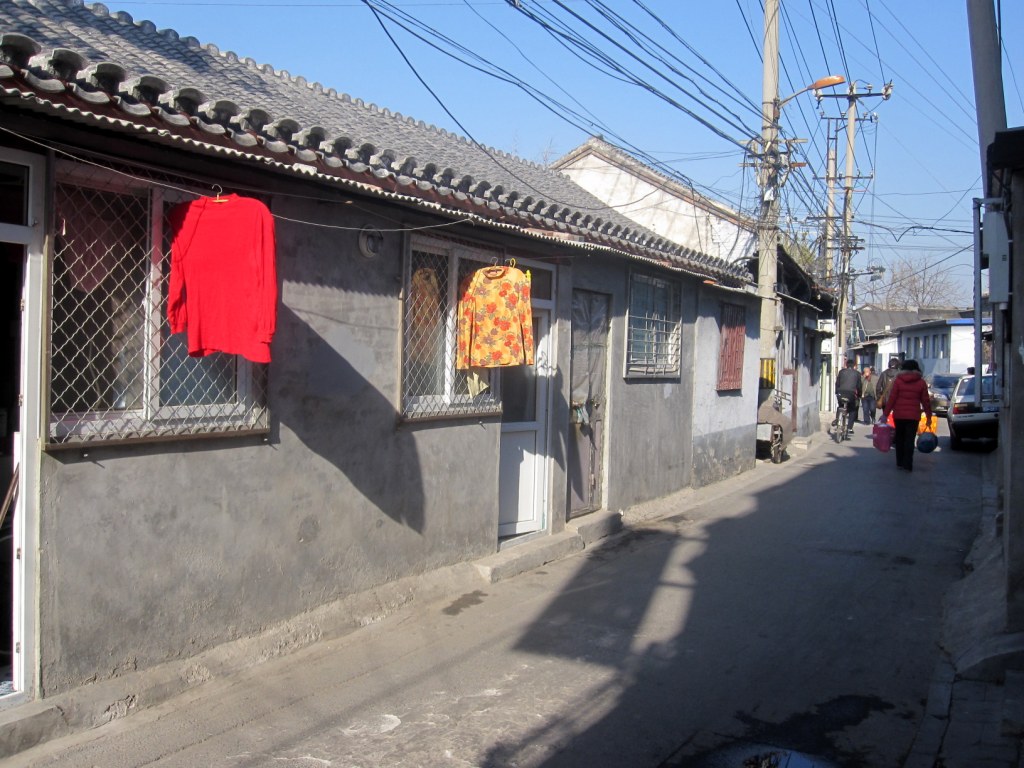
    The street directly outside the front door. The weather was good during my visit so locals had washing and bedding hanging in the streets.

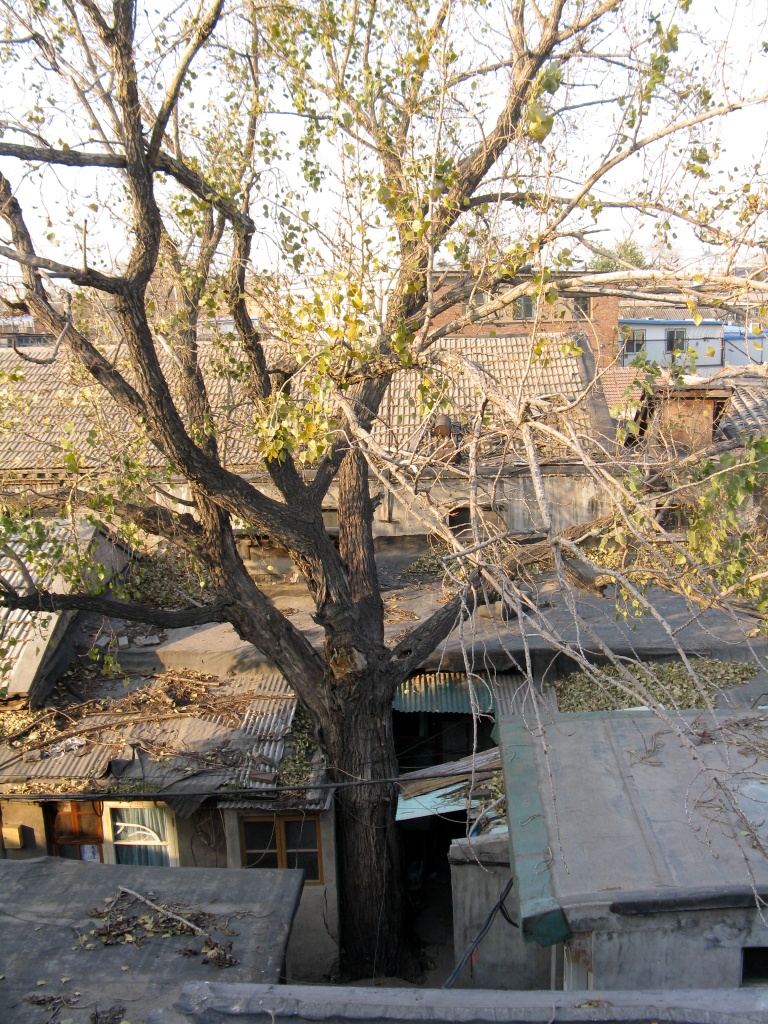
    The hostel had a 3rd floor bar and relaxation area including a door to the outside where more rooms were tacked onto the roof.  This is a photo from there. The tree has a little competition for space.

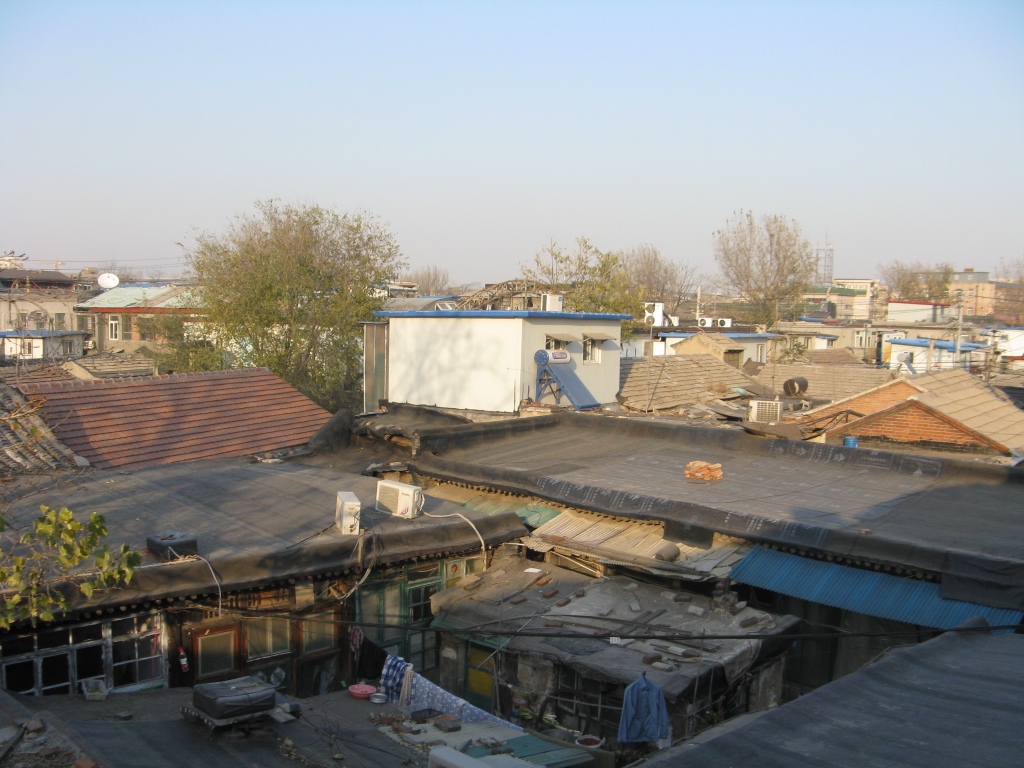
    Another view from the same spot.  Some rooves are flat and some are not.  High density living.

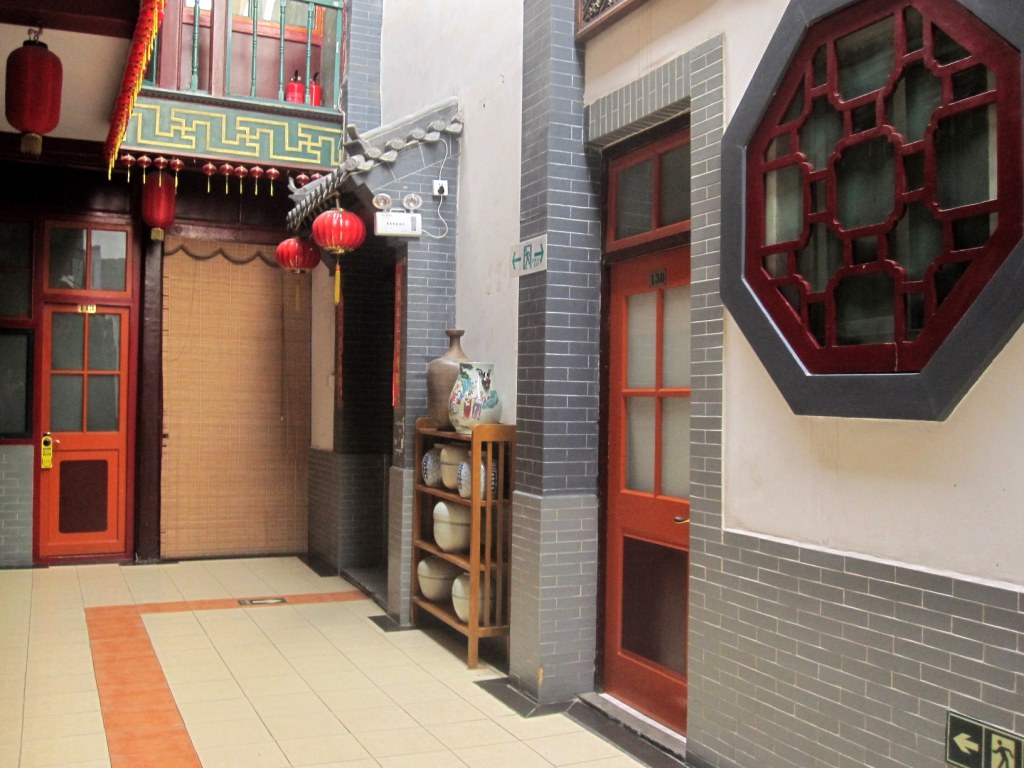
    The area outside my door.  Each morning I was woken by people talking despite there being a sign requesting quiet.  it was in English and the two I saw on the last morning were cleaners removing and cleaning the tiny red lanterns hanging up.  It didn’t get me moving any earlier so I needed to visit the Forbidden City twice to see  a fair bit of the sights.

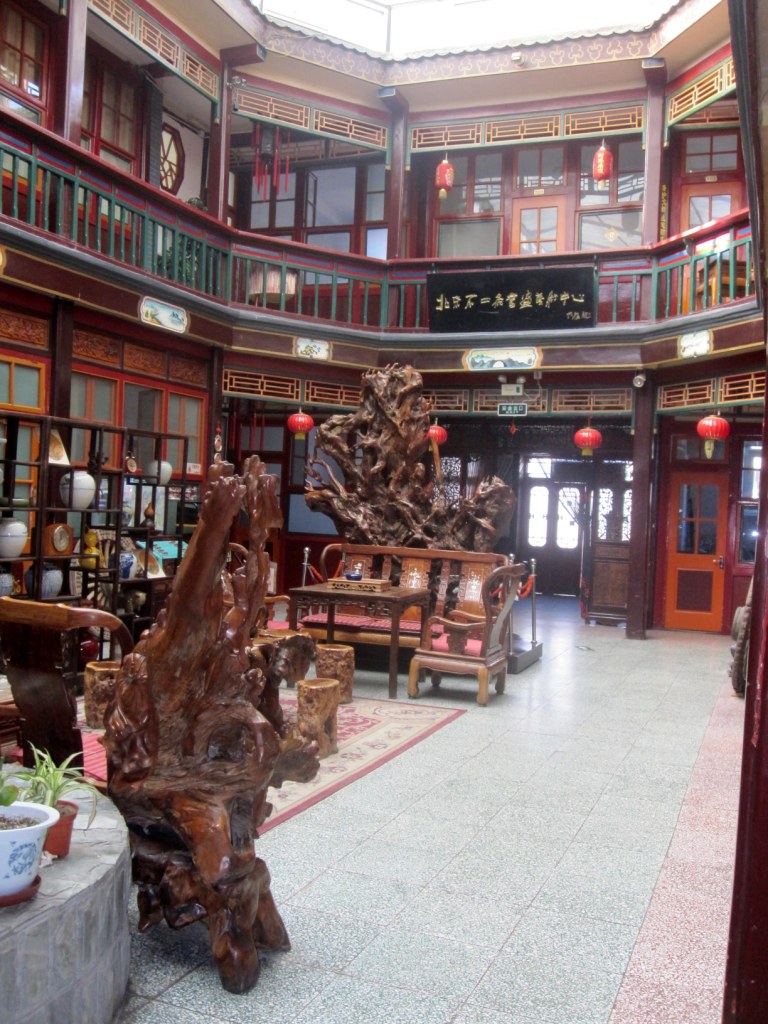
    Furnishings in the courtyard section just inside the second front entrance.

    Another view

    It really looked as if a middle section of the building, including my room, had been built in sometime after its heyday as a gentlemens club.  It would account for the odd layout and the extraneous buildings at the front.

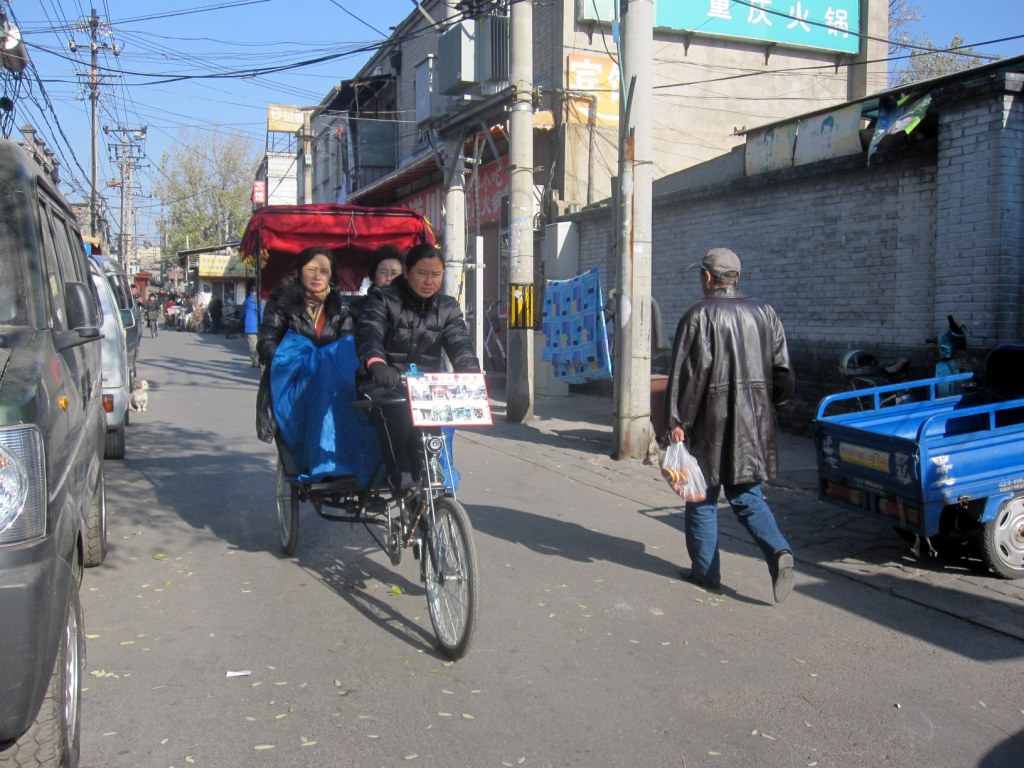
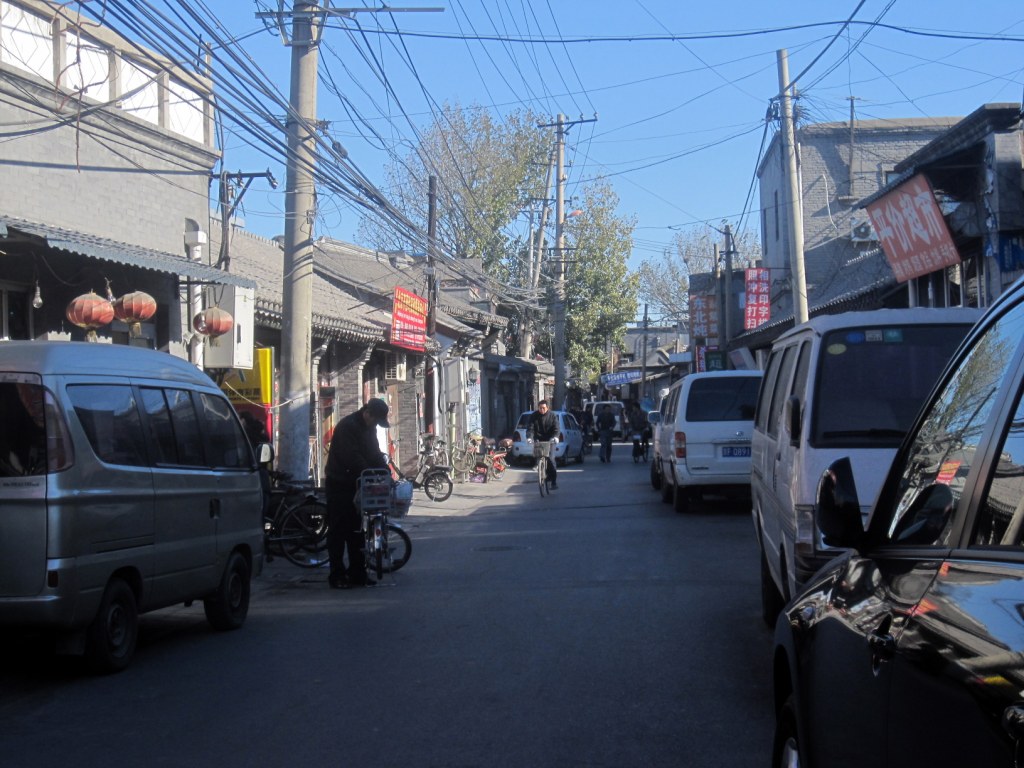
    Nearby in the street.  These pedicabs offer tours of hutongs, narrow alleys, such as this.  Some hutongs have been renovated like Dashalan while others remain cramped and uncomfortable for the locals.  Some show nothing  from the street besides a wall and a red double door.  There was a program on TV tonight where owners of a hutong property were interviewed.  Theirs had been gutted and rebuilt to the traditional style with the addition of mod cons including  plumbing as part of a program and at government expense.  The program gave no indication of how extensive this rebuilding program is.  There has been criticism of the over demolition of hutong properties with loss of social and historical importance.  No doubt it was true but from what I’ve seen there are plenty left to keep such programs going into the distant future.   Yesterday the TV program showed a commercial hutong which had been completely renovated.  It was starkly different from the hutongs near the hostel.

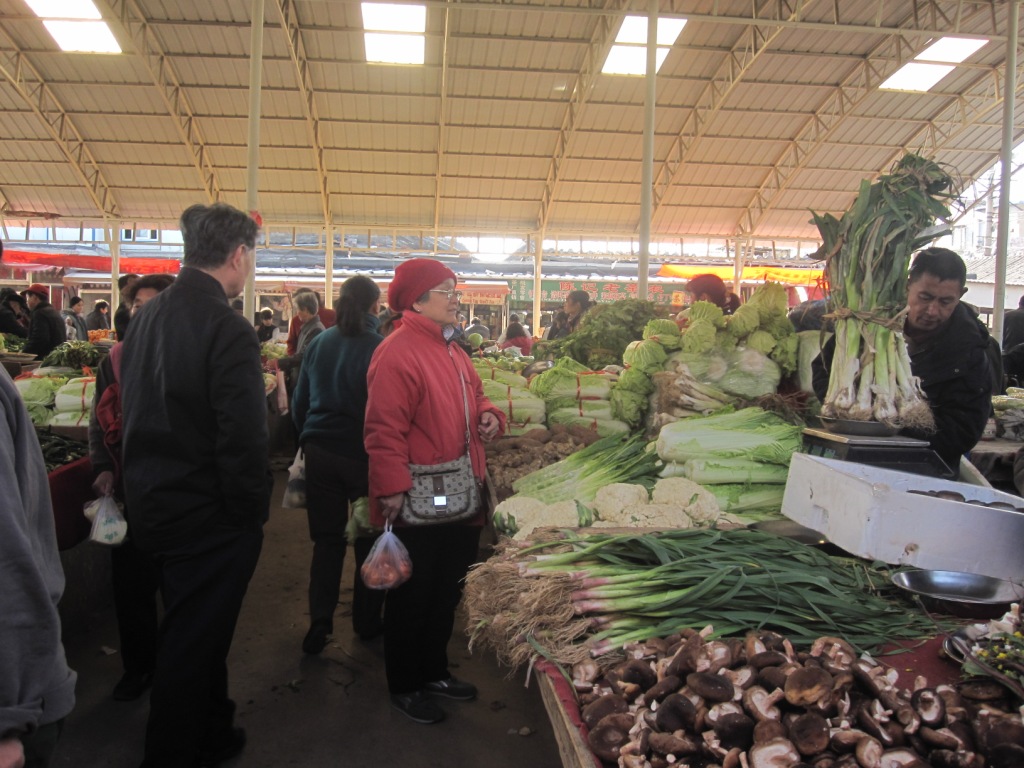
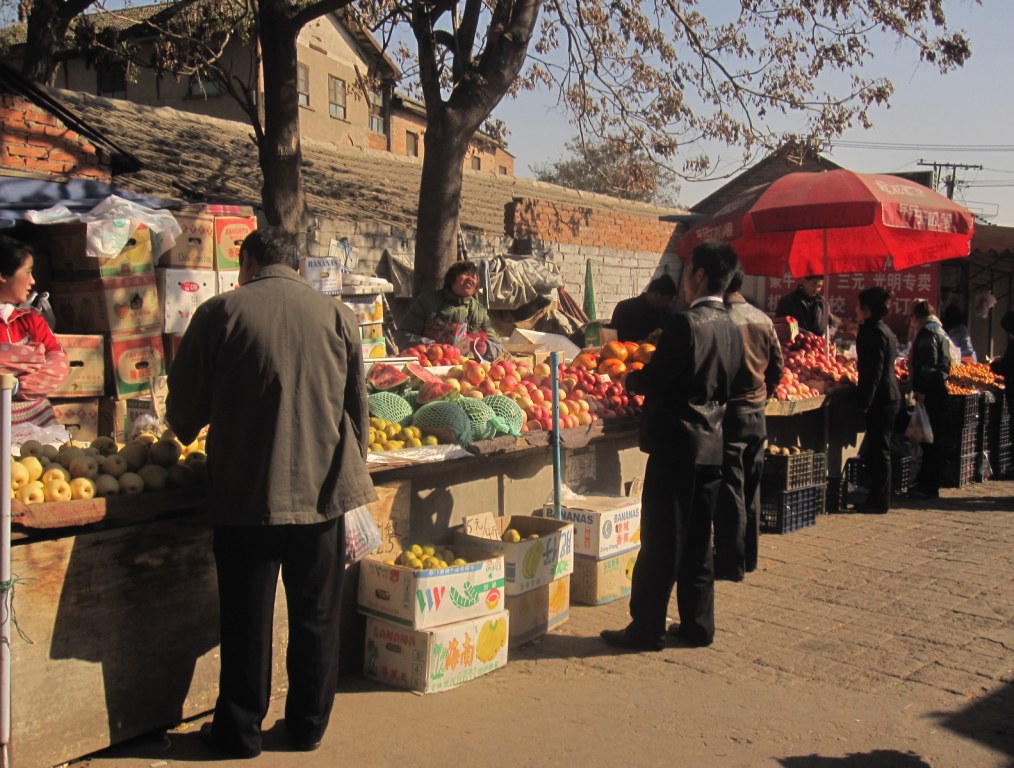
    I walked to a nearby open market and then around some of the neighbouring hutongs.  This is an open air market near the hostel.  It also included some small shops.


    The fruit section was outside.Scene down a nearby street.  

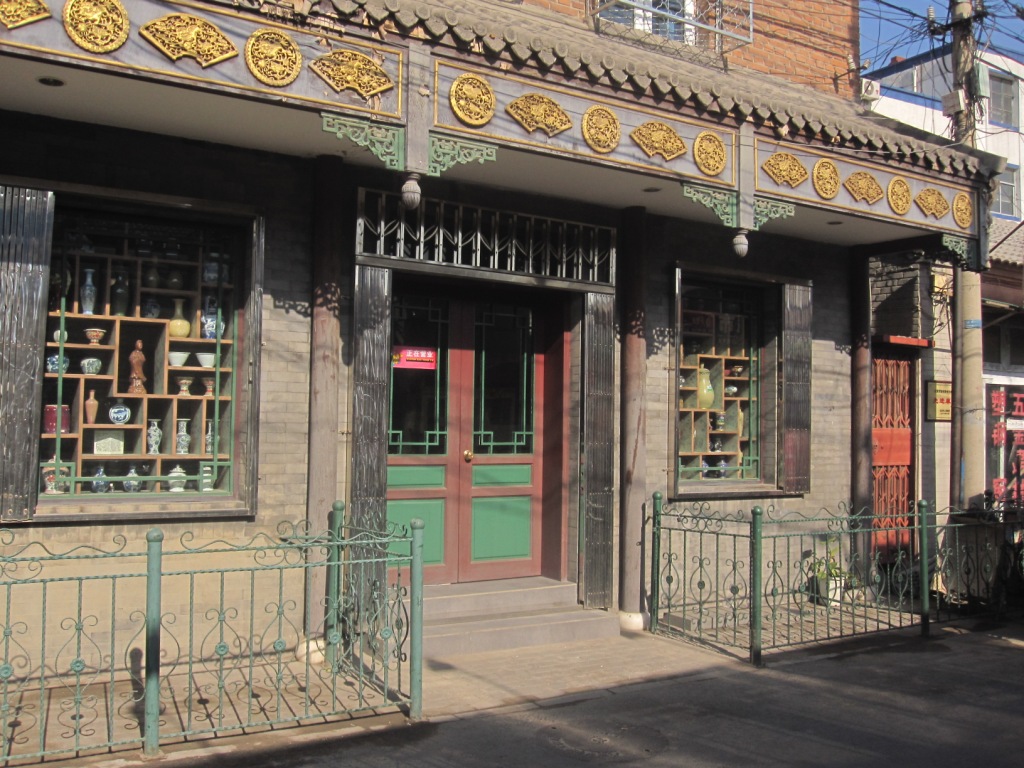
    A more upmarket shop

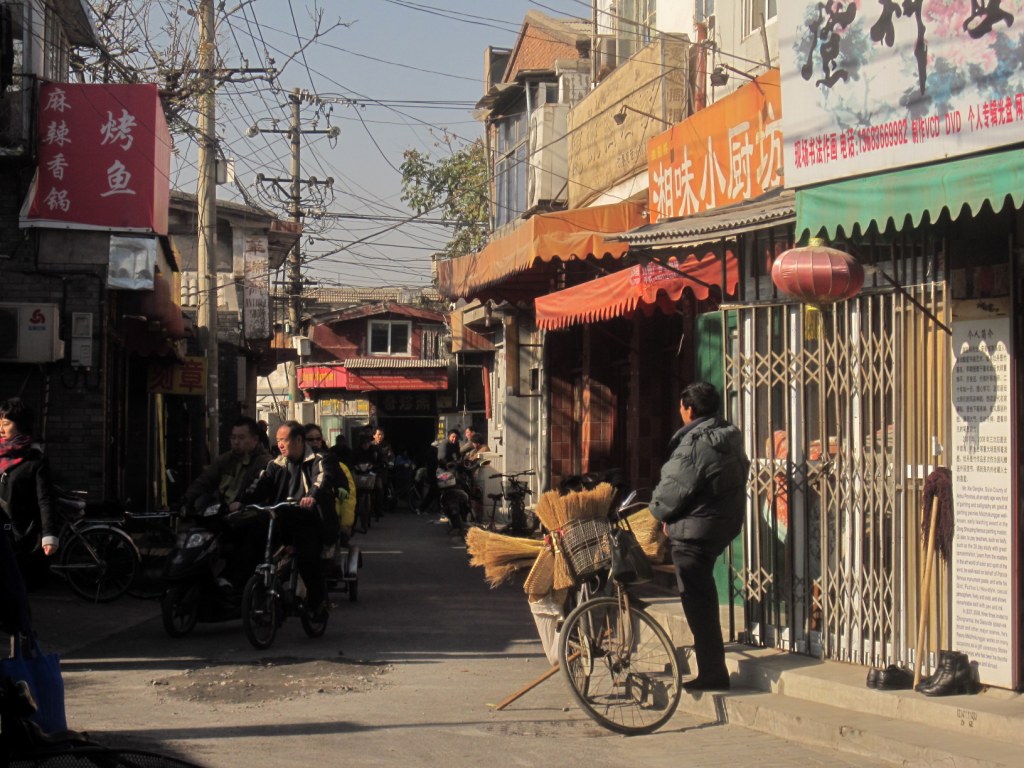
    A brush salesman

    Home with modern windows and doors.  In some places I’ve seen structures build so close to the road that they were  built around or used power poles and tree trunks as part of the structure.

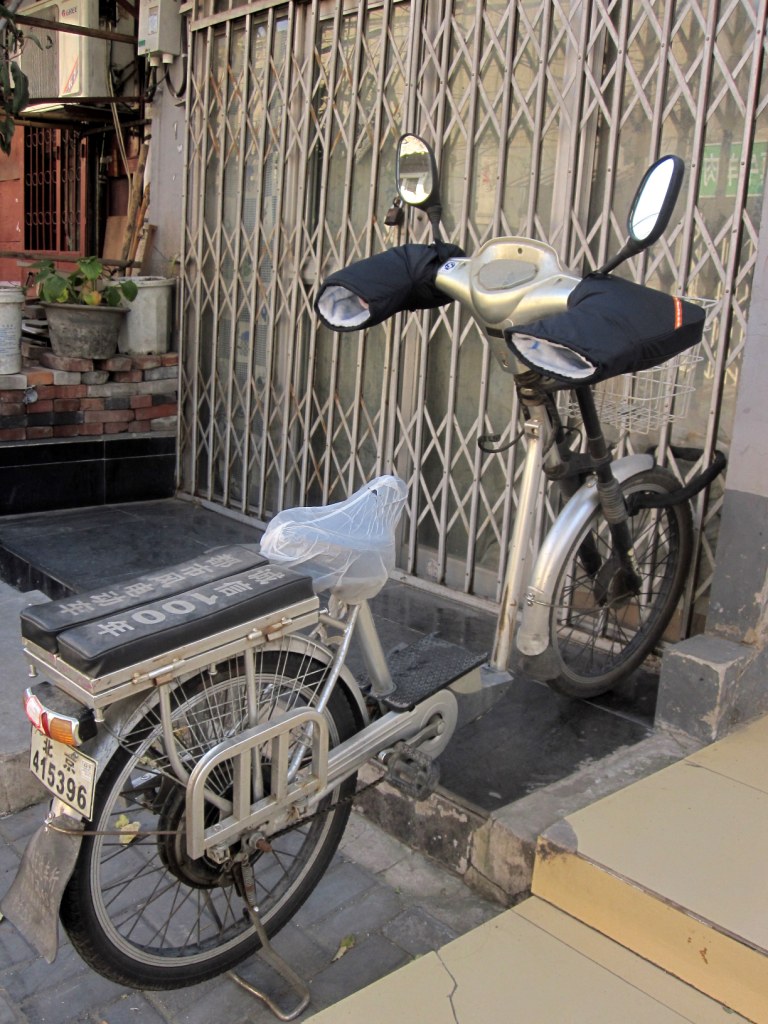
    Bicycle with hand warmers.  These hand warmers are common in  colder areas.

    Beijing, China

    architecture, Beijing, China, hostels, markets, transportation

  • Food

    Nov 10th 2010

    By: Kerry

    No comments

    Food

    Below are some food  photos from my collection which show some of the food I’ve seen or consumed.  Most are local with the last three having been taken in Yunnan.

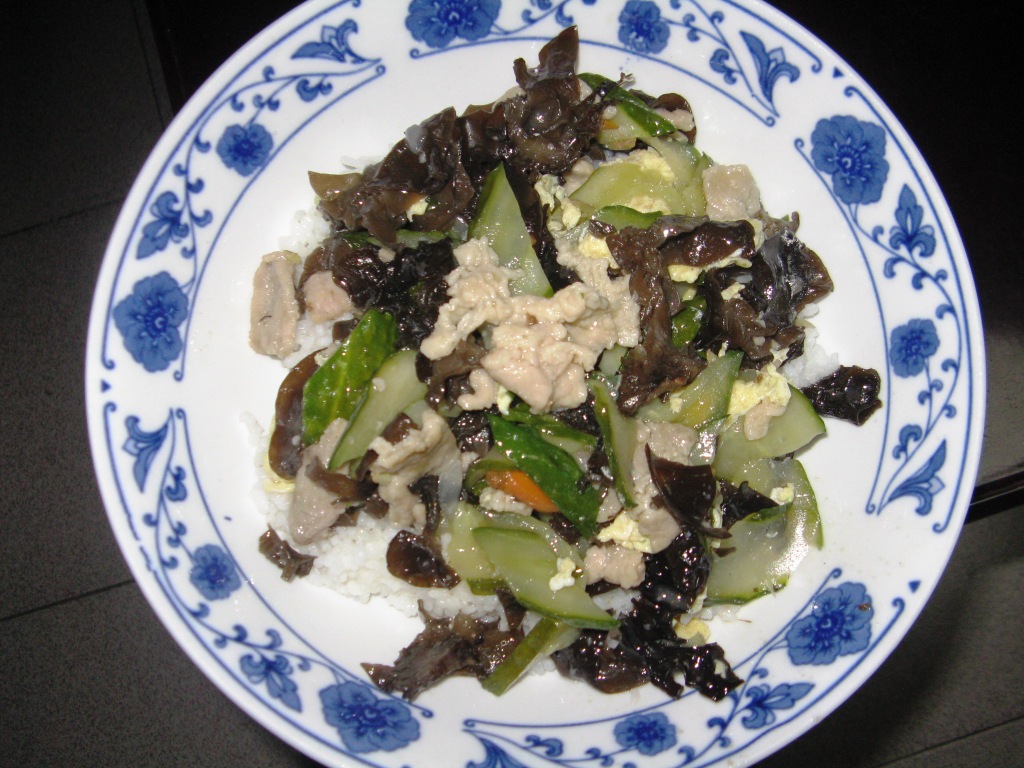
    This one came from the canteen.  It consists of a fungus, zucchini/cucumber, a slither of carrot and what passes for  a large  amount of chicken in these parts.  I like it apart from the over salting.  Despite its appearance I’ve taken to the fungus and even bought some to include in my occasional cooking.

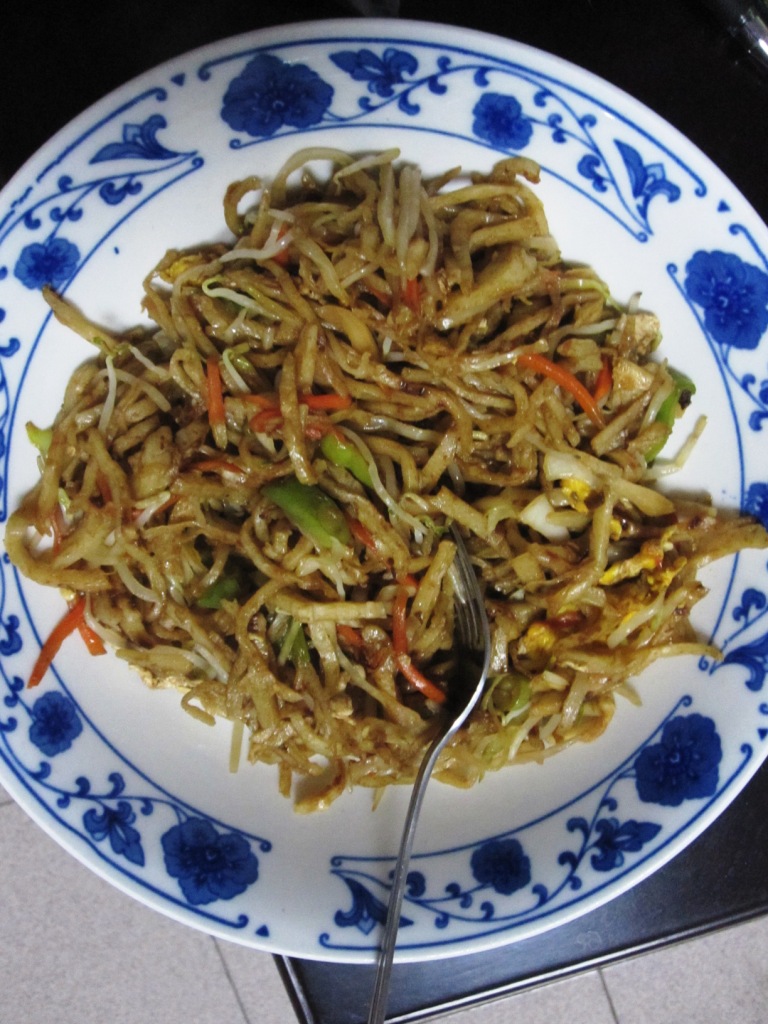
    This a noodle and vegetable dish from a nearby street stall.  It was delicious the first time I ate it.  The second time the flavouring was different and while edible was a disappointment.

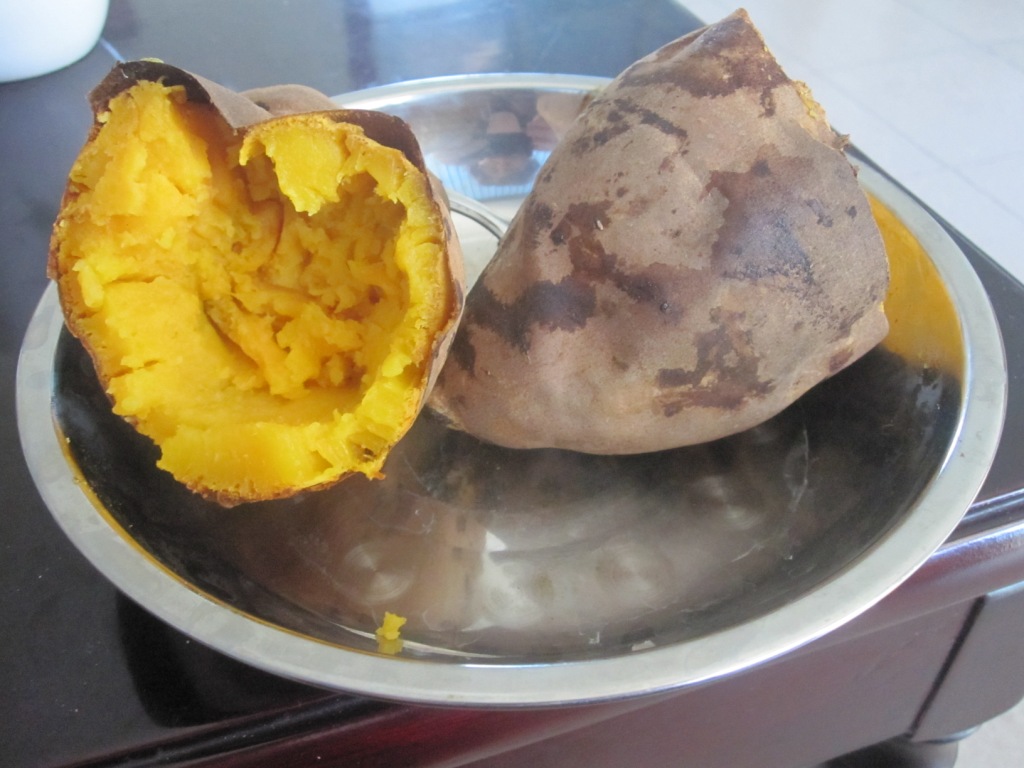
    A roast sweet potato from a street vendor.  It was very tasty.

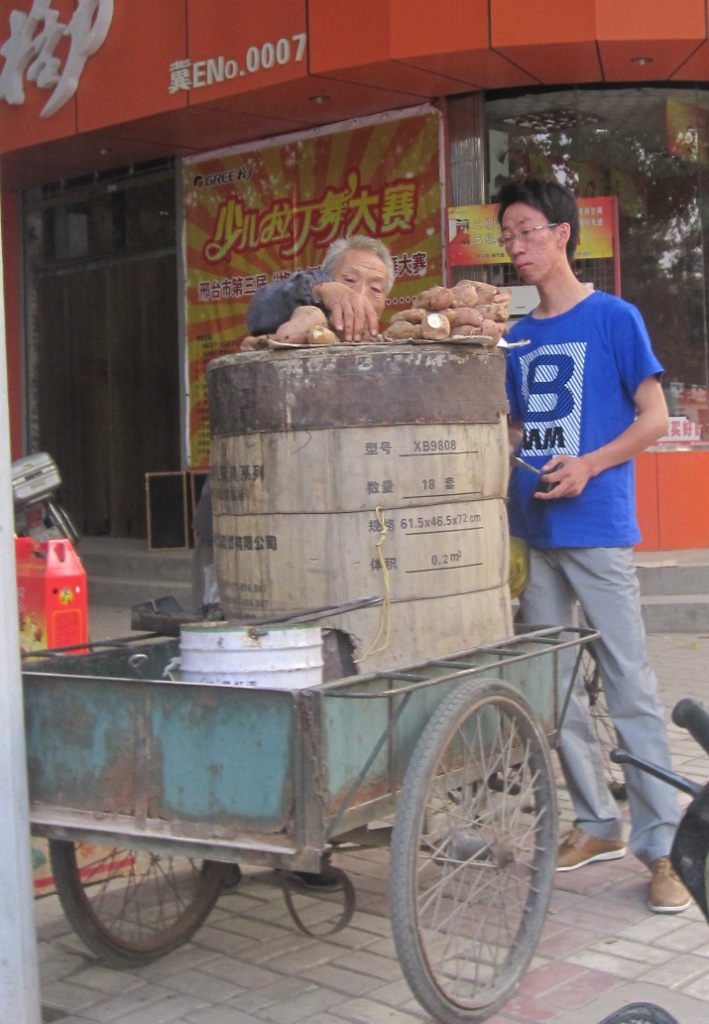
    This is not a good photo but it gives an idea of where the potatoes are cooked.  There are many such small vehicles with  hot plates upon which the potatoes sit and cook. Potatoes are sold by weight.   

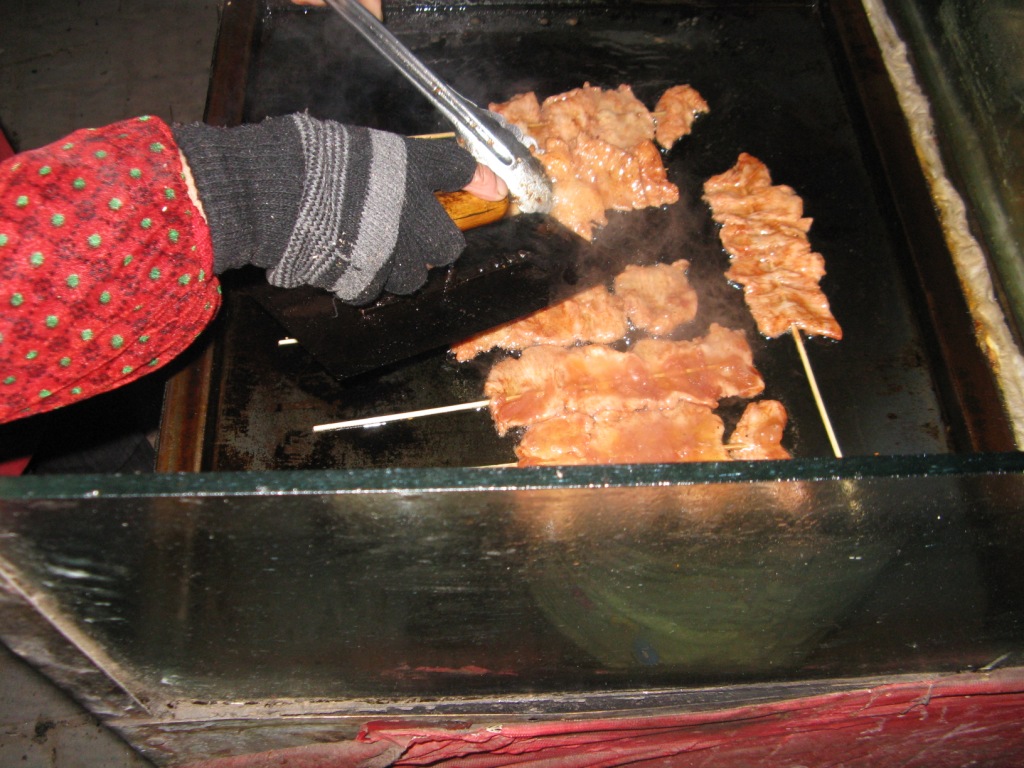
    These are my favourite kebabs cooking on a hotplate on a bicycle. After cooking they were brushed with a bean paste and dusted with several different spices.   Sometimes people buy them stuffed inside a flat bun which is also  warmed on the hotplate.  Other kinds of kebabs including meat, tofu and  squid are also available.   The Muslim style kebabs are cooked over hot coals and are available at other stalls and restaurants.  They are dusted with spices and very yummy too.

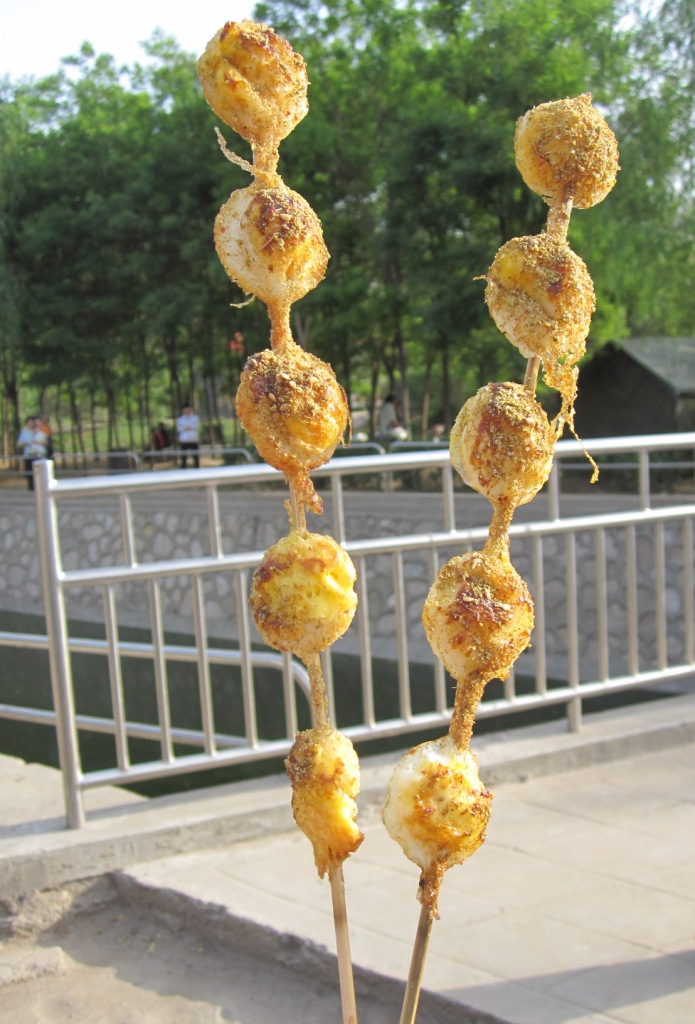
    These  quail egg kebabs were dusted with spices and tasted delicious.  I’ve only ever seen them twice in China.

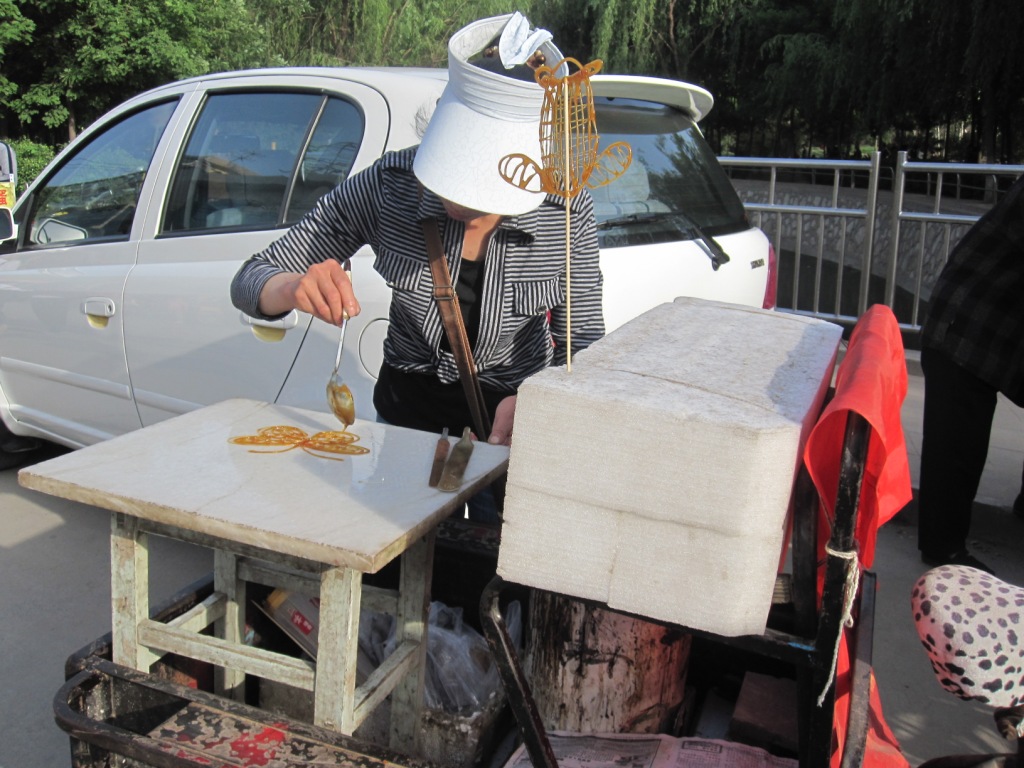
    Drawing in sugar.  It was melted over a small heat and the molten liquid drawn into various shapes designed to appeal to potential customers.  A completed one is hanging near the makers head.  This stall was set up near a kindergarten at close of day. It is a common folk art seen in many tourist areas.
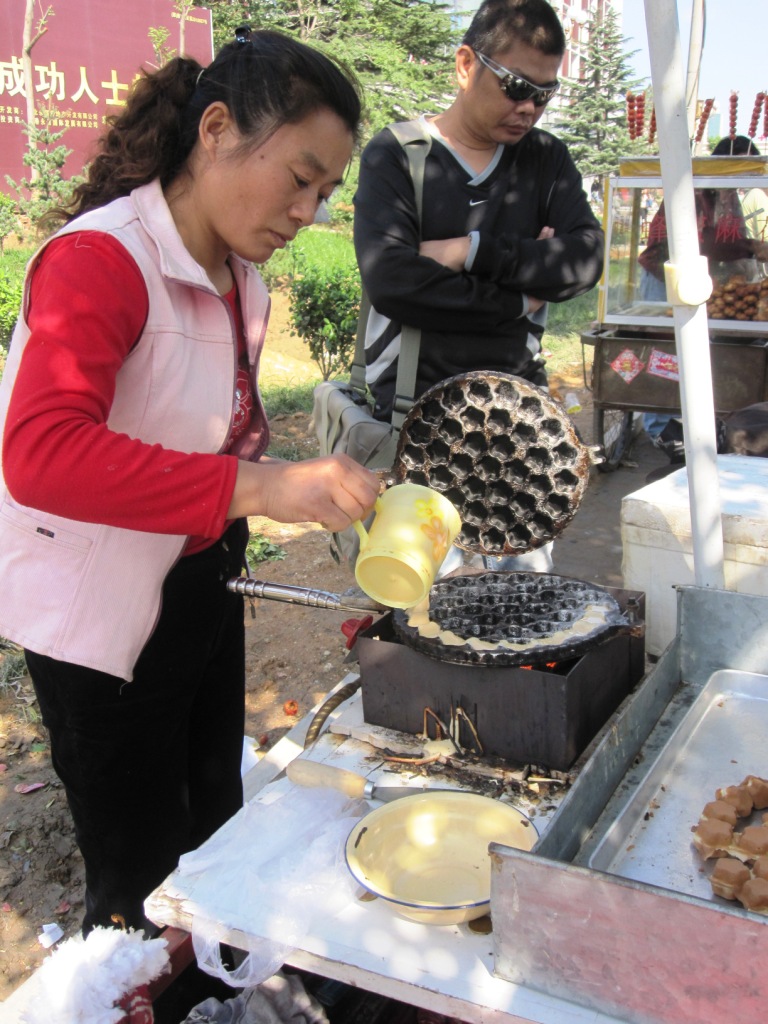
    This woman was pouring a prepared mixture into a greased pan over a gas stove.  Some of the previous batch of tiny star shaped ?cakes are visible in the bottom right of the photo.

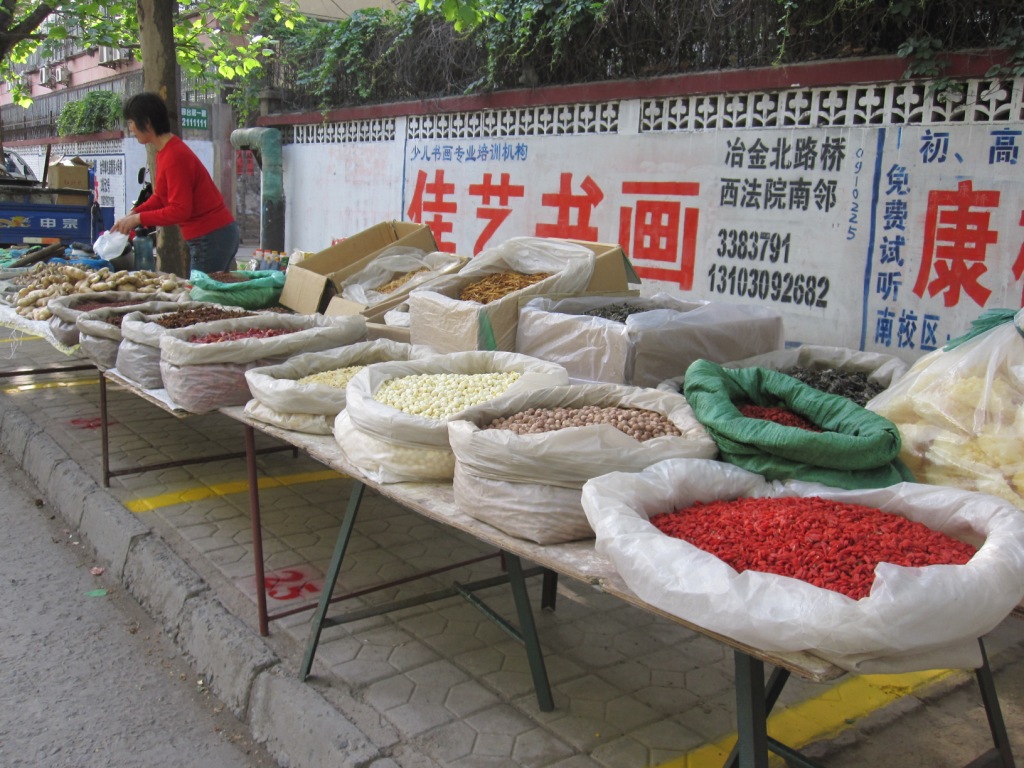
    A footpath stall selling spices.

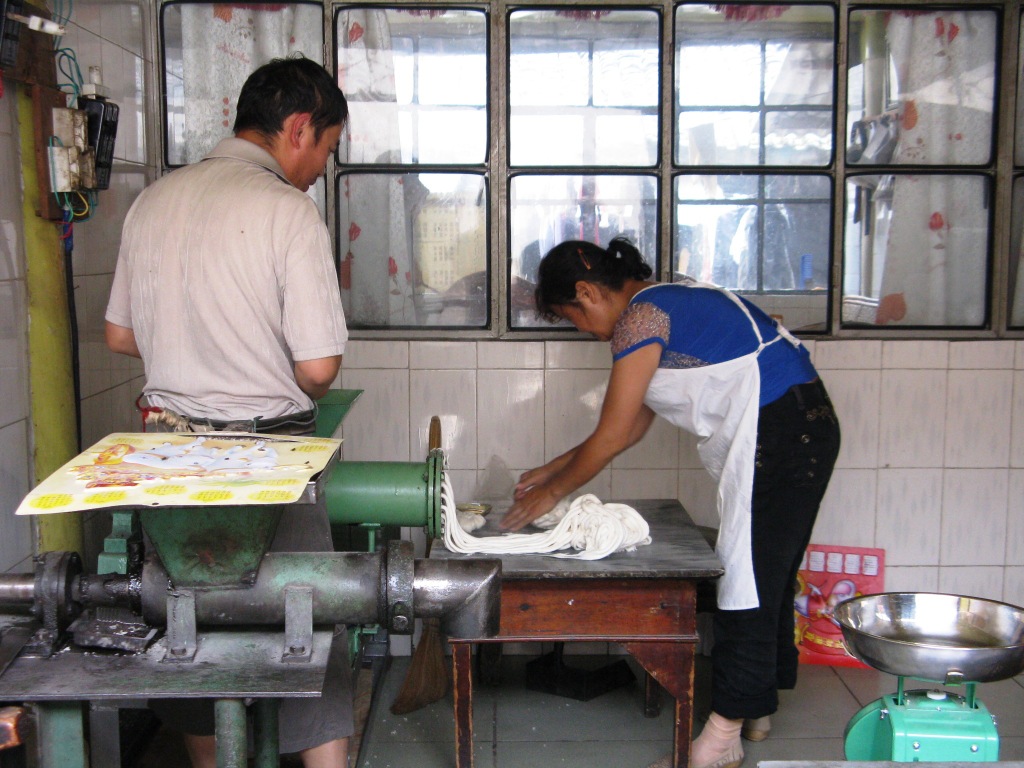
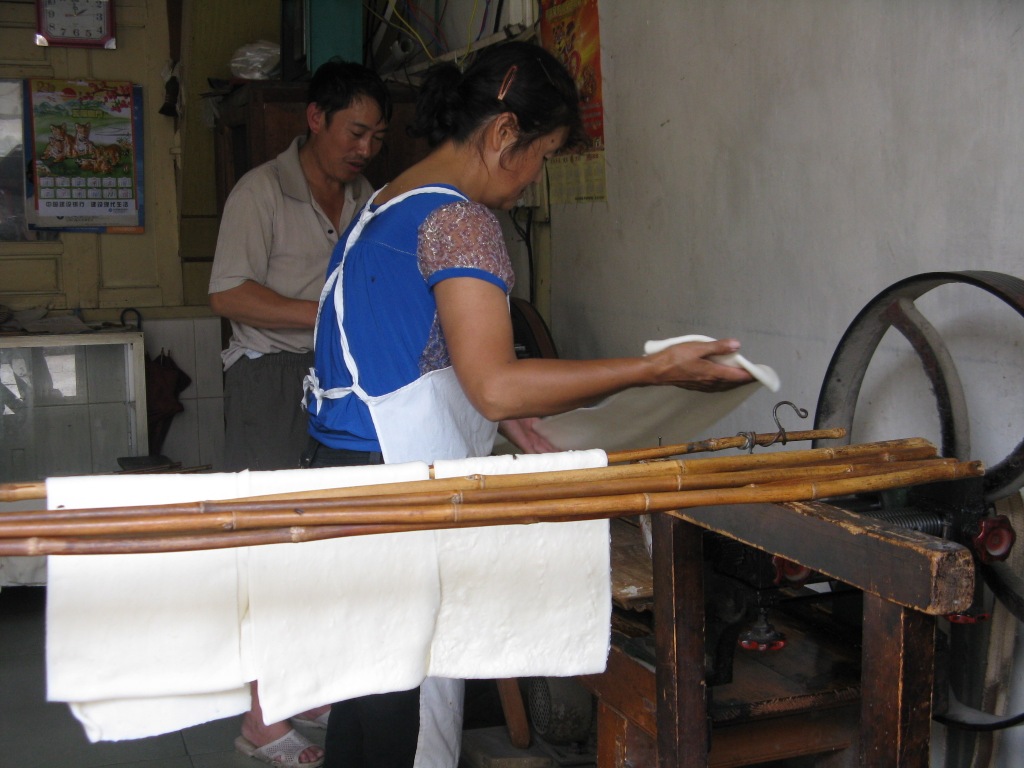
    These people were working in a small village near Dali in Yunnan.  They put the dough through the extruder and then folded it up again. 

    The dough was then rolled out into long strips using the machine in the background and hung on bamboo poles to dry. There was no visual evidence to show the next steps.
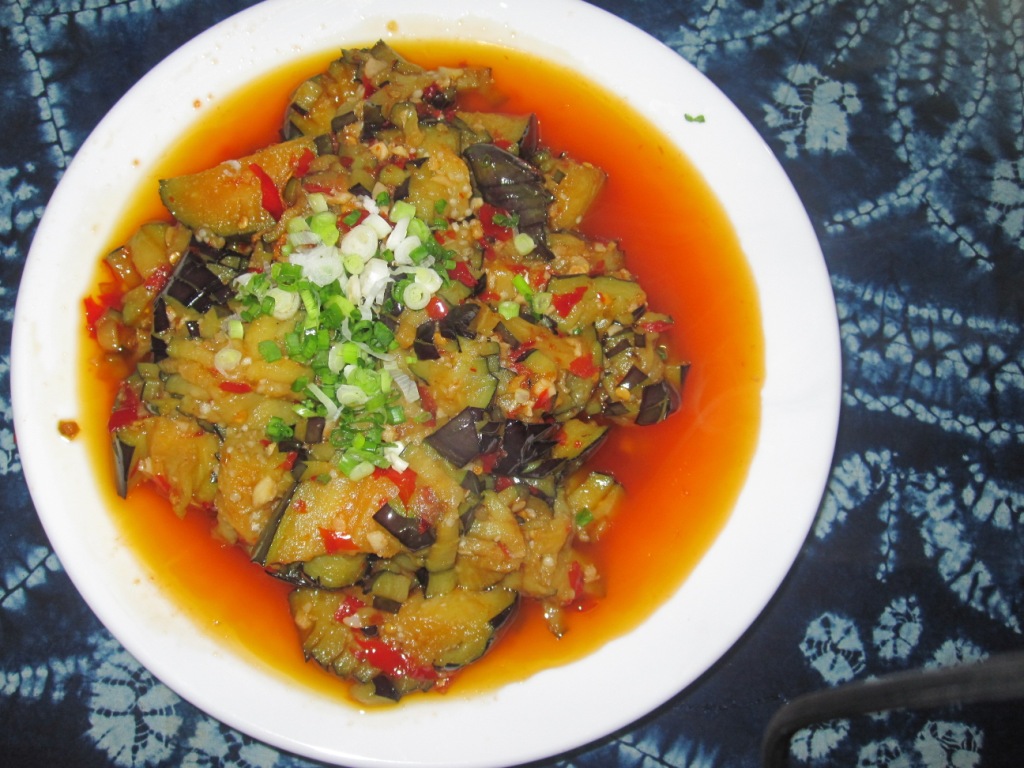
    An eggplant dish in a restaurant in Dali, Yunnan. I returned and ordered the same dish the following night.  Despite them having a menu with words, pictures and listed prices I was charged less on the second occasion. Perhaps it was a frequent diners discount.    One of the young men I met at  Lake Lugo, and with whom I dined  one night,  said our meal was discounted because we ate at a restaurant where he had eaten previously.    I never ate eggplant before going to China but I had quite a bit of it in Yunnan and enjoyed it.  Sichuan is the province known for its spicy food but in Yunnan chilis were sold in large quantities  from large bags and appeared in copious amounts in prepared food.

    China, Dali, Xingtai, Yunnan

    China, culture, Food

  • Summer Palace

    Nov 4th 2010

    By: Kerry

    No comments

    The Beijing Summer Palace

    The Summer Palace is located in northern Beijing and was first created many hundreds of years ago as the summer resort for the imperial family.   It suffered destruction during two foreign  invasions and was rebuilt each time.  It is now open as a grand garden representing several styles and is home to many notable buildings.  The majority of the garden consists of a lake, Kunming Lake.

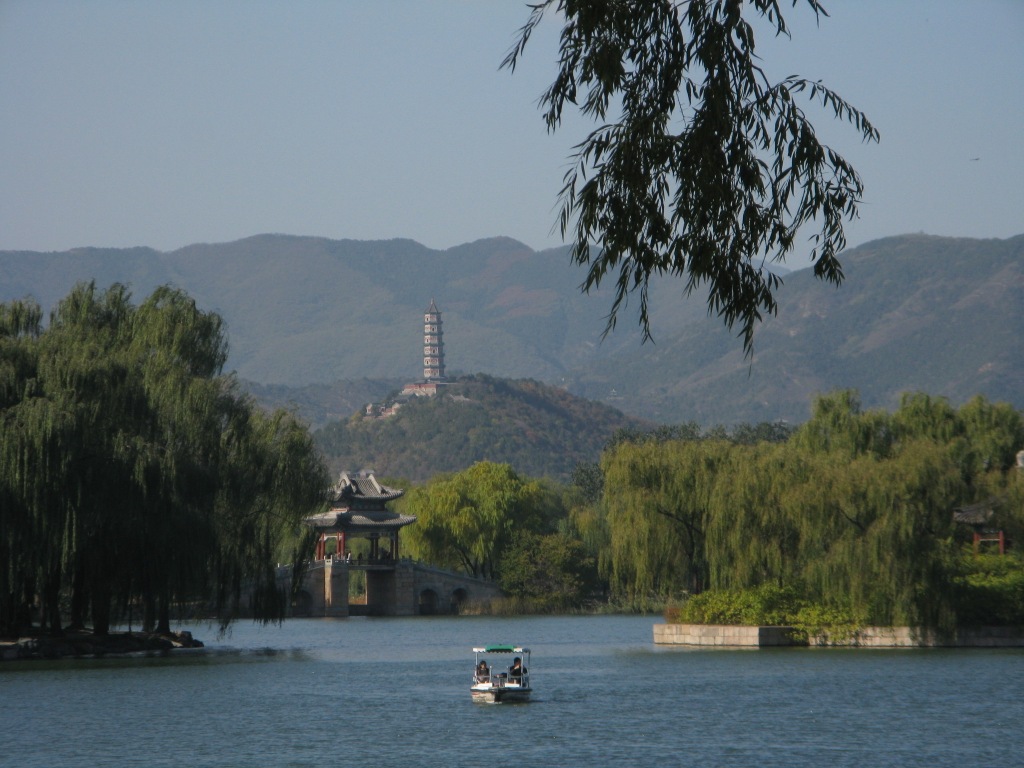
    Mirror Bridge, a pagoda and a small rental boat on Kunming Lake.

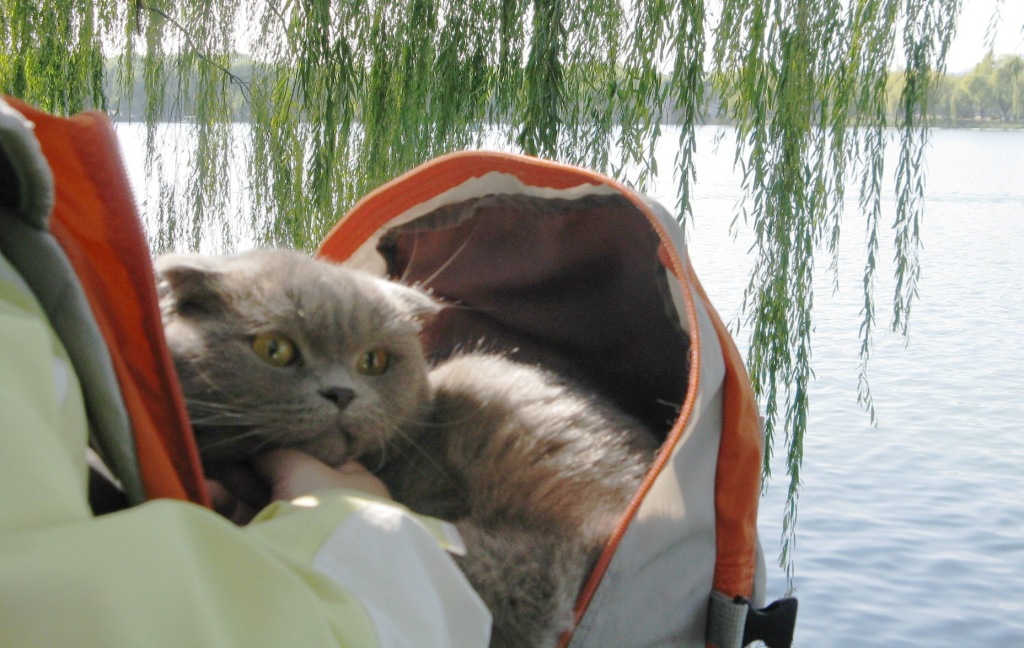
    A cat visiting the gardens. He was not happy about having his nap disturbed.

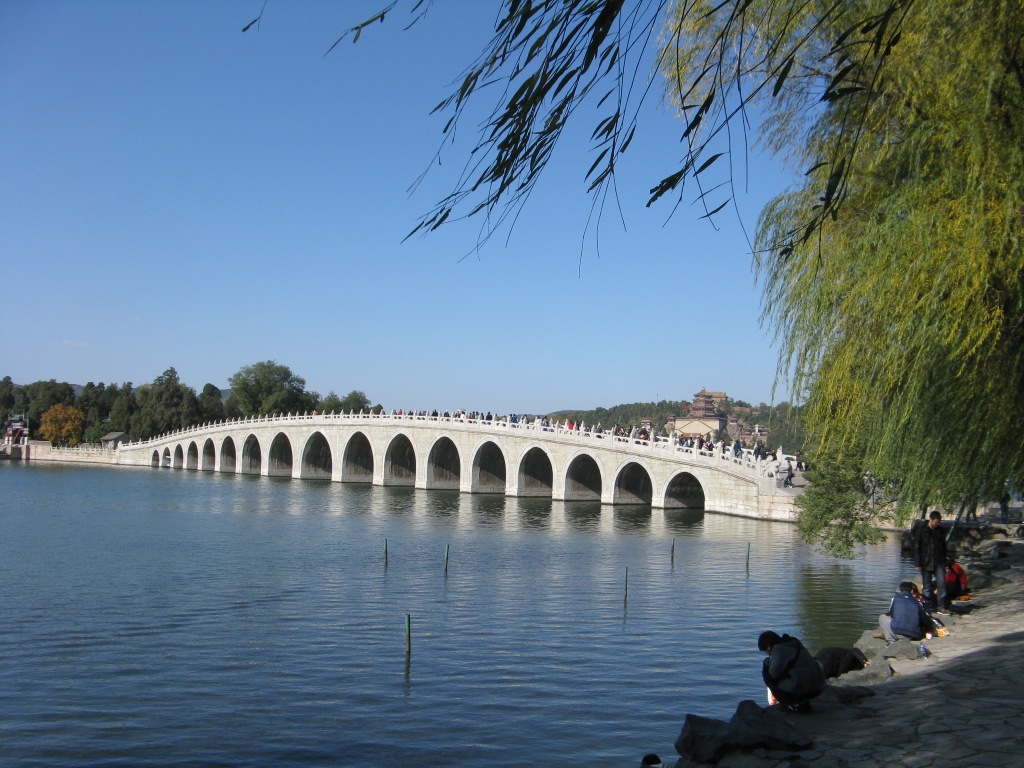
    Seventeen Arch Bridge was built about 250 years ago and links one shore of Kunming Lake with an island, Nanhu.

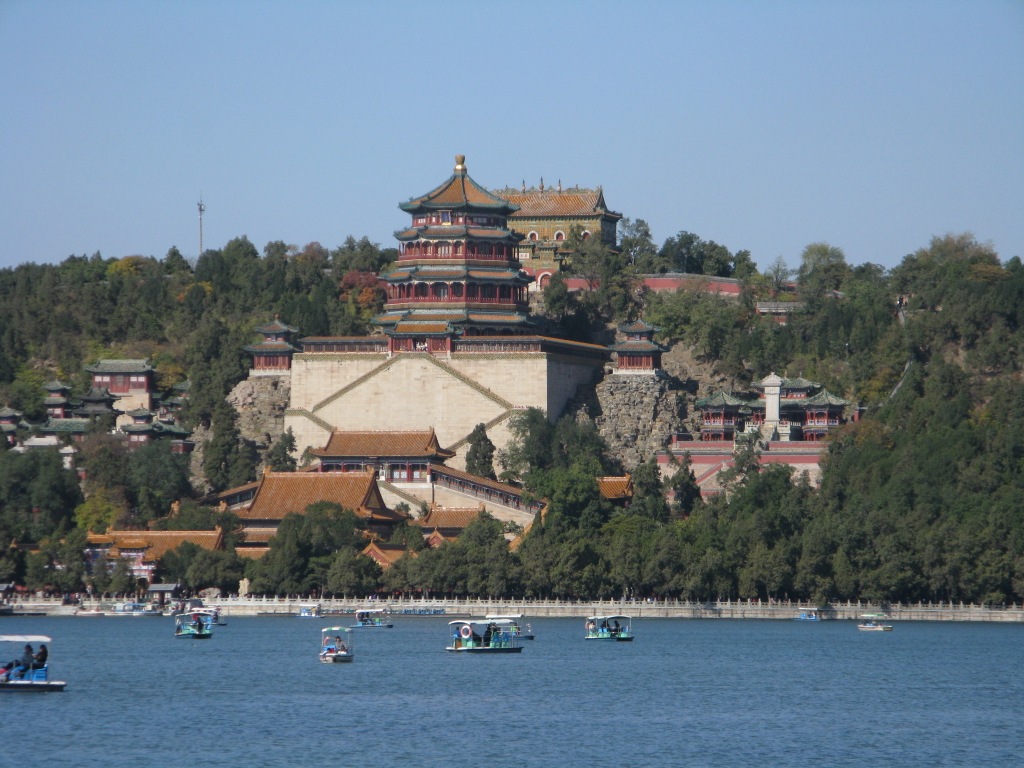
    Hall of Buddist Incense, rental boats and Kunming Lake.

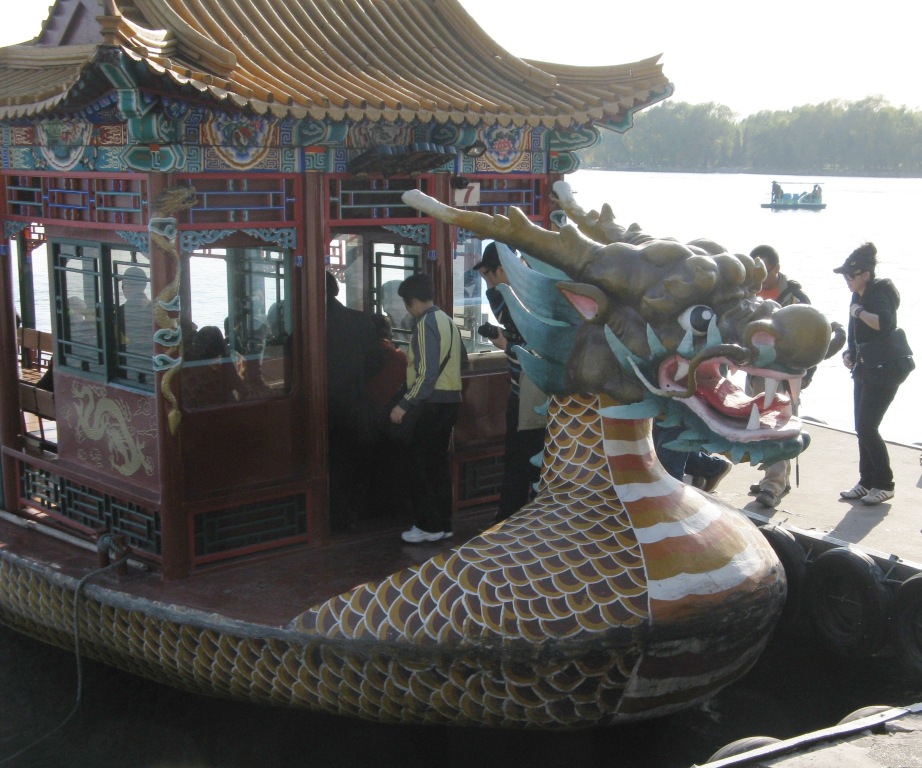
    The front of one of the dragon boats transporting visitors from one part of the lake to another.

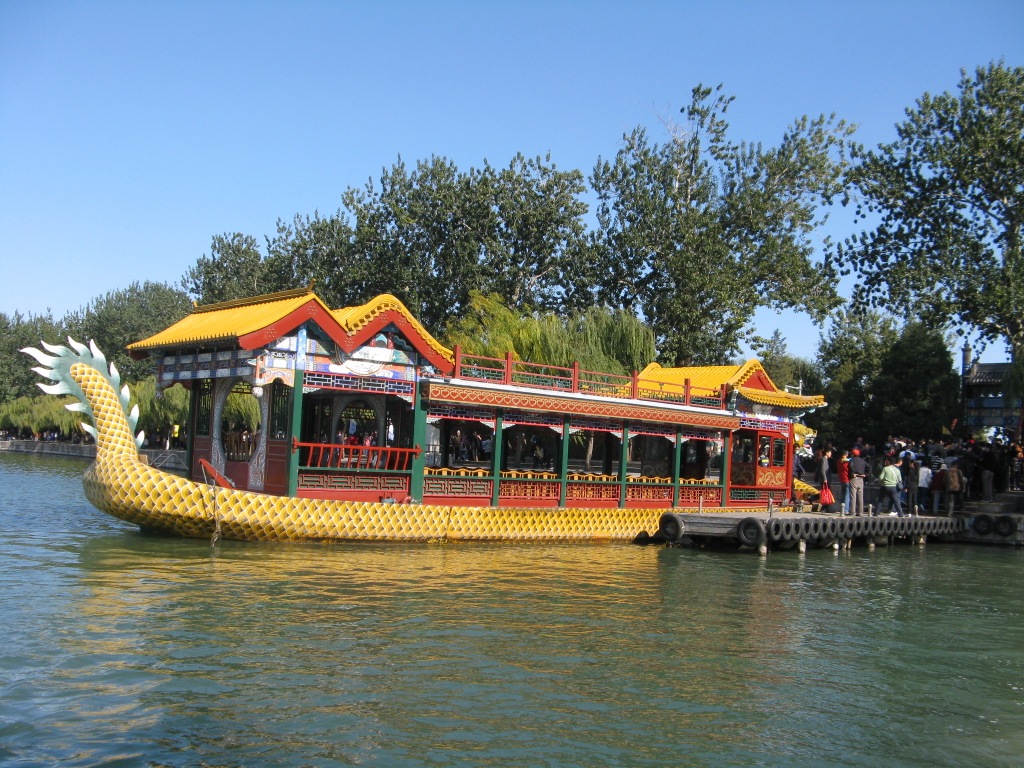
    The side and back of one of the lake boats.

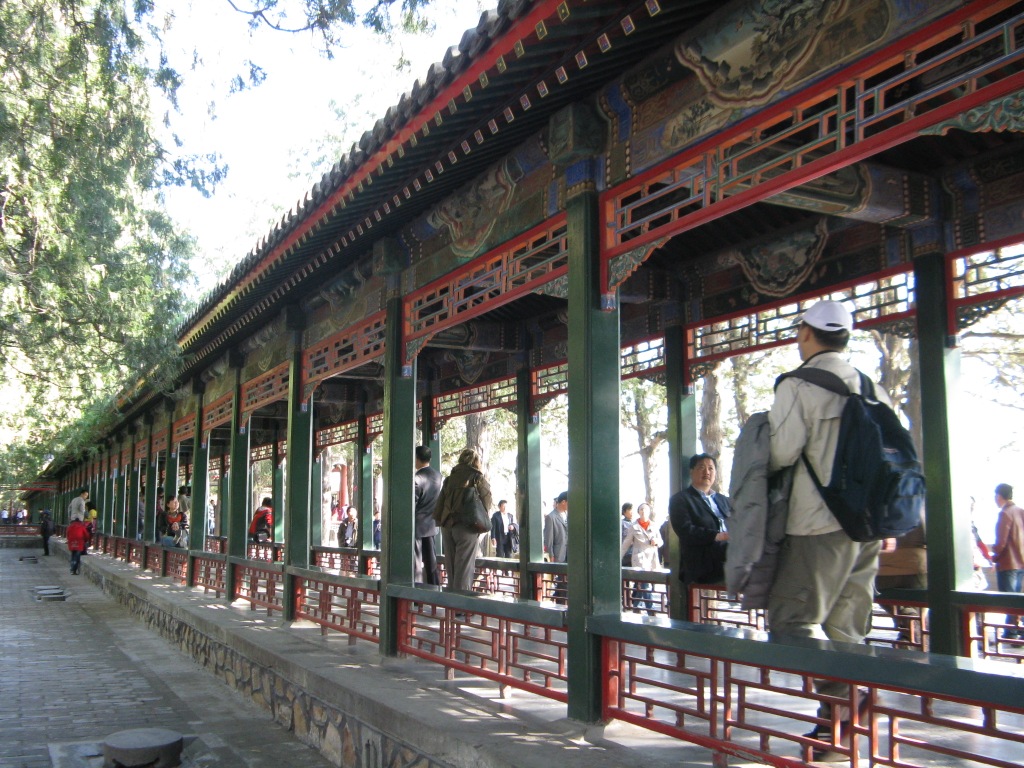
    The Long Corridor, a very long covered way which enabled the imperial family and other notables to travel a vast distance without being affected by the elements.  It is highly decorated with paintings which according to what I read need renewing every 12 years.  The ones I saw were not particularly spectacular.

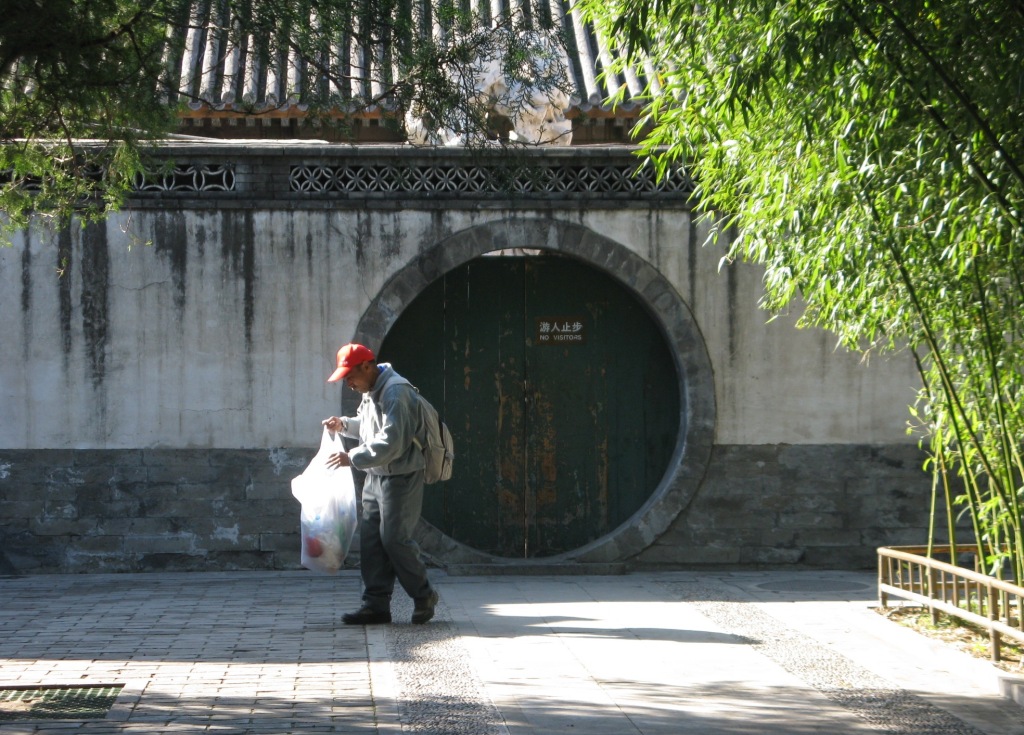
    A Chinese door, bamboo and the usual elderly bottle collector.

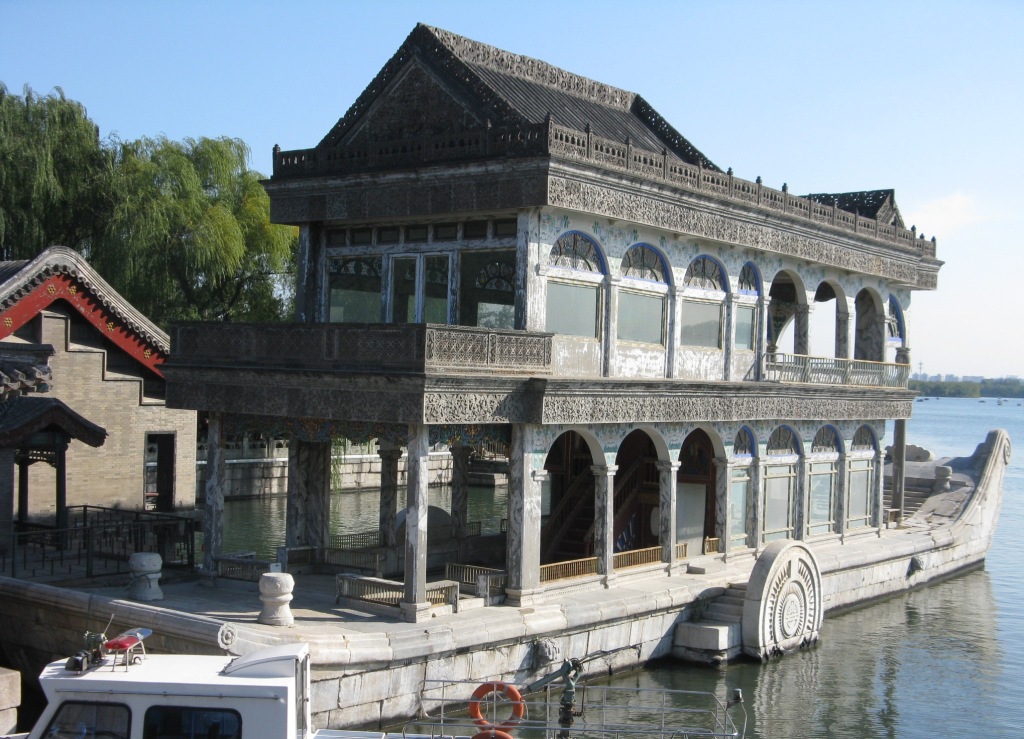
    The marble boat paid for with money  embeezled from the navy by the Empress Cixi.

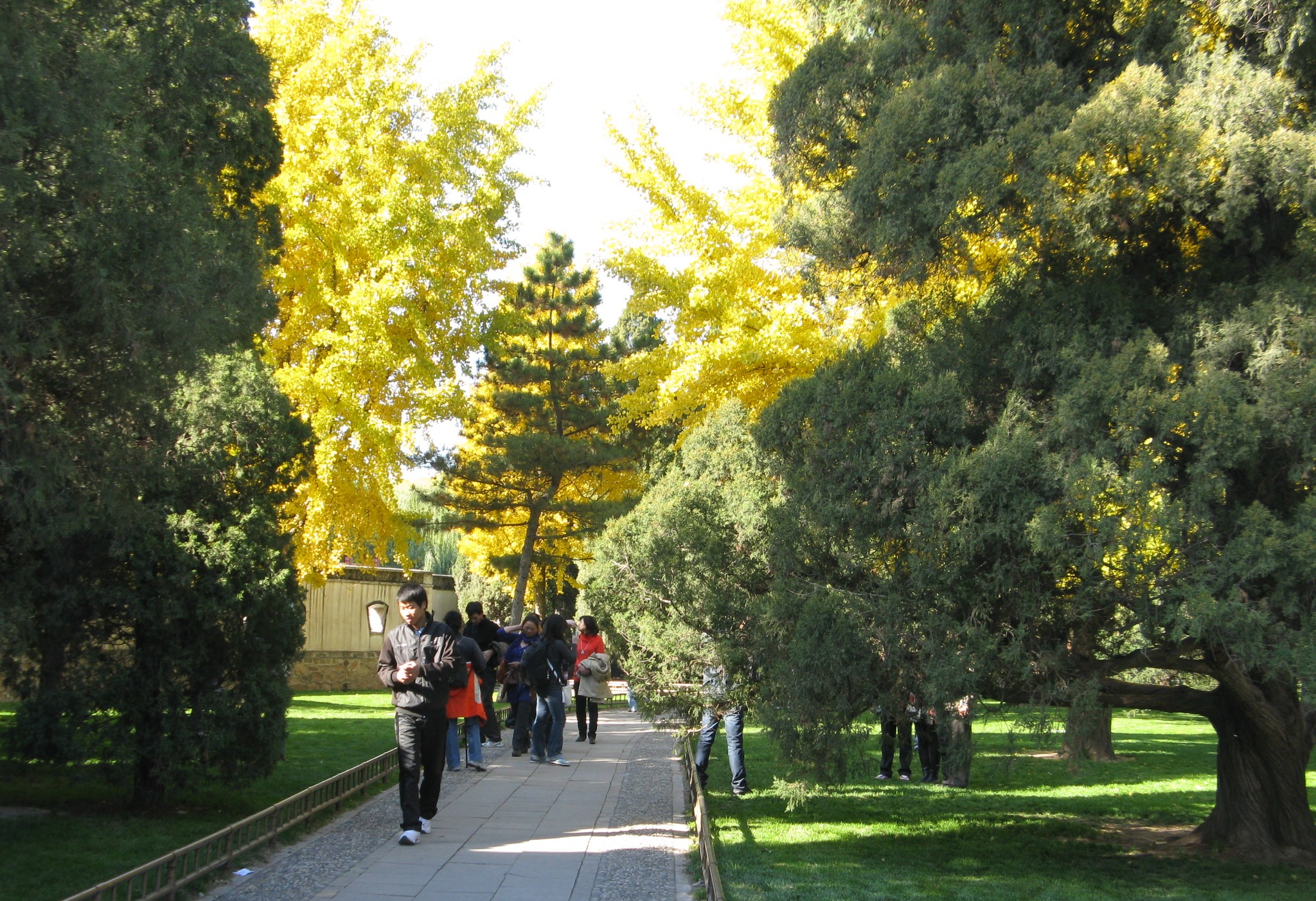
    Some of the trees were starting to change colour.

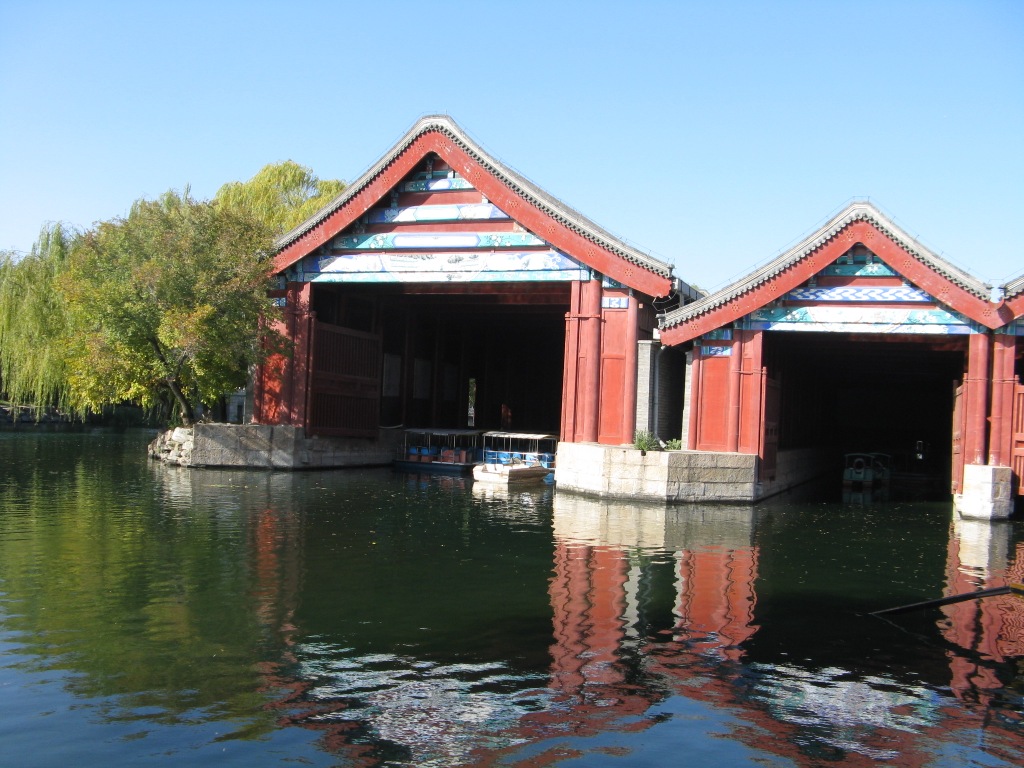
    Qing era boathouses.

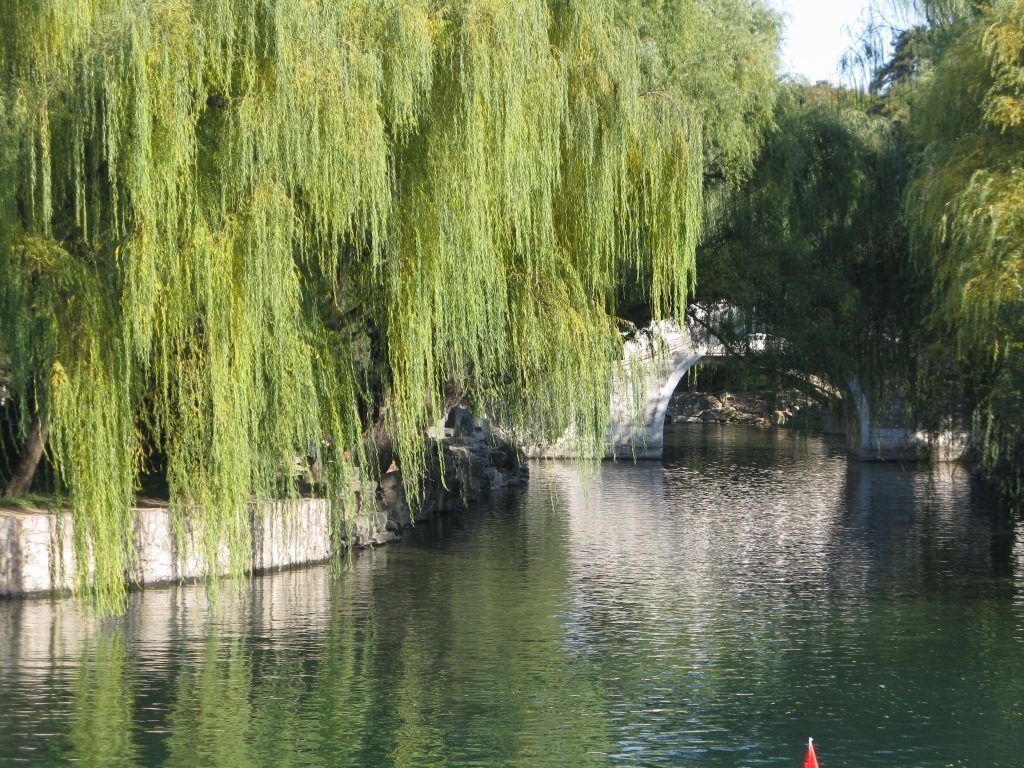
    One of the many canals and bridges within the gardens.

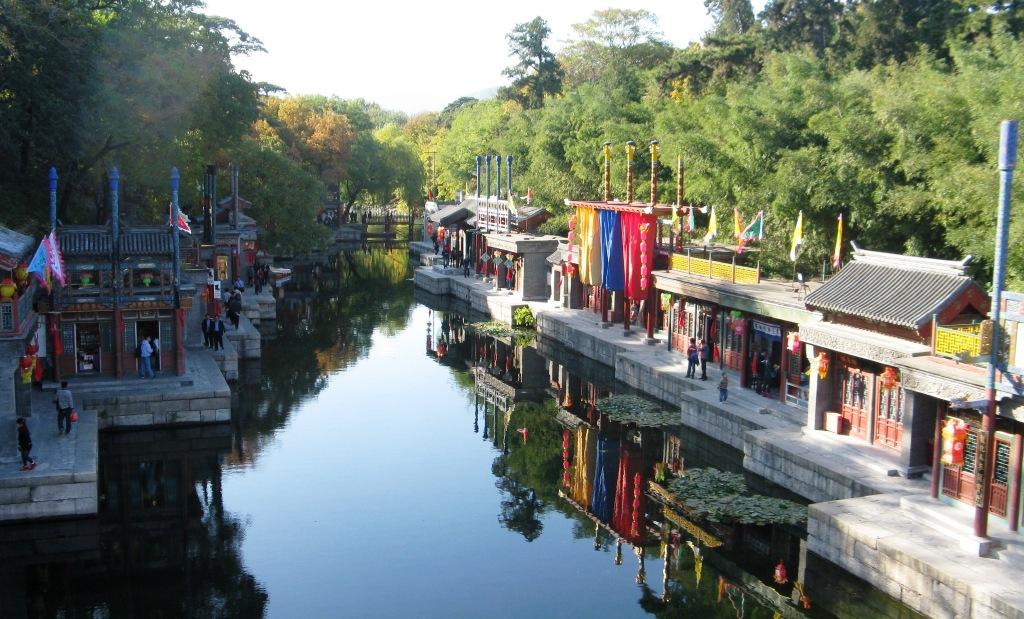
    Suzhou Street.  One of an emperor’s favourite concubines missed her home so he developped an area of narrow canals lined with shops to make her feel more at comfortable.  They were renovated in more recent times.

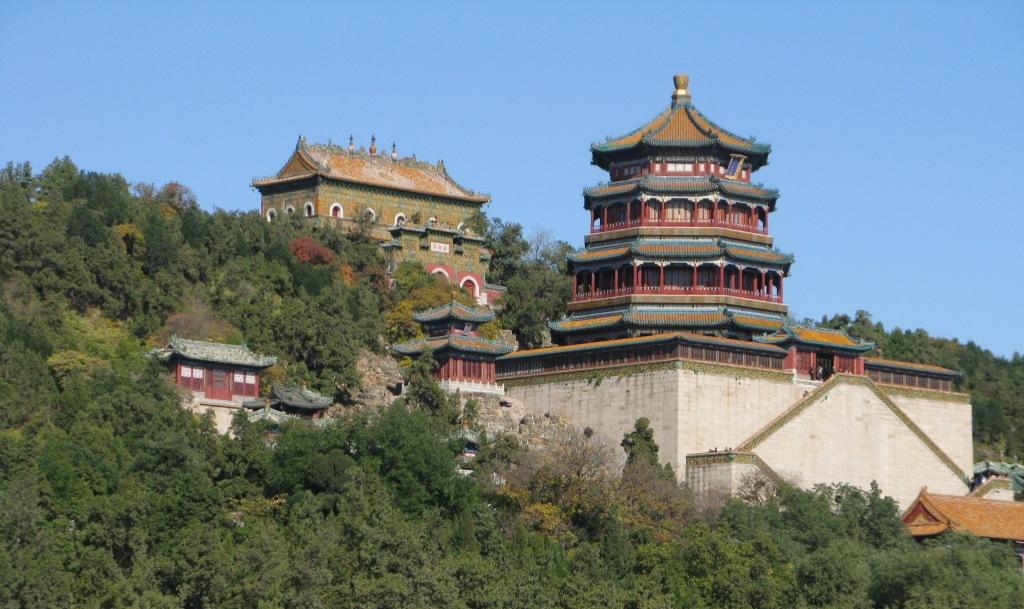
    Duo Bao Pagoda and Hall of Buddist Fragrance

    There were many other buildings and waterways, some of which I saw and some I didn’t.  Not all photos were noteworthy.  It’s worth a return visit.

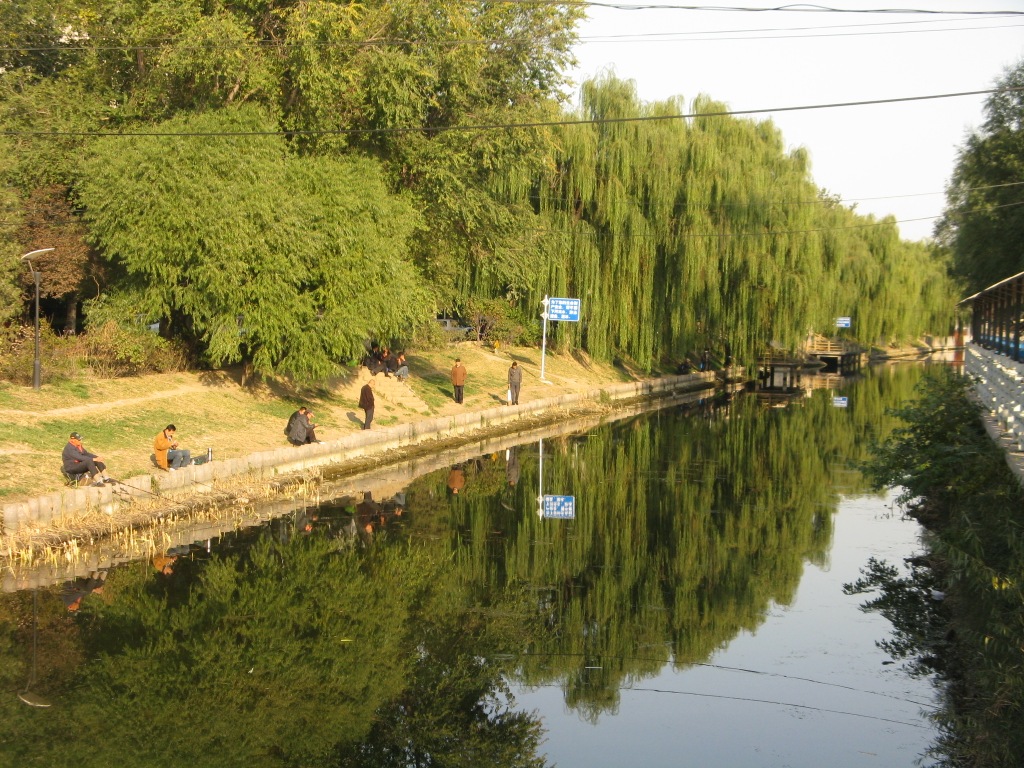
    This was not at the Summer Palace but near one of the subways I used to get there.  It is one of the original waterways in Beijing and has not been renovated for vehicular traffic.   A peaceful afternoon of men fishing in one of the world’s biggest cities.

    Beijing, China

    animals, architecture, art and craft, Beijing, China, culture, lake, park, religion, temple, transportation

    • <
    • 1
    • …
    • 17
    • 18
    • 19
    • 20
    • 21
    • …
    • 31
    • >

© Copyright Kerry's Blog. All rights reserved.