• Home
  • About
  • Work
  • Contact Me
  • Blog Visitors

Kerry's Blog

Feed
  • Hello and Welcome

    Hello and thanks for visiting my blog. Please have a look around, and if you would like to leave a comment on any posts please click HERE to register.
  • Subscribe


  • Recent Comments

    • sandra mosley on The Update
    • sandra mosley on The Carpentry and the Return
    • sandra mosley on Two onto One does Go
    • sandra mosley on Spring has Sprung
    • grazer on A singing waiter and a travelling cat
  • Pages

    • About
    • Work
    • Contact Me
    • Blog Visitors
  • Categories

    • Abbot's Leigh
    • Animals
    • Australia
    • Beijing
    • Brecon
    • Bristol
    • bunbeg
    • Castle Carey
    • Chaddesden and Breadsall
    • China
    • Churches
    • Clifton Bridge
    • Copenhagen
    • Culross
    • Dali
    • Derby
    • Easton in Gordano
    • Edinburgh
    • Elmore
    • Family History
    • Gloucester
    • Home
    • Inverkeithing
    • Jinghong
    • Kent
    • Kunming
    • Lake Lugu
    • Ledbury and Colwall
    • Lijiang
    • London
    • Lydney Harbour
    • Melbourne
    • Other
    • Portbury
    • Qingdao
    • Tadcaster and Newton Kyme
    • UK
    • Uncategorized
    • Wells
    • Work
    • Xingtai
    • York
    • Yunnan
  • Favourite Websites

    • David's Blog
    • Webmail
  • Site

    • Register
    • Log in
    • Entries feed
    • Comments feed
    • WordPress.org
  • Tags

    agriculture animals architecture art and craft Australia baby carriers Behai Park Beijing bus China college computer culture Dali Dashalan dogs Education ethnic minorities Fashion Parade Food games guanxi Health holidays hostels Kumning lake Lake Lugo Lijiang maps markets matriarchial society medicine military training park performance plants Qianmen religion shops taxis teaching temple transportation Xingtai
  • Archives

    • April 2018
    • December 2015
    • November 2015
    • October 2015
    • September 2015
    • November 2014
    • October 2014
    • September 2014
    • August 2014
    • July 2014
    • June 2011
    • January 2011
    • December 2010
    • November 2010
    • October 2010
    • September 2010
    • August 2010
    • July 2010
    • June 2010
  • Art 798

    Nov 3rd 2010

    By: Kerry

    No comments

    Art 798

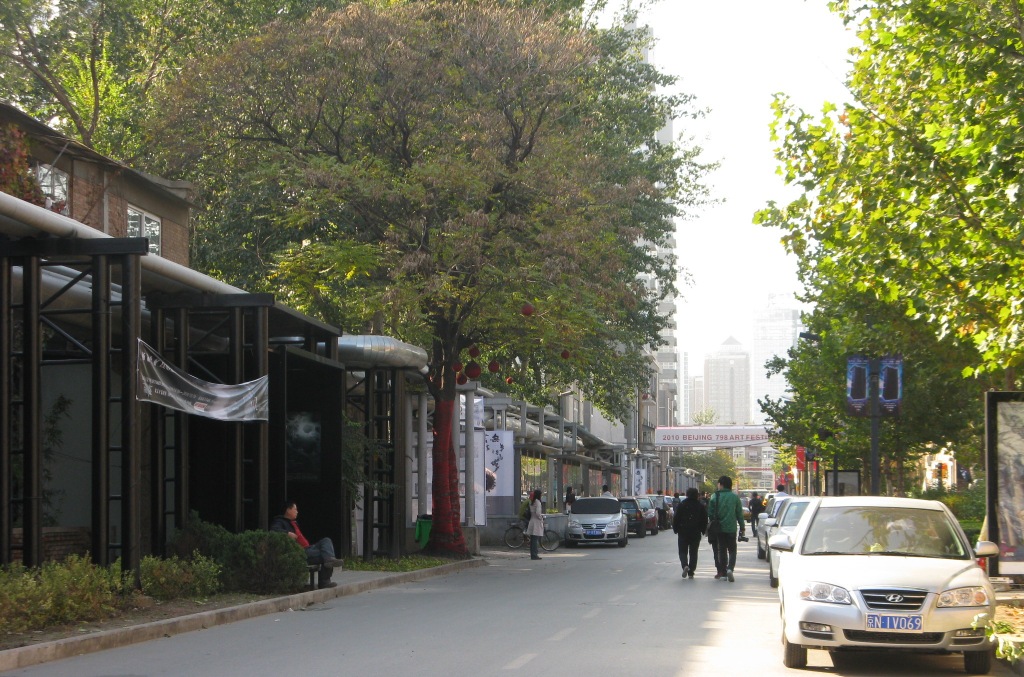
    This is a large art precinct in north eastern Beijing on what used to  an old electronics factory site.  The area is very large and I had insufficient time to explore it all.  There were art galleries, nick nack shops, fashion designer clothing and various art exhibitions.  One shop’s entire stock consisted of items, mainly sculptural rather than clothing, fashioned from crochet.

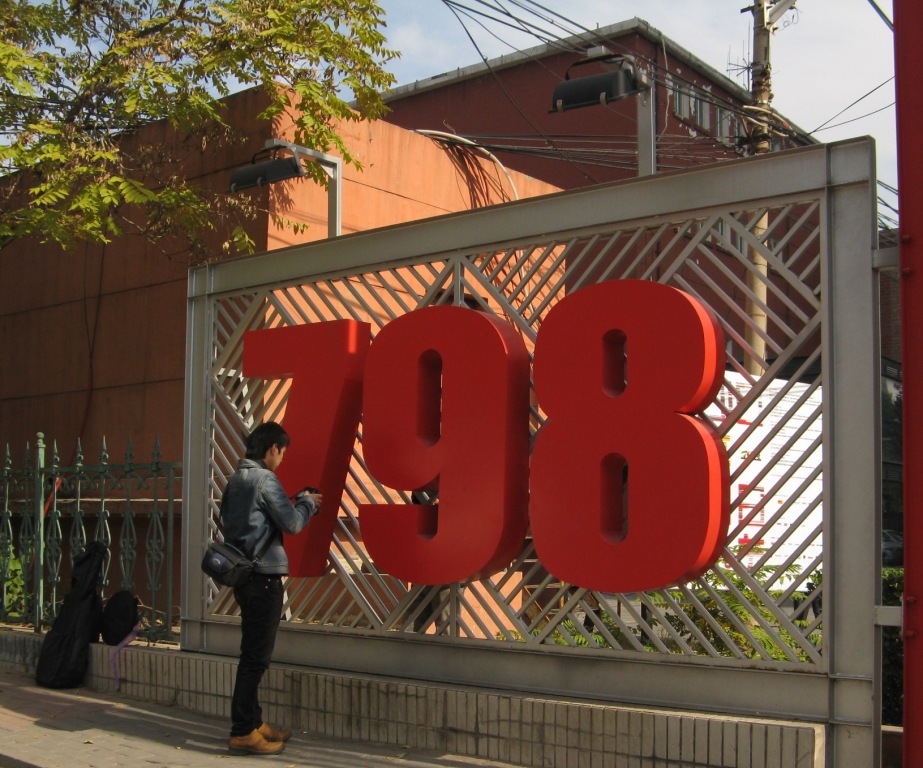
    Sign at entrance

    One of the streets.

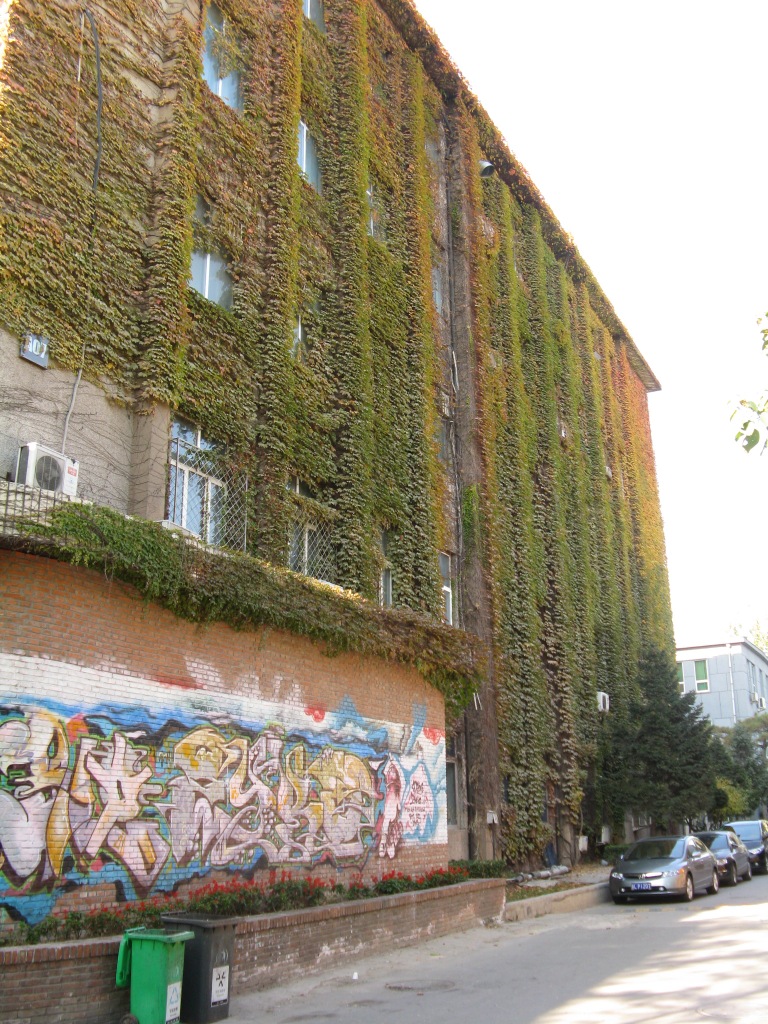
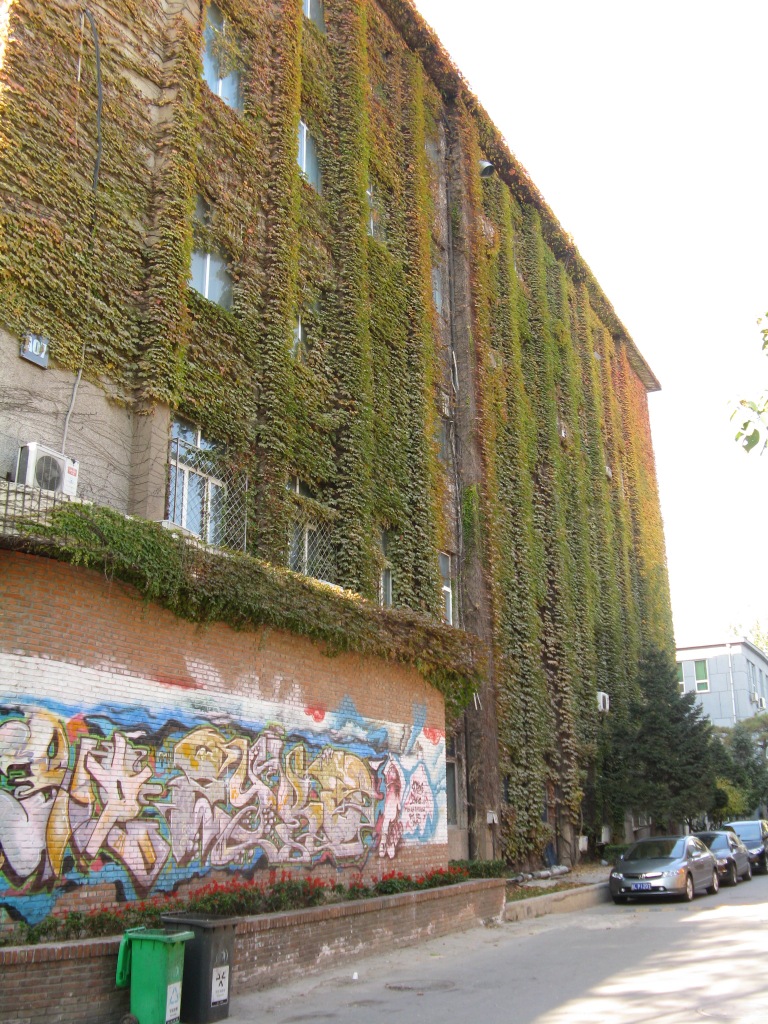
    Graffiti and vine covered wall with autumn tones.

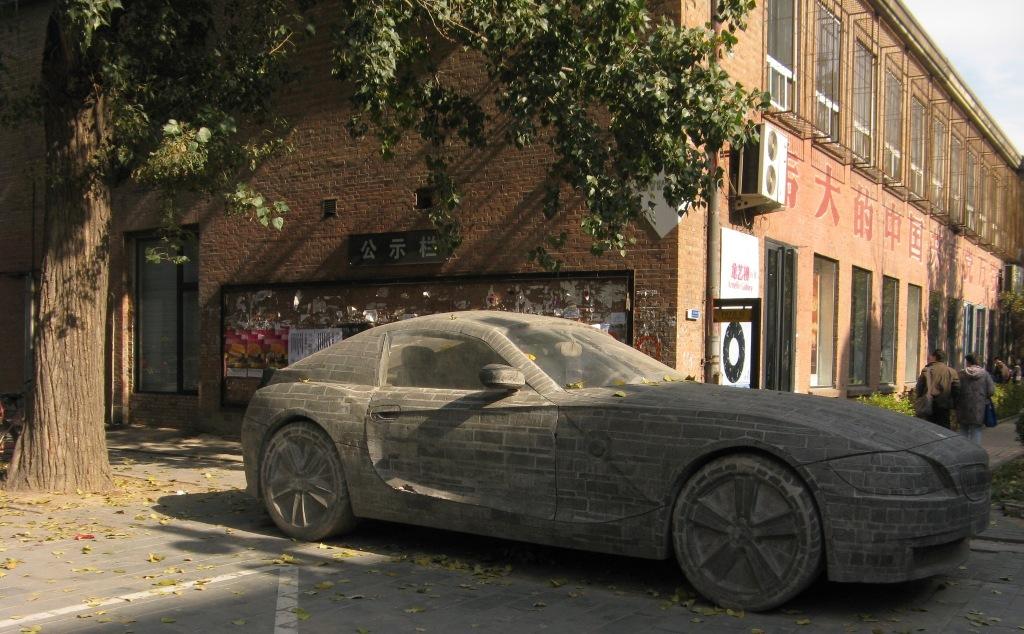
    Brick sculpture of a car.   There was one of an iron in orange bricks.  There were large numbers of outdoor sculptures.


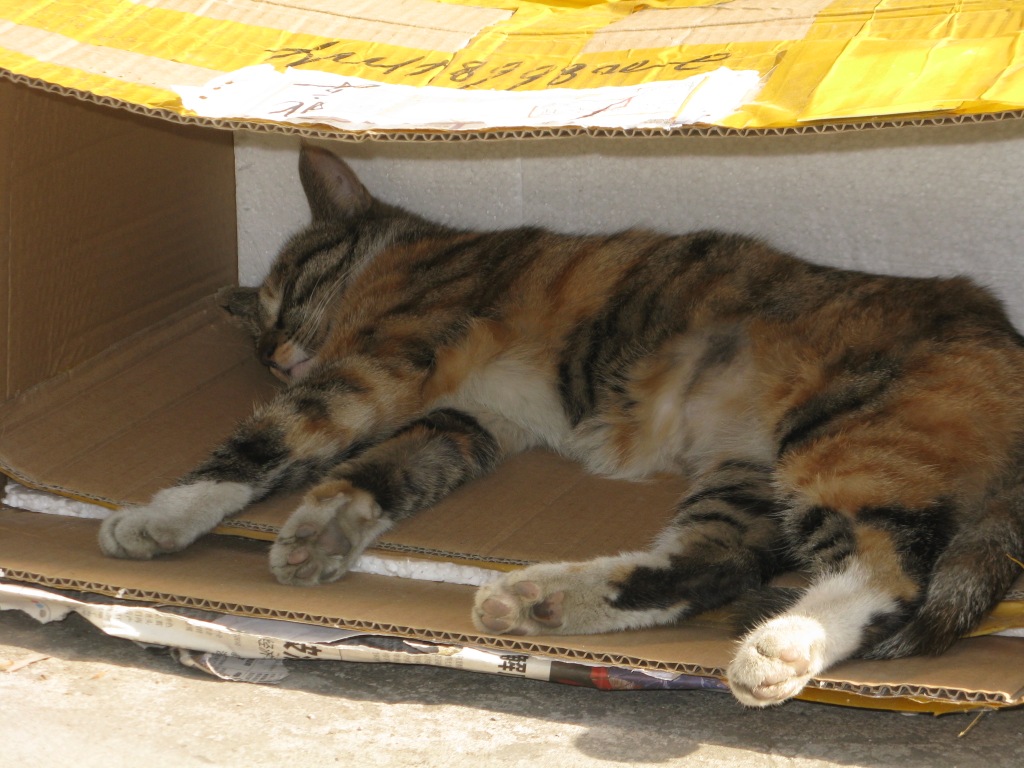
    Cat in box outside a shop exclusively selling small products about cats and with cat shapes and motifs.

    Further down the street were several boxes made into homes for cat or cat. One was busy napping when I walked past.

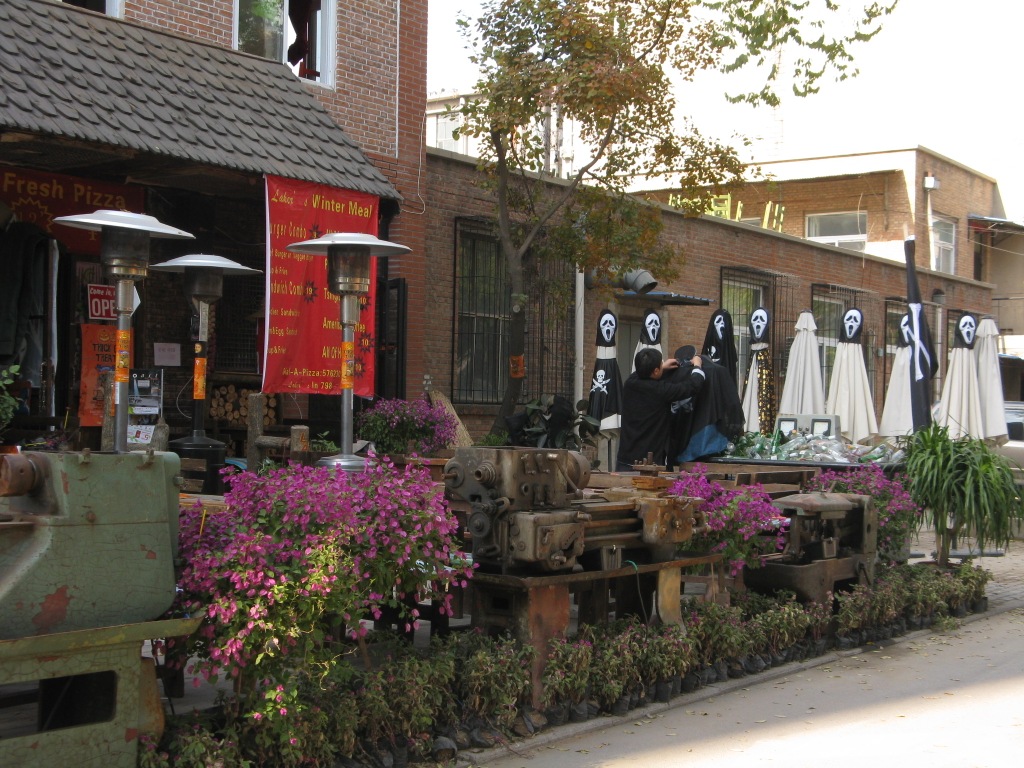
    One of quite a few cafes and restaurants.  It was being decorated for halloween.

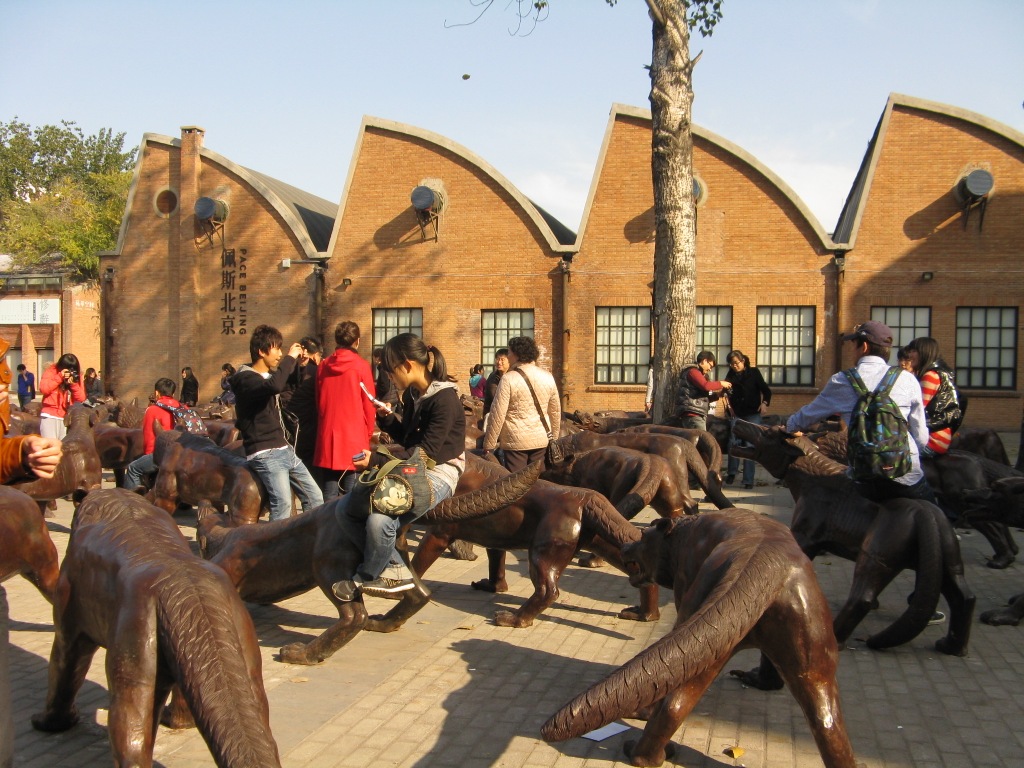
    A large multipiece sculpture receiving lots of attention.

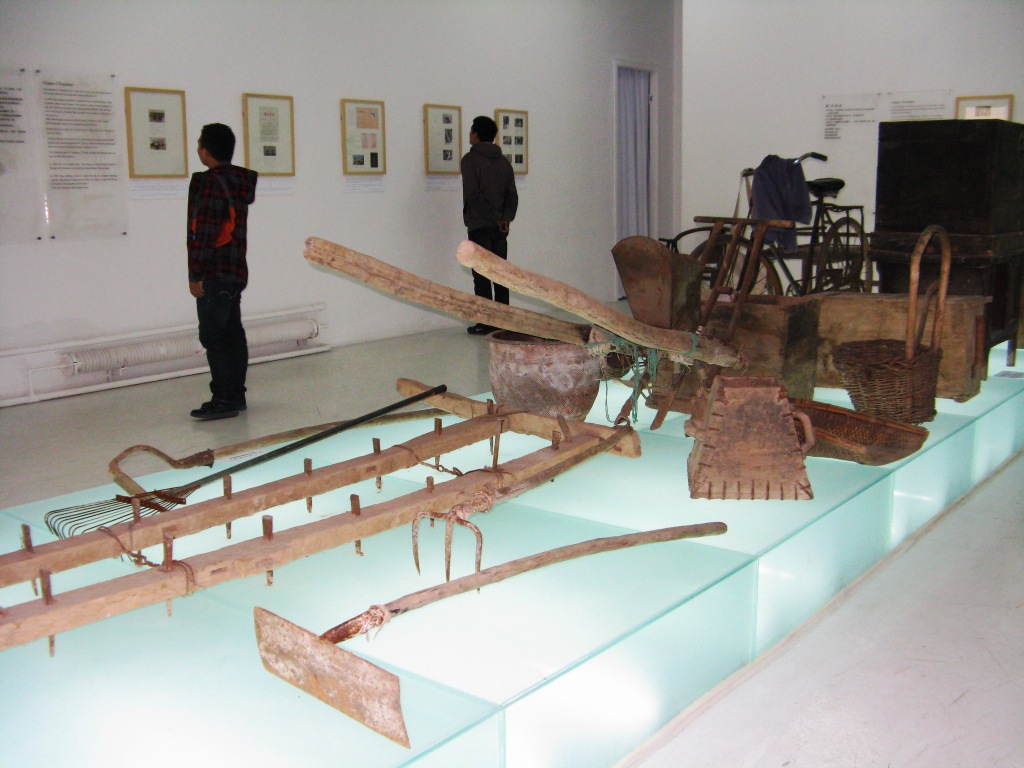
    An exhibition about the origins of two of the founders of Art Space 798.  Children of poor farmers who overcame adversities to achieve education, develop abilities and found the area.

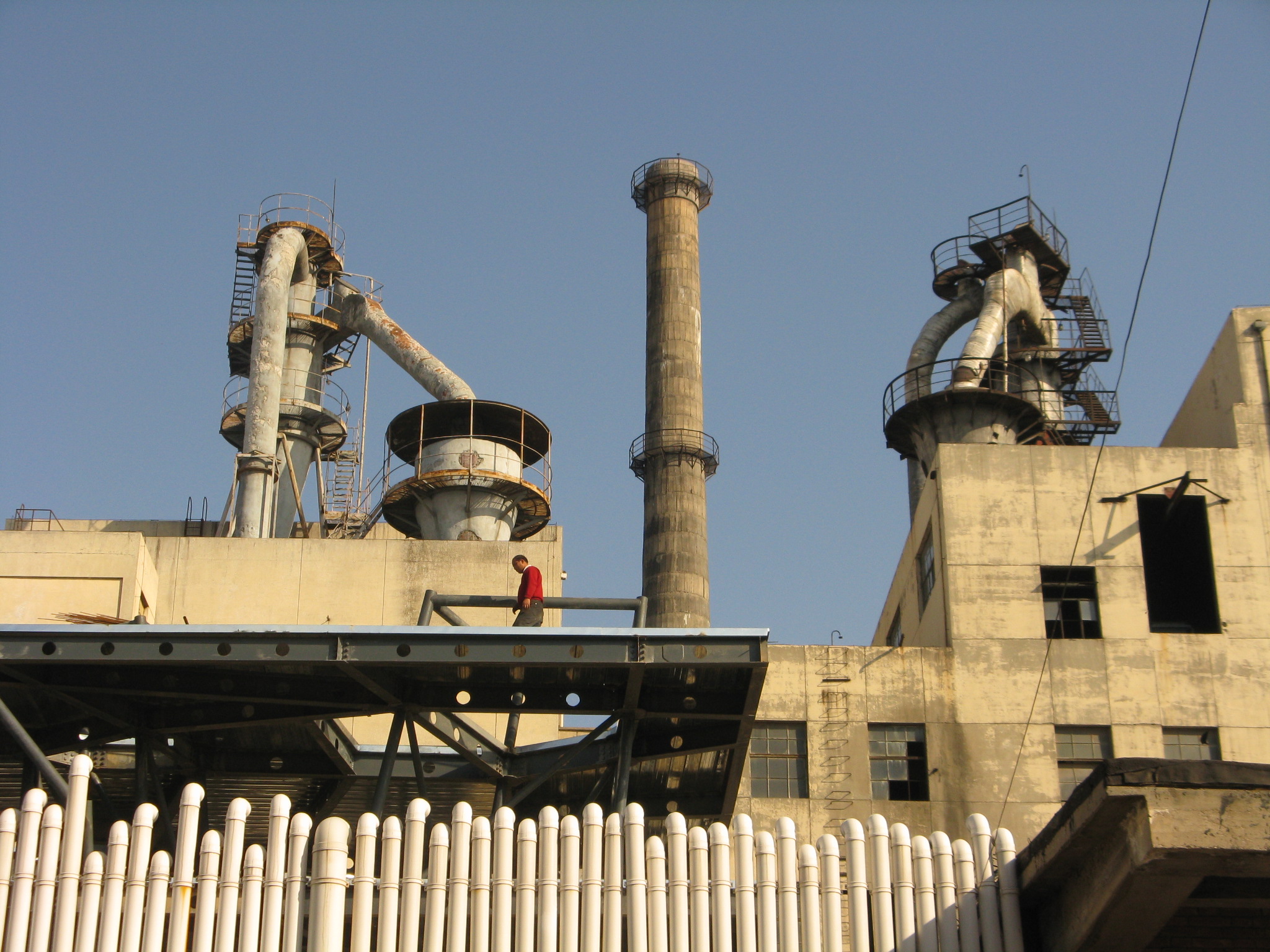
    Renments of the past with a glimpse of today in the poly pipes at the bottom of the photo.

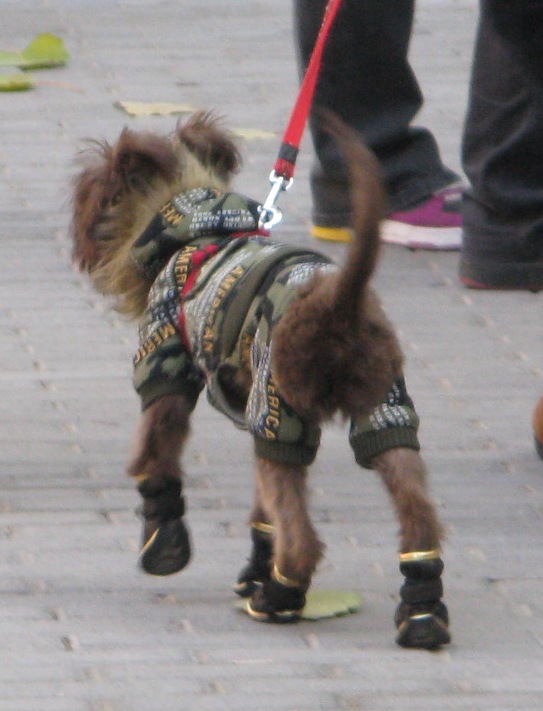
    A well co ordinated dog out among the art.

    Beijing, China

    architecture, art and craft, China, culture, dogs

  • Beijing and my adventures with transport

    Nov 2nd 2010

    By: Kerry

    No comments

    Beijing and my adventures with transport

    Another trip on the fast expensive train on Friday night had me in Beijing on time.  The train arrived at a different part of the station and I had to walk past a vast area where probably hundreds of people were bunked down for the night.  An increasingly longer wait in a taxi queue, there is no public transport very late at night, and a quick taxi trip on scantly traversed streets had me at a new hostel in northern inner Beijing some time after midnight.

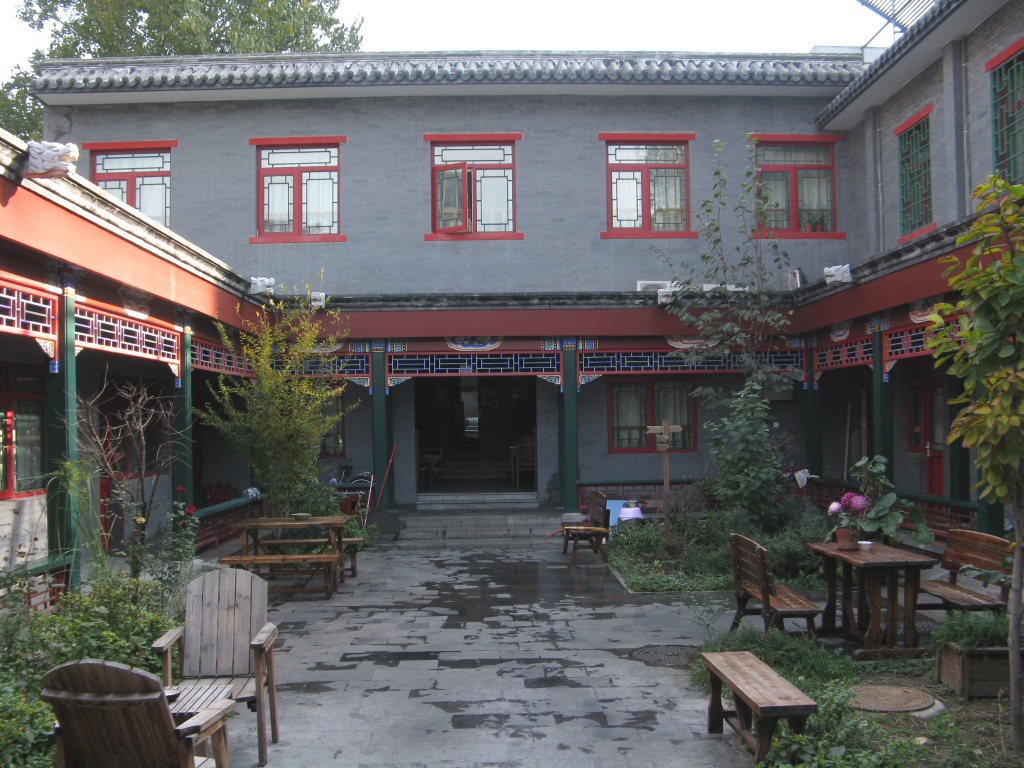
    The hostel was new yet built in a traditional courtyard style. My room was more expensive than the previous week’s  as it had an ensuite. I was upgraded and it was akin to an Australian motel.

    A hostel courtyard

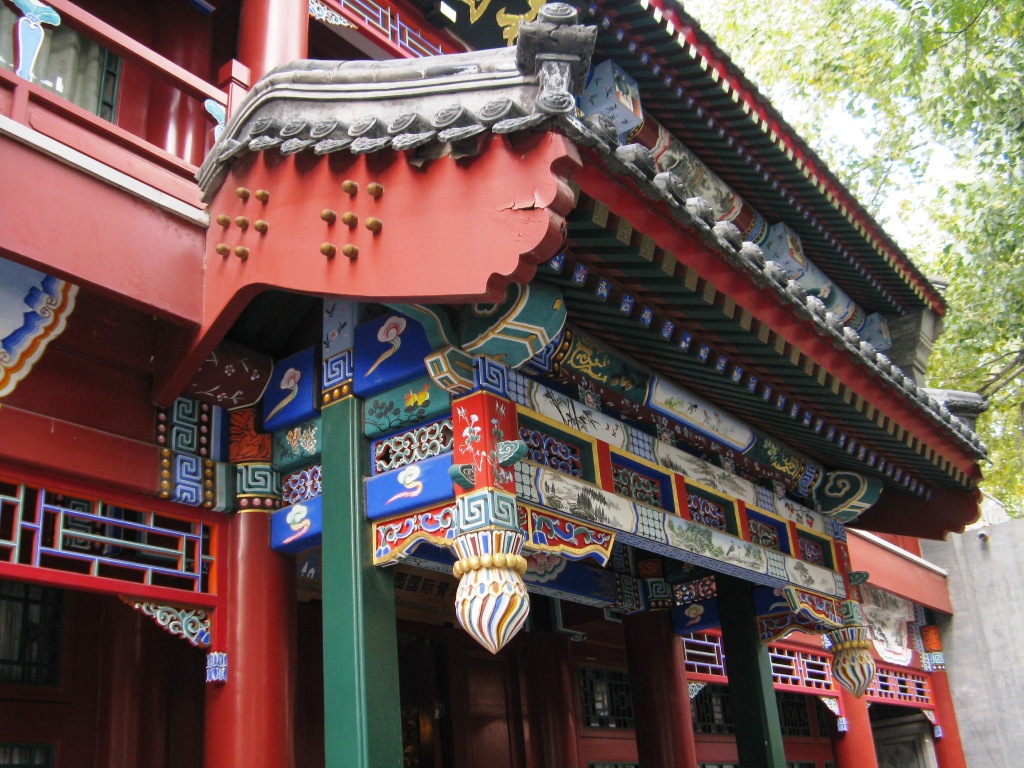
    The entrance to the hostel

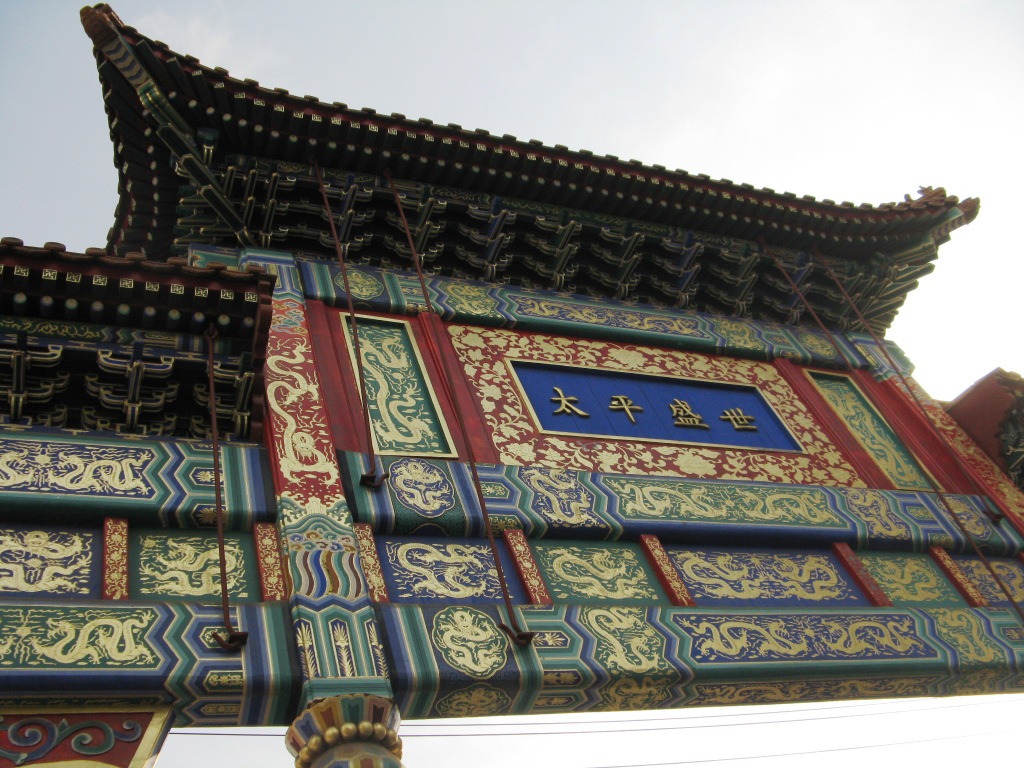
    The immediate laneway looked pretty daggy but the surrounding area had been redeveloped into high rise apartments and institutional buildings.  Evening footpath markets and food stalls gave the area some character.  An imposing wooden gateway stood at the entrance to the street adjoining the laneway.

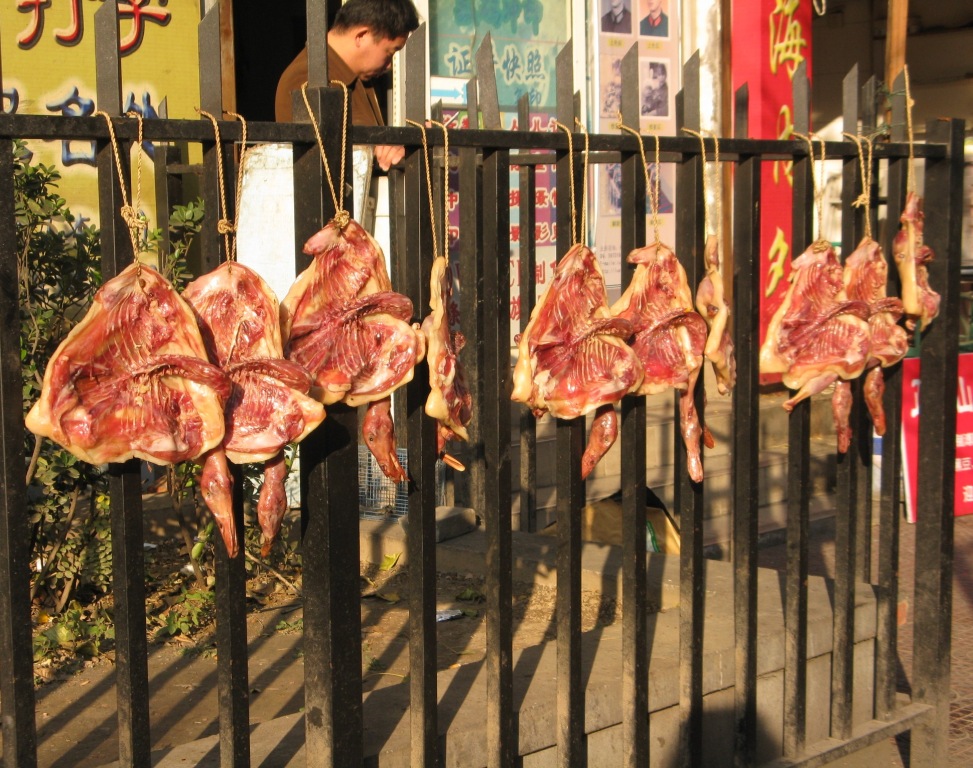
    These ducks were drying on one of the fences in the street and were part of a food stall.  In the morning I had been so intent on photographing the large containers of dumplings beside them that I hadn’t even noticed the ducks.  Fortunately I saw them in the afternoon.

    Looking up at the entrance way to the suburban street off which the hostels laneway runs.

    I arose early on Saturday to catch a 9.30am boat via old canals to the Summer Palace.  An unfortunate problem with direction finding had me wasting 15 minutes walking down the right street in the wrong direction.  After being rejected by a taxi driver for the quick fix trip I continued on in the hope that there would be another departure which wasn’t listed in my information. 

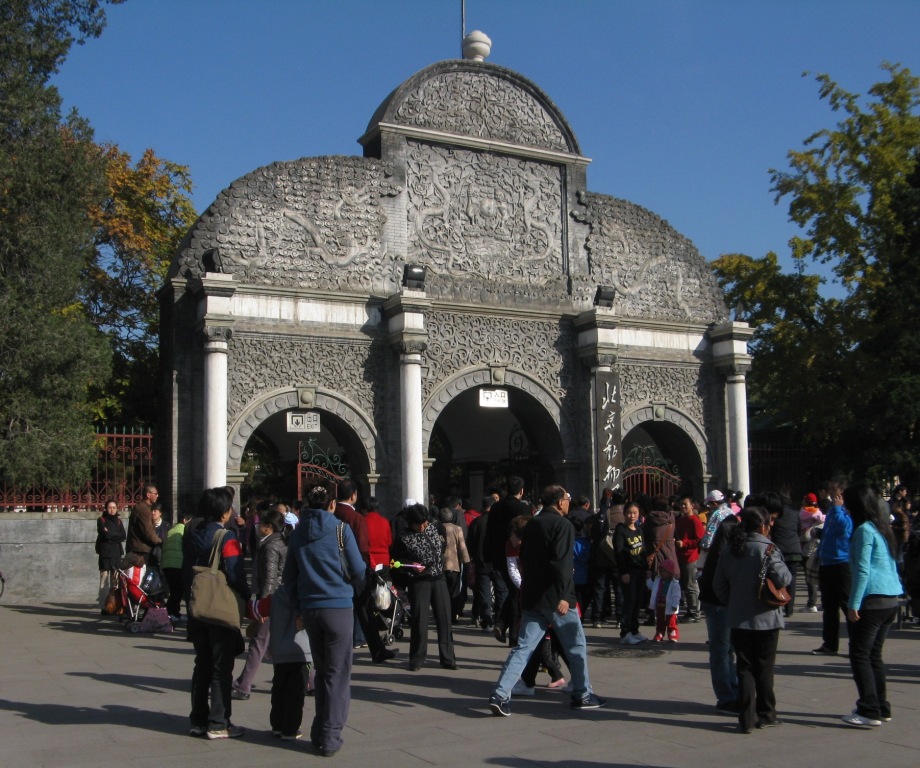
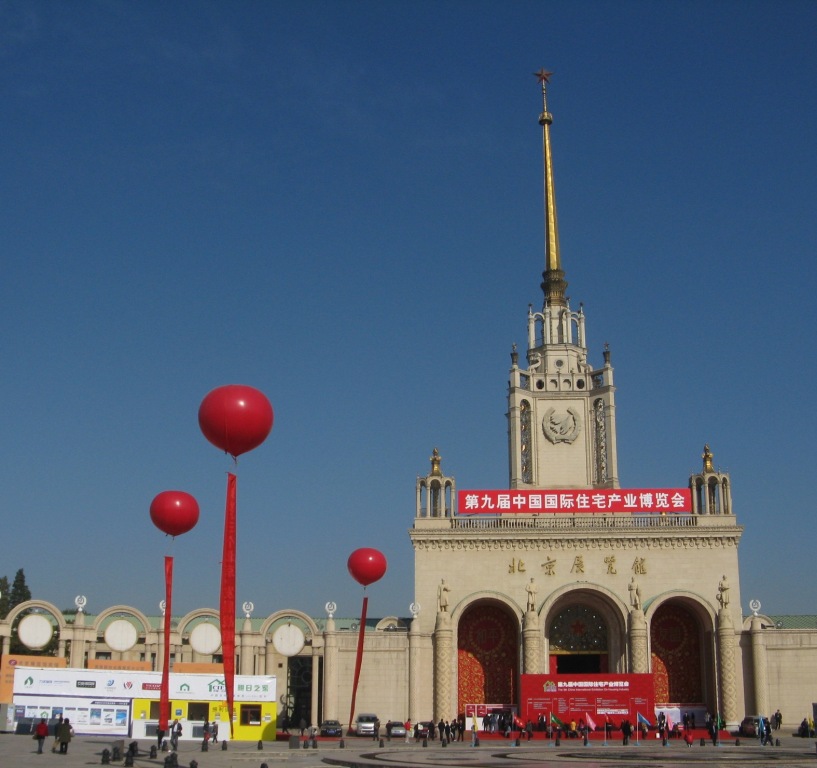
    After traversing 2 different subway lines, another bout of directional challenge outside the Beijing Zoo subway, passing the zoo and the Exhibition Building and a long walk down a street I found myself at the wharf in the company of many people.  Fortunately my timing was impeccable for ticketing, some photography and getting a spot in the queue guaranteeing me a seat on the boat.  Quite a few people had to wait for the next boat.

    Entrance to Beijing Zoo.  The ticket counters to the right were thronged.  Never been there.

    Beijing Exhibition Centre.  Some sort of home show was occurring.

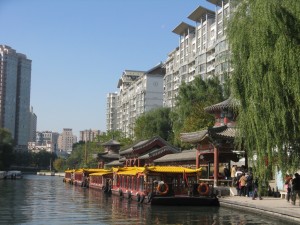
    The wharf and canal boat.

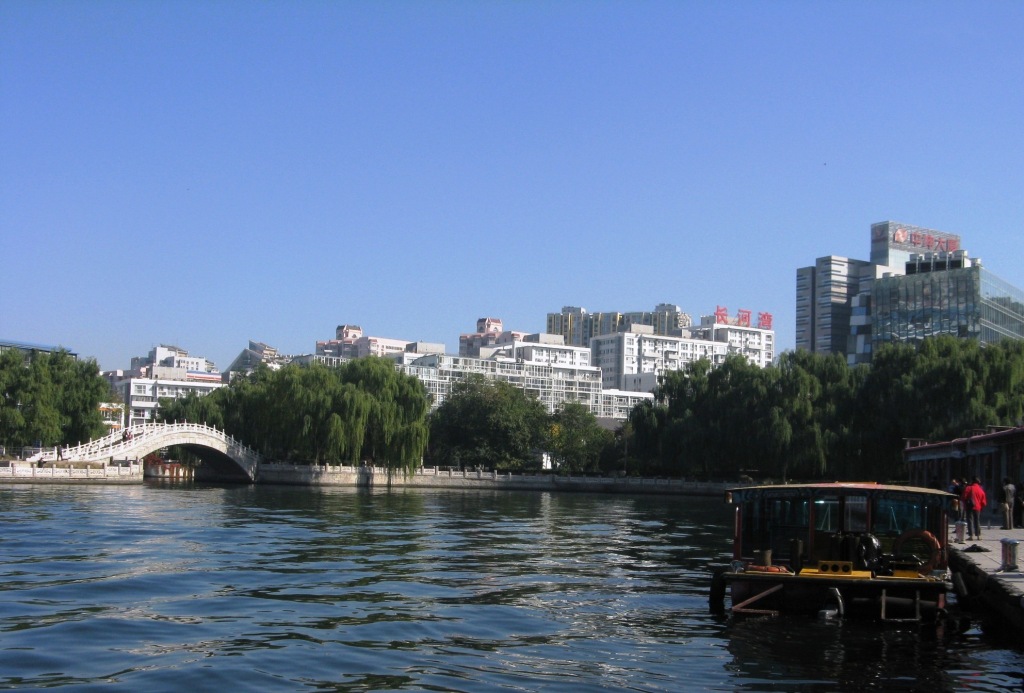
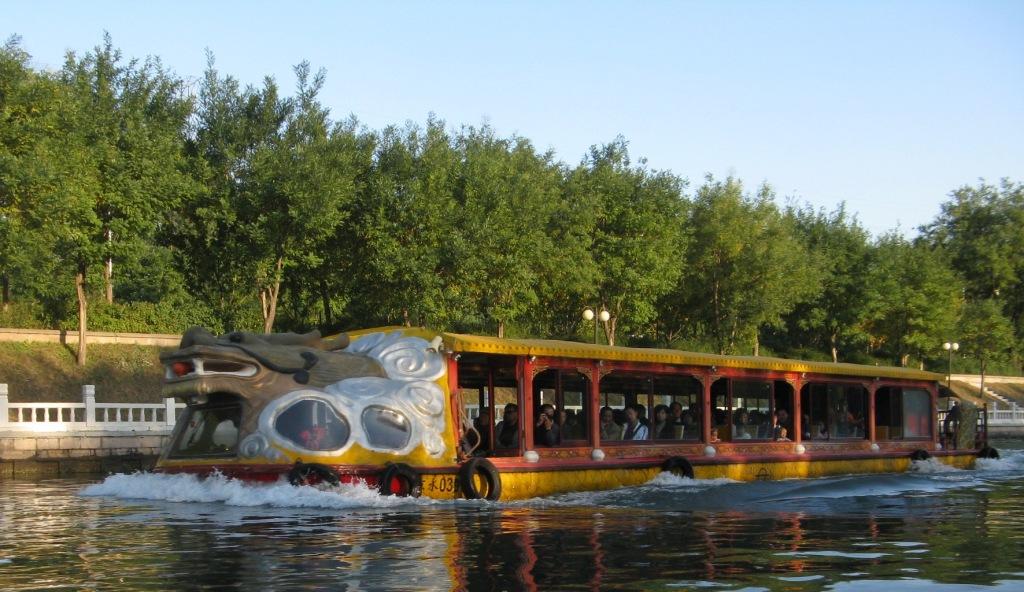
    The boat sailed along canals which in times gone by had been important transport links within Beijing and as far south as past Shanghai. They become disused but in recent years  were resurrected for tourist traffic.  The canal was low so it was hard to see too much from the boat.  It reached a park where we transshipped to another boat which travelled through much a wider canal until we reached the Summer Palace in northern Beijing.   The entire trip took a bit less than an hour. 

     The area where we found a replacement boat.

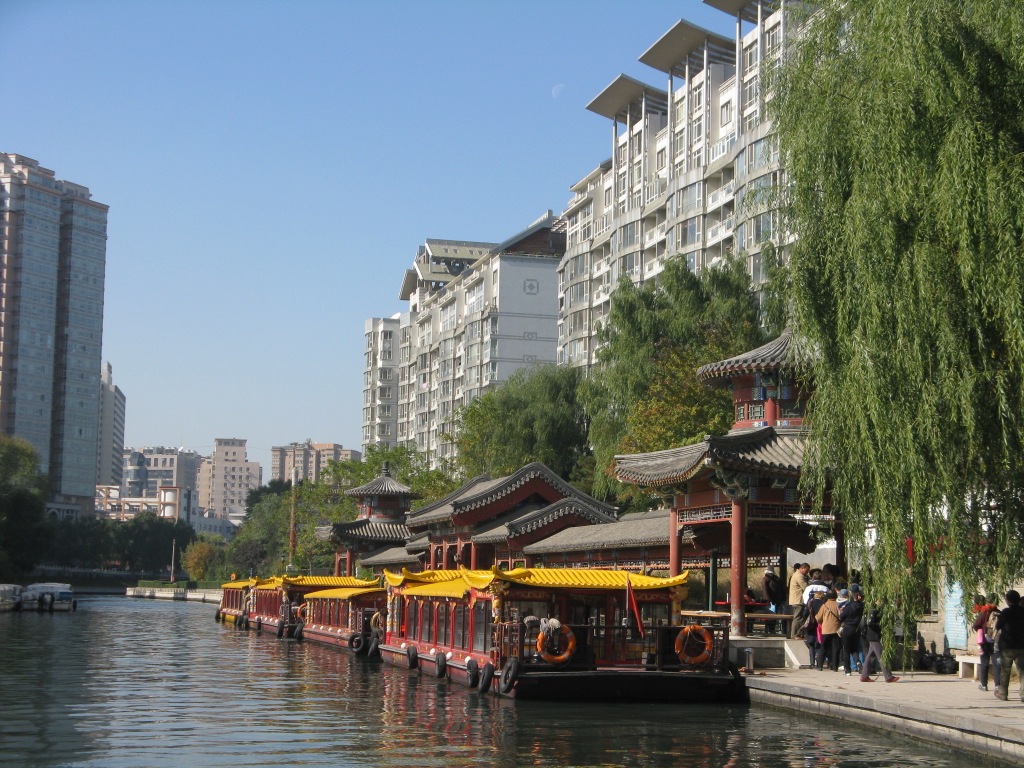
    One of the canal boats

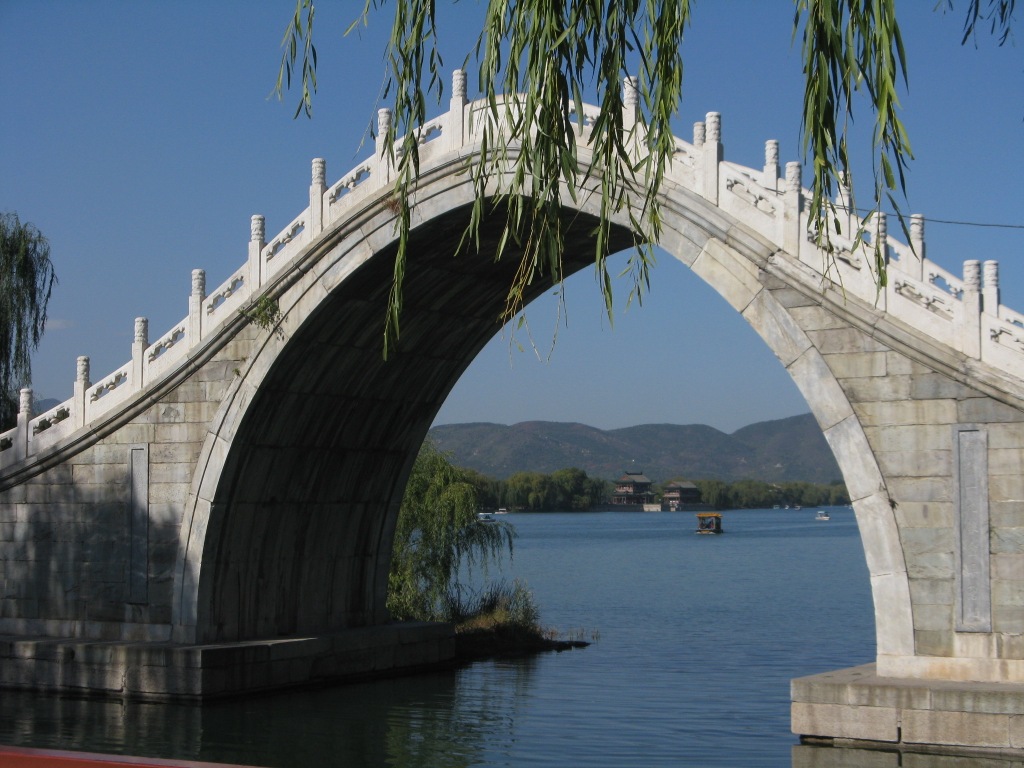
    The destination, Kunming Lake within the grounds of the Summer Palace.

    The return trip was a little more adventurous.  We had to wait at the transshipment point for about 20 minutes before the boat appeared.  The back of it then banged into the bank quite hard and at an angle.  The end of the muffler was quite bent.  It was impossible to know if it happened then or was an old issue.  After we set off it was obvious that the trip was not to be usual.  Eventually the driver got out his gloves and screwdriver and worked on the engine while 2 staff pulled the boat along the canal with ropes.  The tinkering wasn’t producing effects.  One Chinese couple was rather perturbed and after consultation with staff disappeared.  This led to a large scale exodus and a young foreign couple and I followed the others in search of a subway.  We were lucky and had disembarked practically on the doorstep of the subway next to the one I needed to use.   It was actually much easier for me as it involved much less walking so I was lucky.

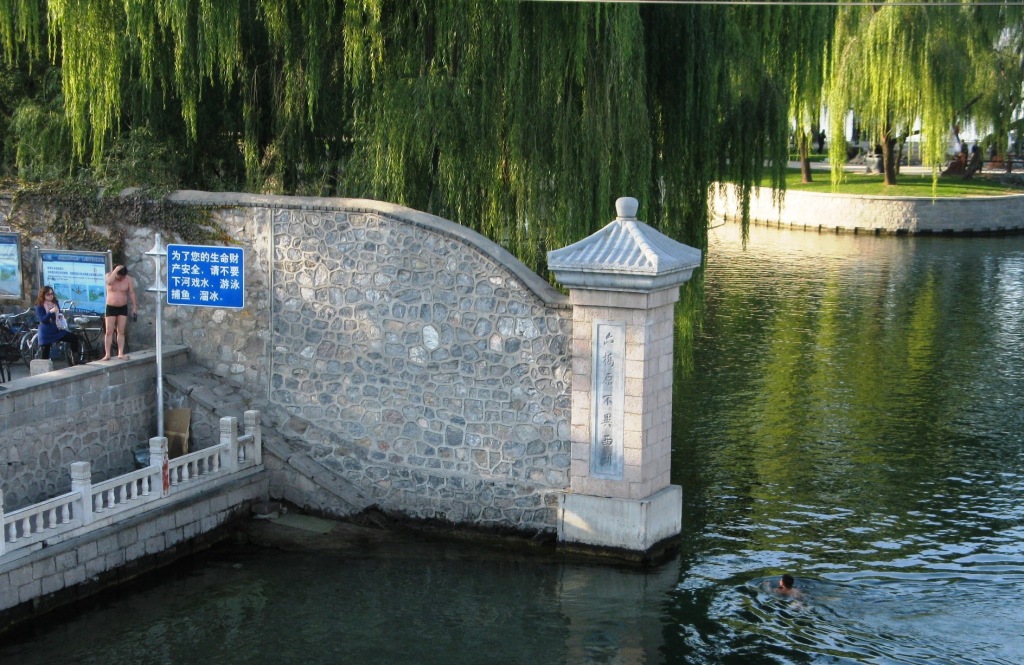
     An intrepid swimmer in the canal  and another on the bank seen while waiting for the boat at the Summer Palace.

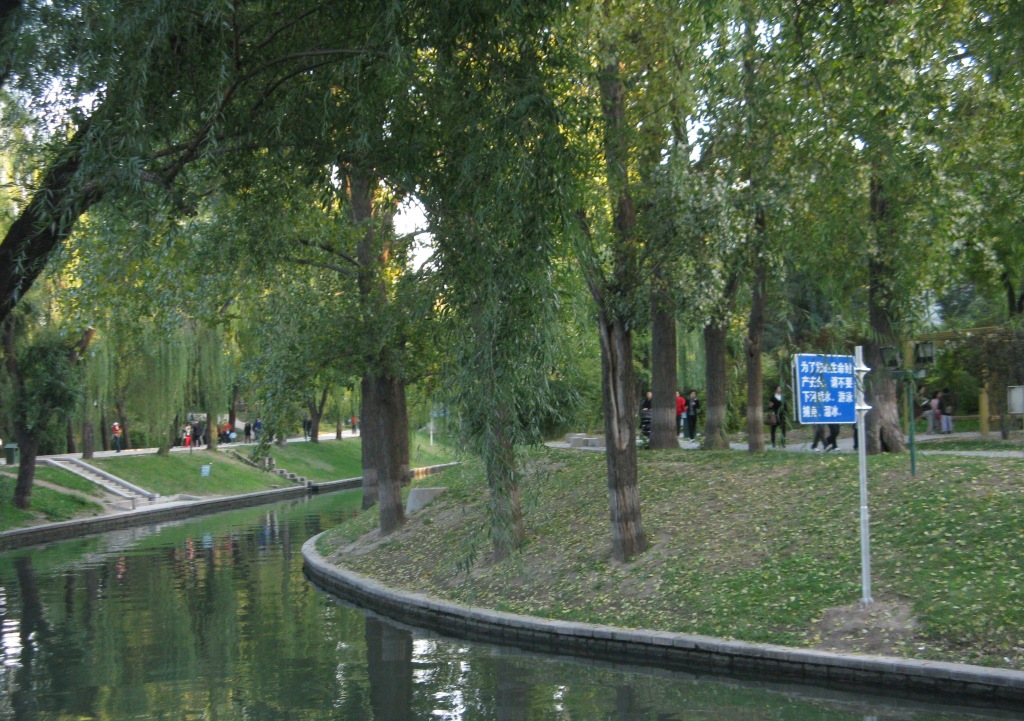
    The narrower canal in the park where we cooled our heels.

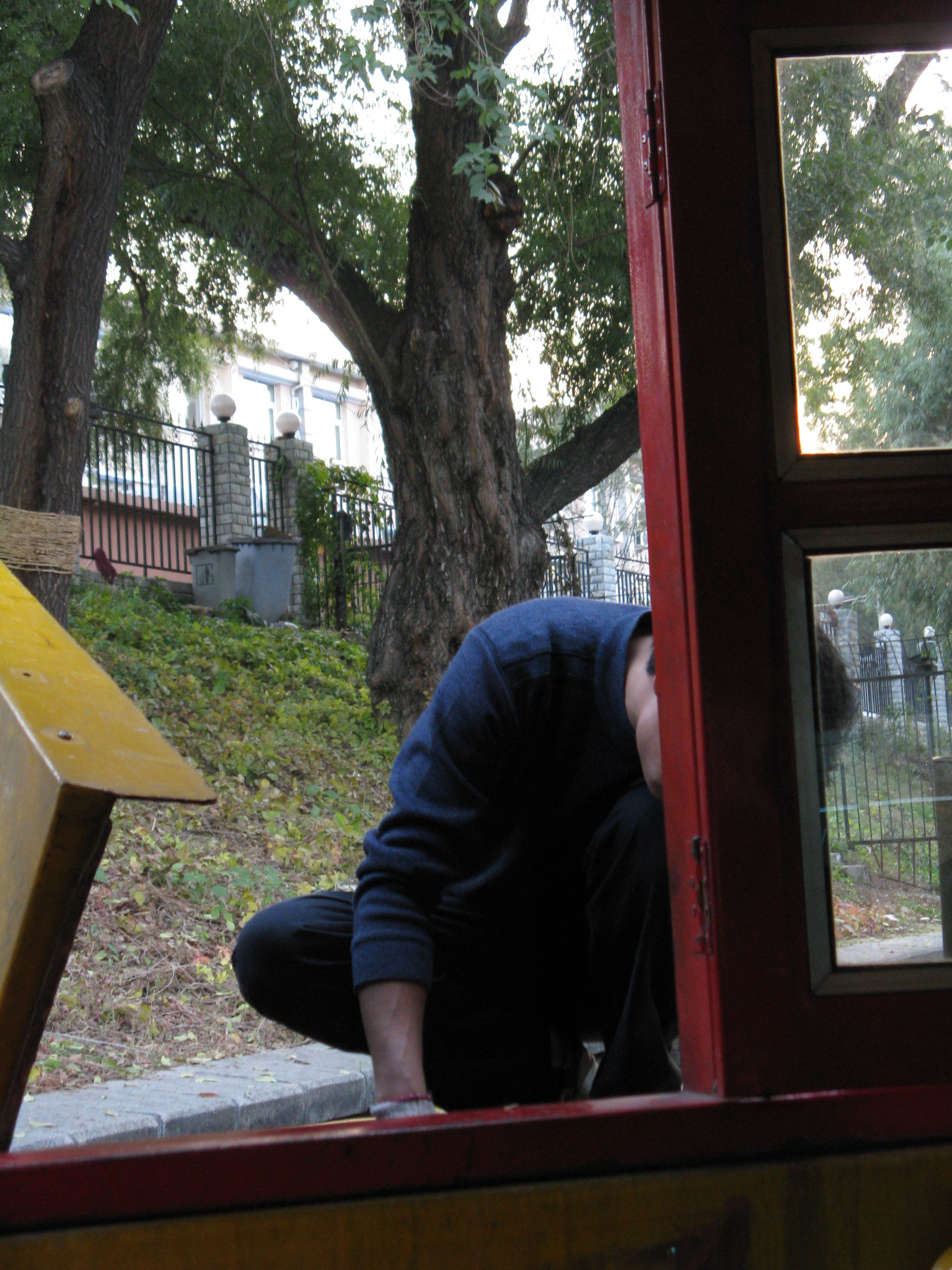
    Tinkering

    The following day I headed off into the unknown in terms of not knowing exactly where to find a particular bus after leaving a subway having 4 exits.  One helpful woman spontaneously asked to help before I had reached the helpless looking stage, the presence of a map in my hand was enough for her.  She immediately told me that the required bus was on the opposite side of the road.  A trip underground and up again, a good search of the bus listings still had me missing my required bus.  At that stage I decided a taxi was the answer.   One driver rejected me but the next, a woman, after initially being puzzled accepted the challenge.  After stopping several times while she tried to repair her meter receipt machine we finally headed off in search of Art Space 798 and were successful.

    I chose a taxi for the return trip to the subway station after my visit to 798 rather than messing around looking for the right bus.   I thought an A4 colourful diagram of the subway system and pointing to and saying the name of the subway station would identify my destination.  We headed off in agreement.   However, after that some unclear discussion occurred which I think must have confused the driver.  I saw the subway sign pass me I had to quickly discover and use the Chinese word for subway.  Fortunately it did the trick and an about turn soon had me back underground again. 

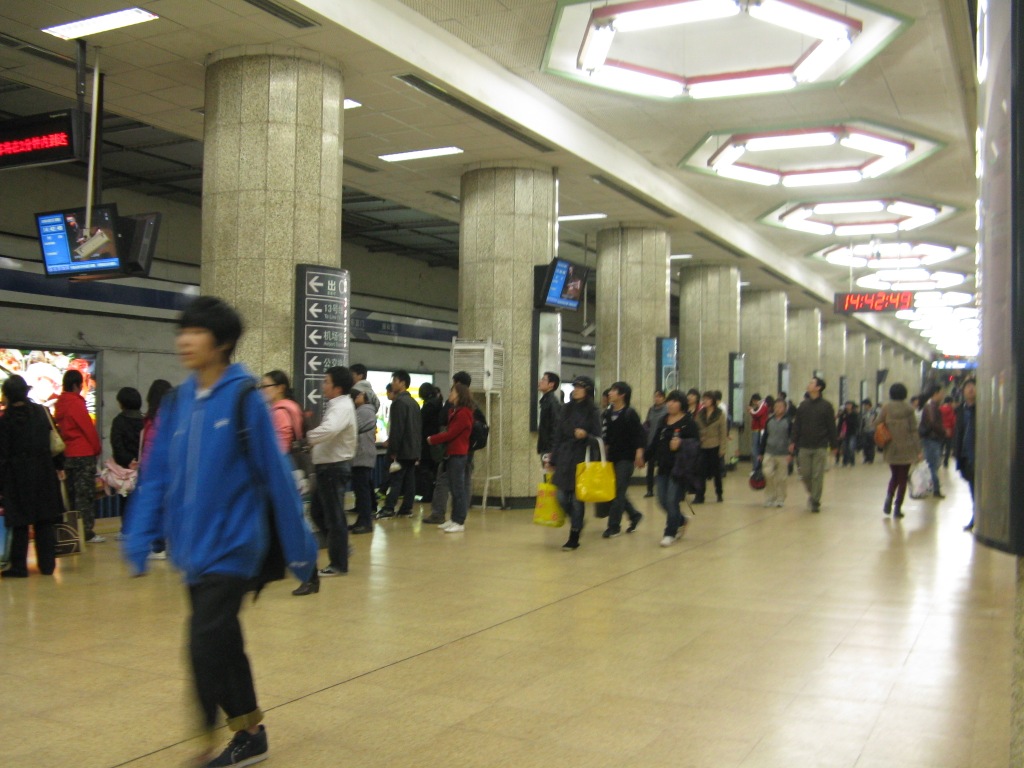
    The subways I’ve been in have been clean and organized.  It is normal procedure to have all bags scanned before entering subway and railway stations.  Subway tickets can be purchased from a ticket counter or from a machine which has an English language option.   That’s what I use.  Getting on and off trains is not so organized, usually with those getting off mixed up with those getting on.  Some stations do have a system of arrows indicating direction of movement and that works but people don’t implement it where there are no arrows.  The late afternoon train was full and definitely a sardine can situation. 


    One of the subway stations.  Train tracks to the right and left.

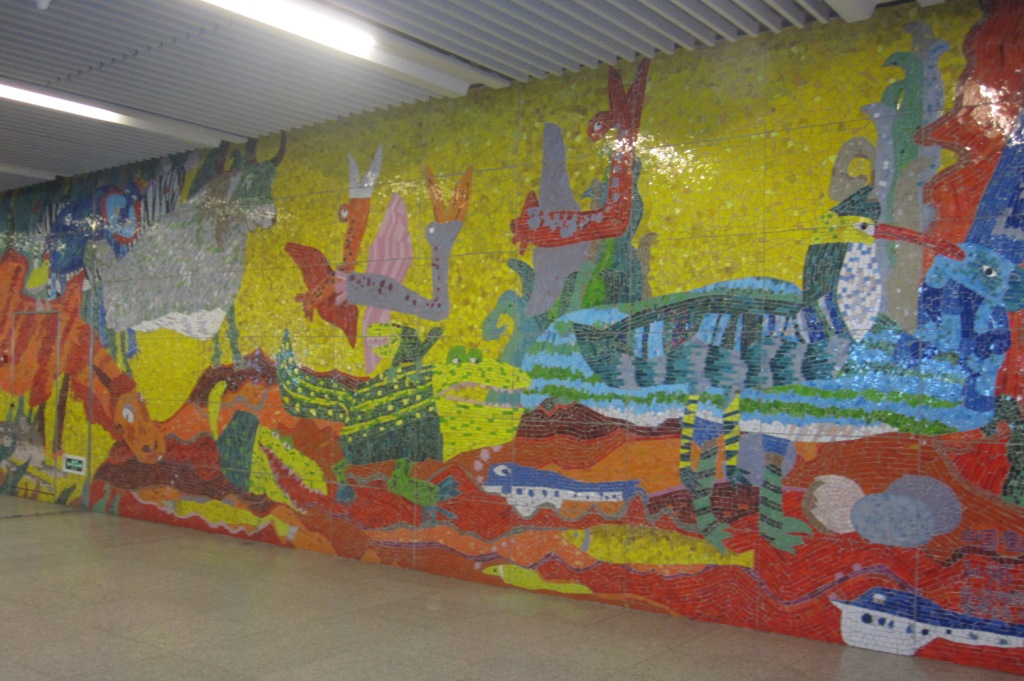
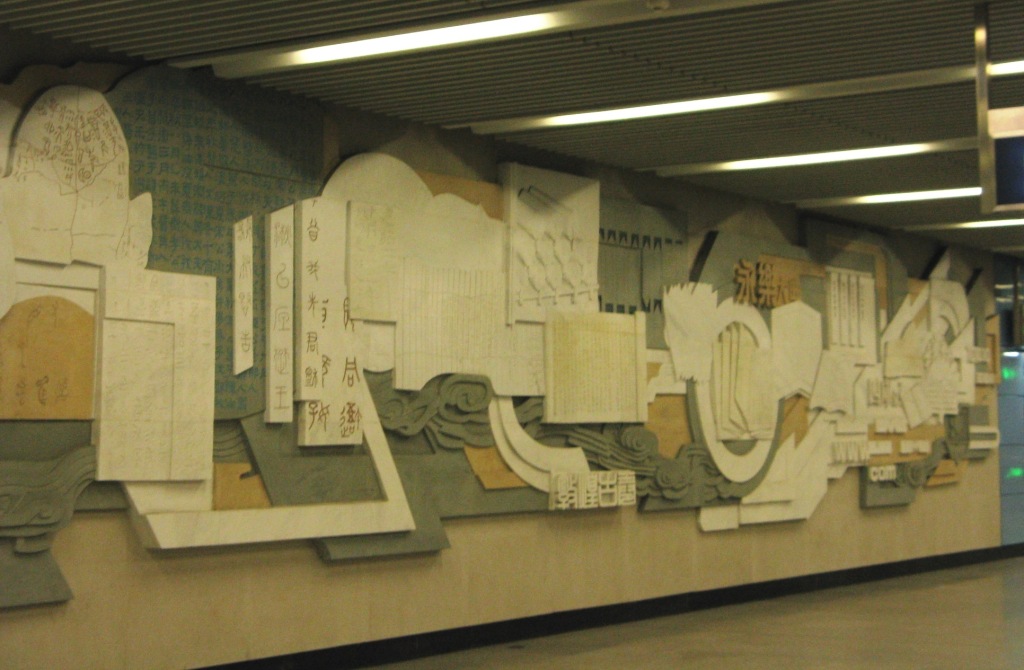
    Part of murals at Beijing Zoo subway station.

    Mural at the National Library station where I disembarked from the canal boat.  It and the zoo station are part of a subway line which opened last year. 

    When it was time to depart for my train station  I was rejected by a taxi driver again.  He didn’t even stop to discover where I wanted to go, but shook his head from across the road.  The fact that I was foreign with luggage was enough for him.  The next one did stop and agreed to take me.  He seemed a bit tired.  I was rejected by several drivers the previous Sunday and I finally secured my seat by placing myself and luggage in the front seat before the next one could reject me.  He seemed so tired and miserable that it was probably too much effort to get me out even if he had wanted.   I discovered why Sunday’s first taxi driver was reluctant.  Once we got onto the main road the traffic was extremely slow and I was beginning to wonder if I would arrive on time.  However, once we reached a different road the traffic thinned and we then travelled well.

    The station was busy as usual and I sat on my bag while I waited for boarding.  The same train on the previous Sunday had had numerous empty soft seats.  The hostel had been unable to get me a soft seat and my efforts to upgrade at boarding were unsuccessful.  All seats in the carriage were occupied but fortunately there were no standing passengers which made travel much easier for everyone.  I made friends with the passenger beside me who was trying hard to remember English from uni many years ago.  She ensured I got a taxi when we arrived at our destination.

    Beijing, China

    architecture, Beijing, bus, China, culture, Food, lake, markets, park, transportation

  • Stone Village

    Oct 28th 2010

    By: Kerry

    No comments

    Stone Village

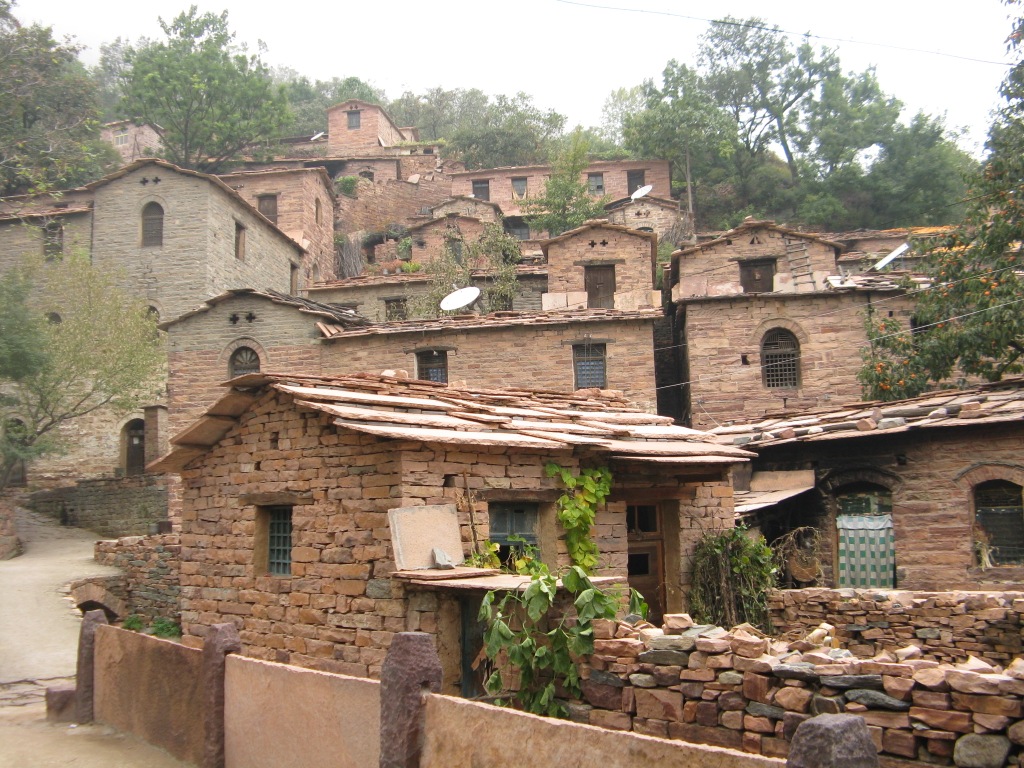
    Recently one of the students took me to visit a village constructed from stone. One of my students had been, enthused about it, showed me photos and so I wanted to go. Stone villages are uncommon in my experience and while I had been to Lijang it was a different kind of stone . We set off early on the first cold day of the season and while we were not uncomfortably cold another couple of layers would have been beneficial.  I seem to specialize in sightseeing on grey days so there is no sun or light in my photos.

     The trip involved a taxi to a bus terminus serving rural areas, bus to a small town and then the village taxi which was a small van containing a double seat leaning against a side and tiny wooden stools around the remaining perimeter of the van.

    There is no map as I don’t know where we went and I can’t find it on the internet. We headed west, turned off the main road and headed south west, I think. We were supposed to have a 2 hour bus ride but the jack-hammering of a bridge and the need to wait for diversion added about 20 minutes. We had to wait at the town for about 20 minutes for the village taxi to collect us. A Chinese man from the bus was also intending to visit the village so we teamed up to travel and to wander around the village together.
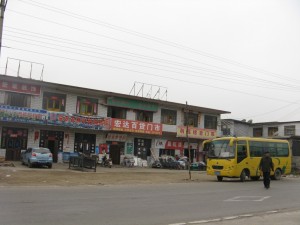
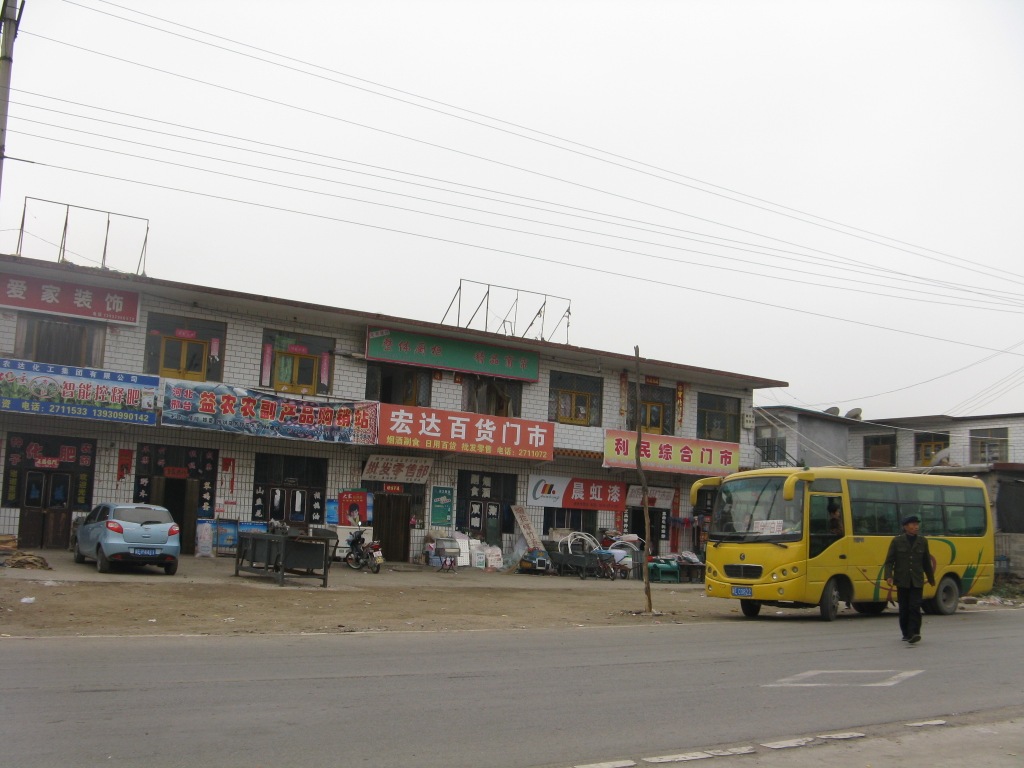
    That’s the town bus stop and the bus we returned on.   The metal contraption in front of the shops had something to do with removing chestnuts from their burrs, outer casings.  There were open fields to the left of the photo where numerous bags of corn cobs were piled.
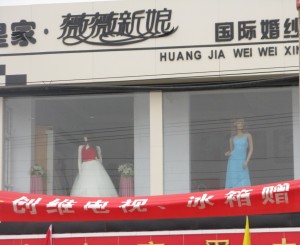
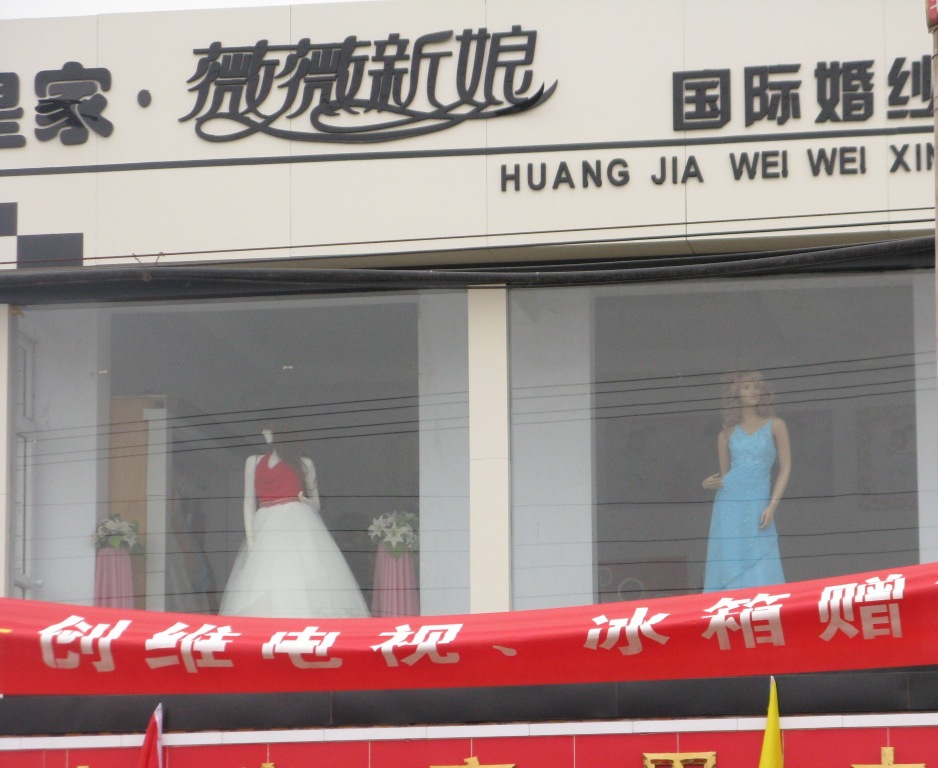
    This is the second small village/town displaying such clothing.  Maybe they have money and a social life not evident to me.

    Once we reached the hills the village was not the only construction from stone, but it certainly stood out.  The village had reached the modern age with an entry fee for all visitors.  Different figures were bandied about and I suspect the presence of a pink face increased the days takings.  The village was said to be about 600 years old.
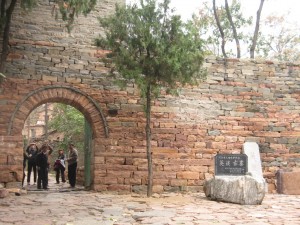
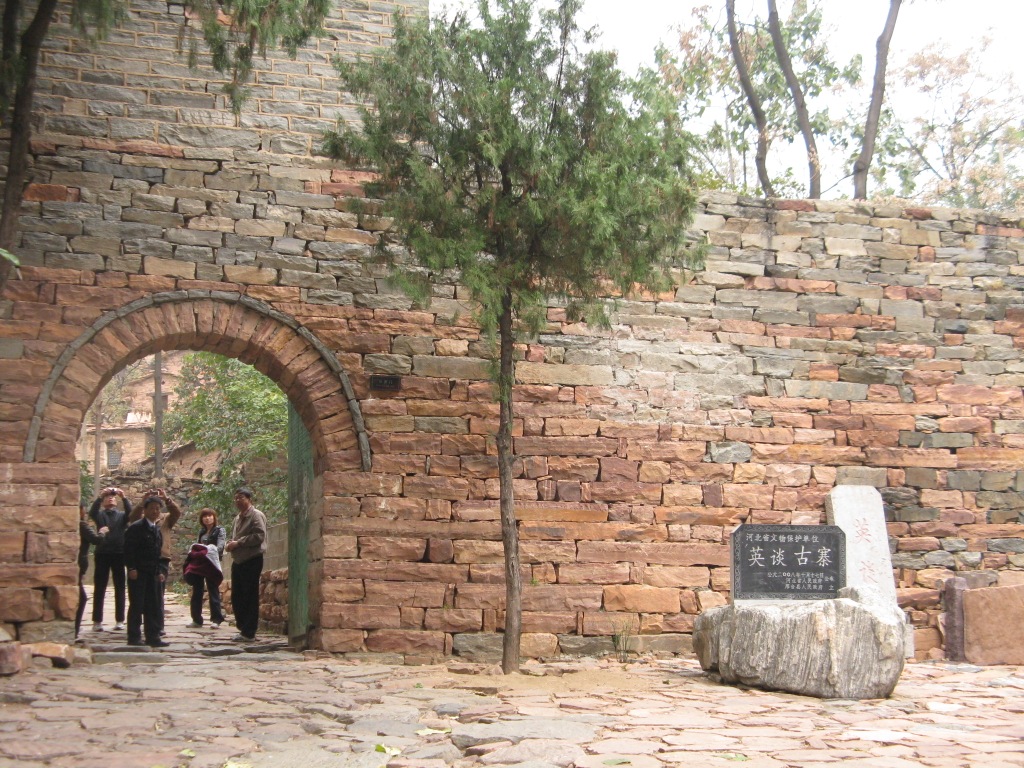
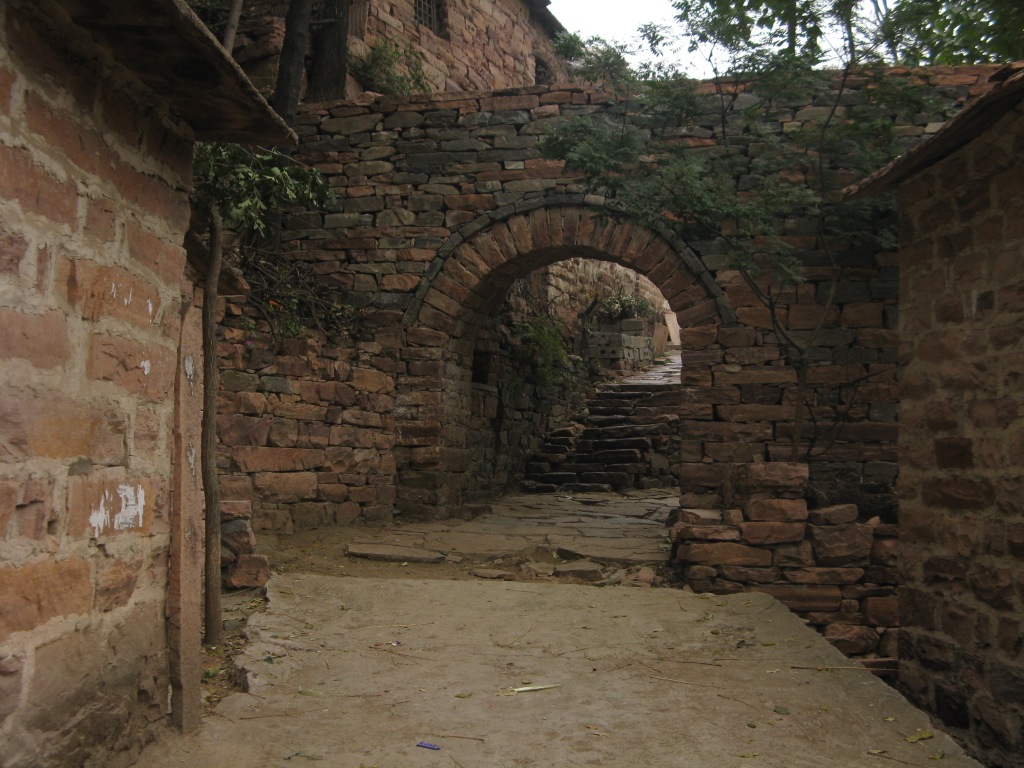
    One of the village gates.
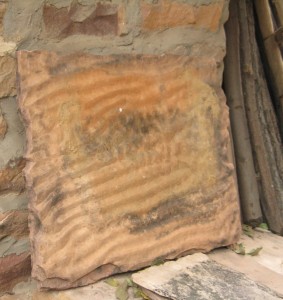
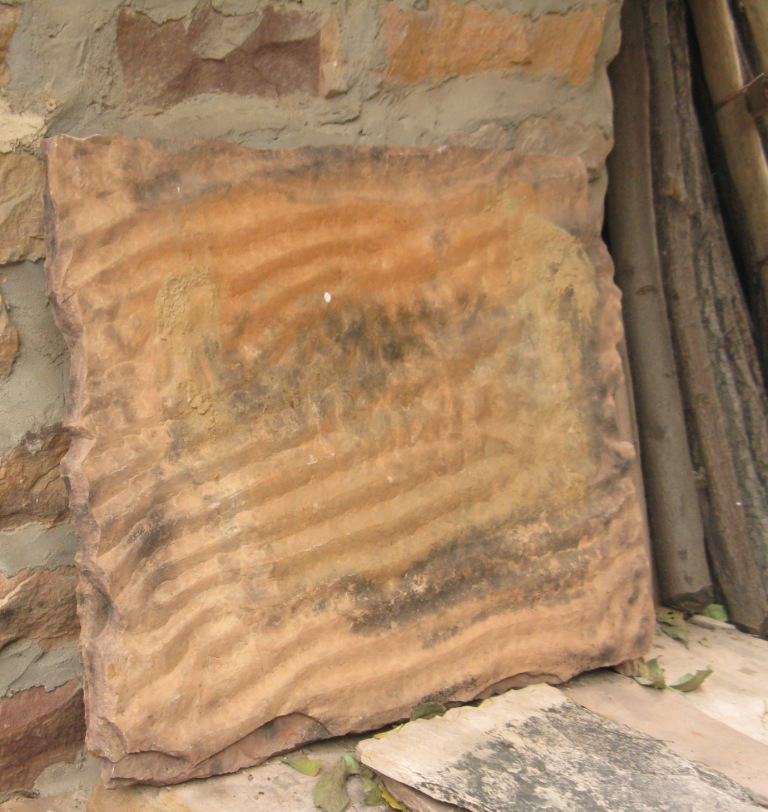
    One of the dominant features of the village was the type of stone.  Most of it appeared reddy/pinky/orangey coloured.  There were many slices of stone of various sizes just leaning against walls and so on such as this one.  Many had unusual patterns on them.  This looks like rippled sand frozen in time and there were others with similar characteristics.   Others were of an  inexplicable  colour and pattern and I was informed that they were not man made.   I can’t find anything useful on the internet about the geology of the area and don’t know anyone who would know.
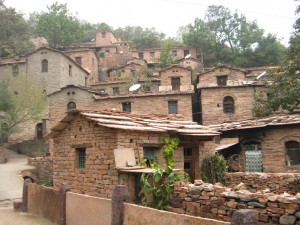
    Some of the village from near the base.
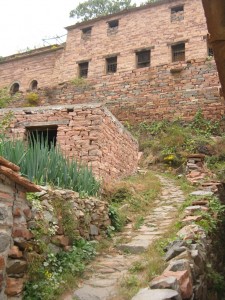
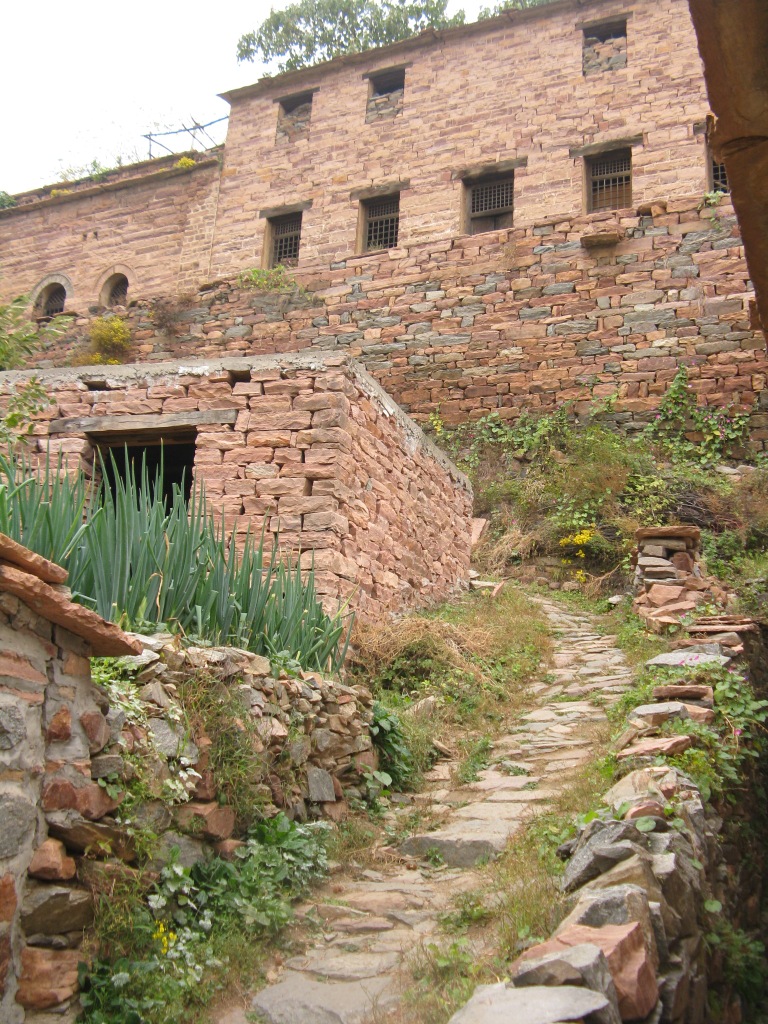
    Another looking uphill with a glimpse of a vegie field.
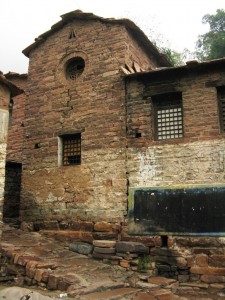
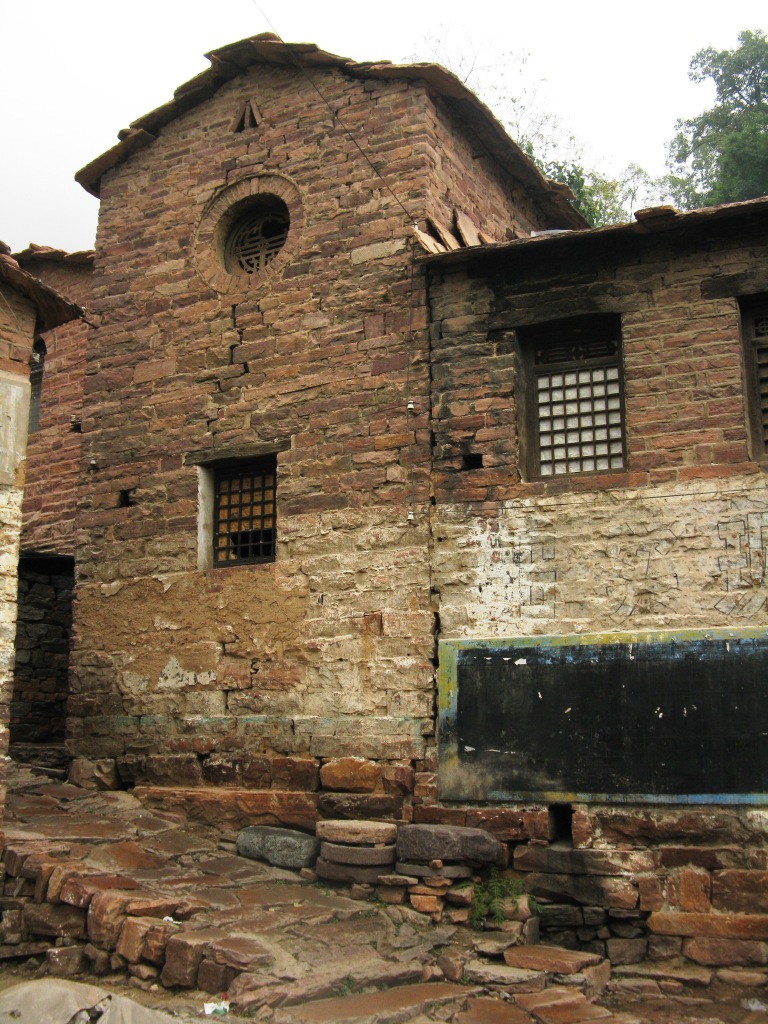
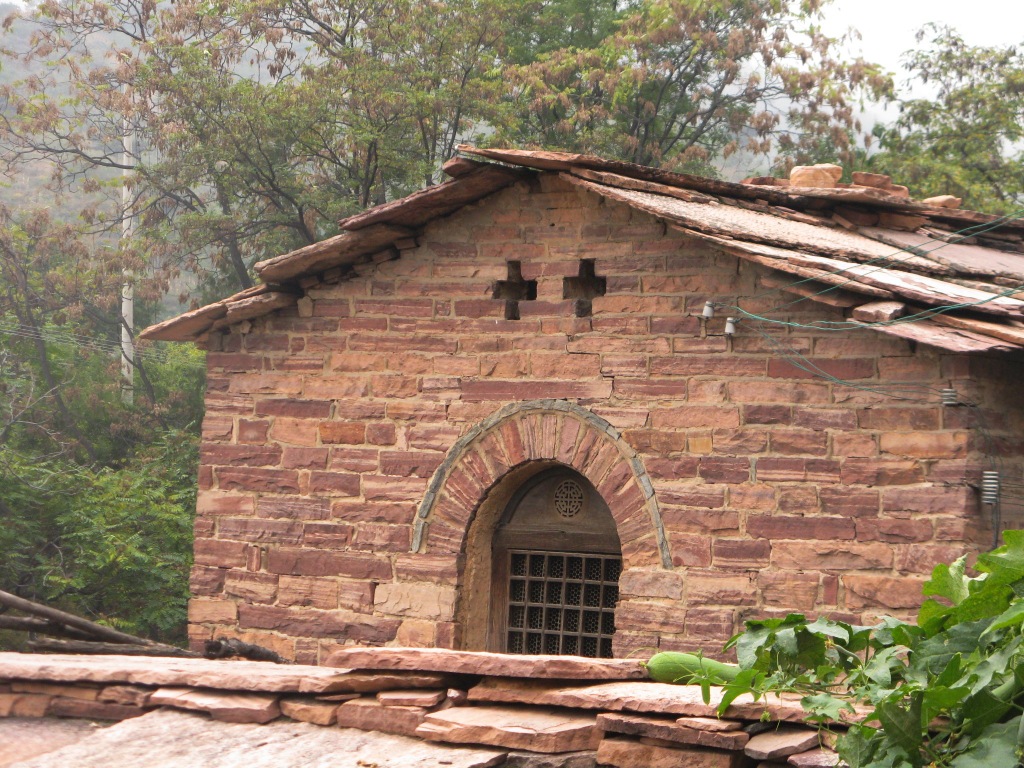
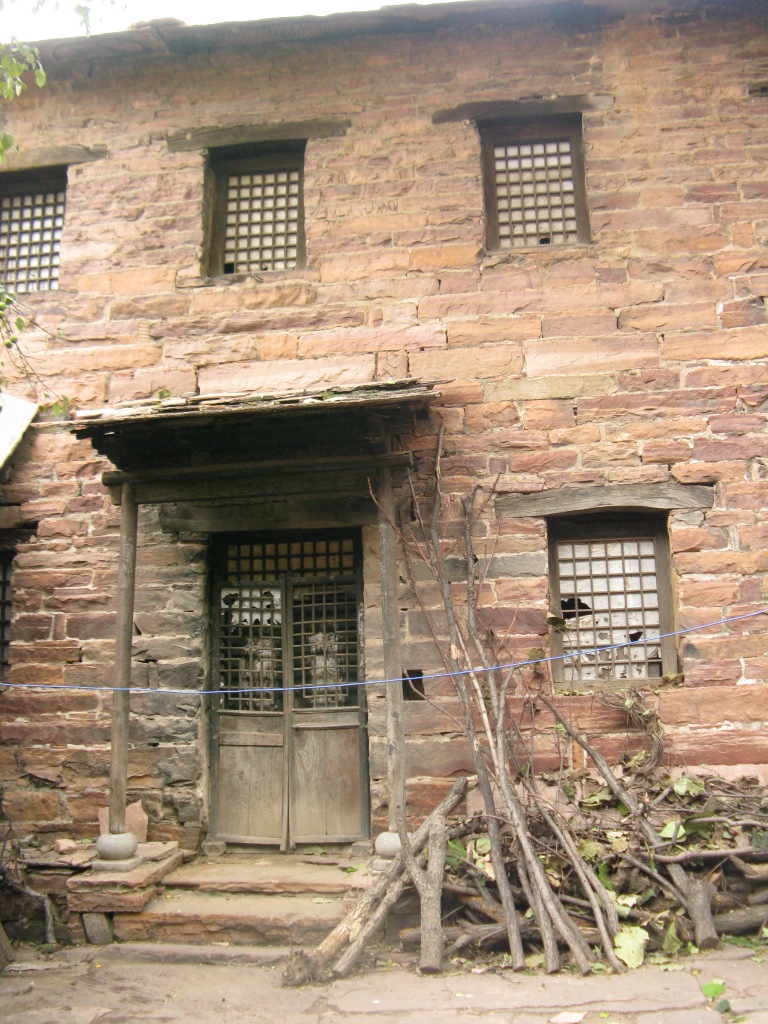
    From inside a courtyard.  The village is unusual for its number of round  windows and those with a curved top.  Houses consisted of 2 storey buildings arranged around a courtyard which was usually internal.  There were several different building styles.
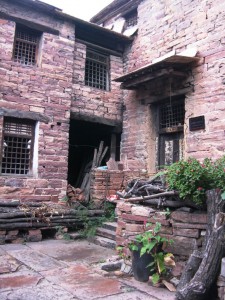
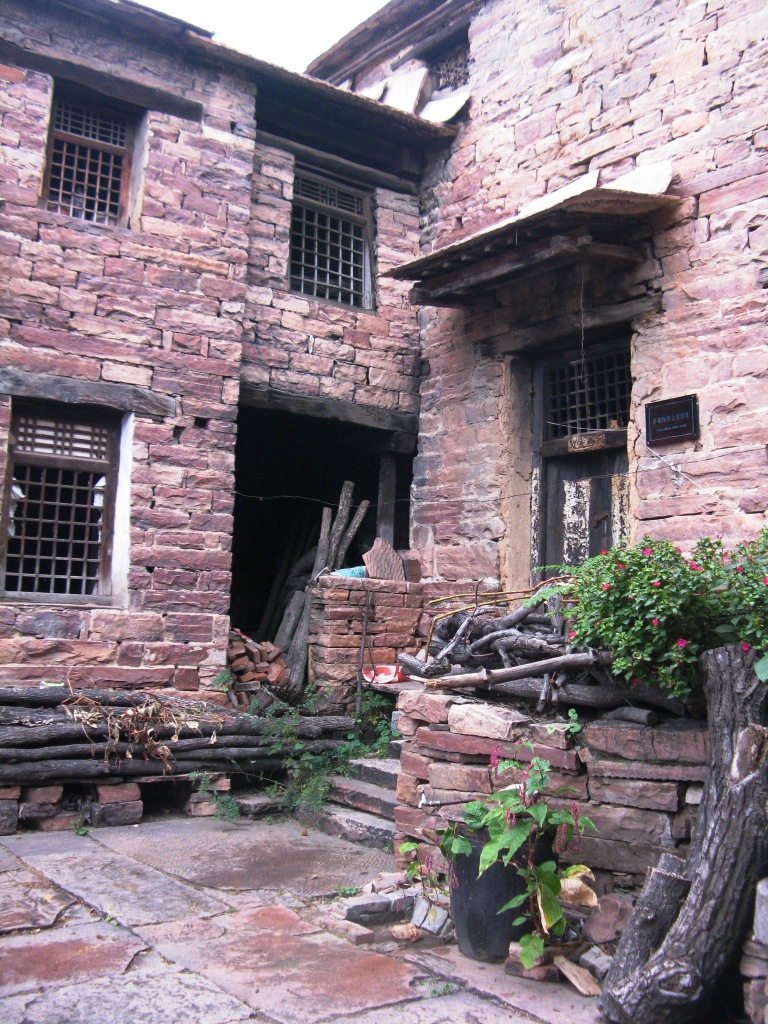
    Another courtyard.
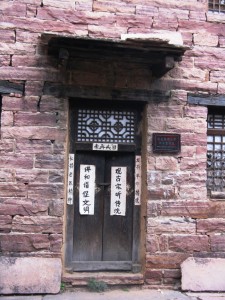
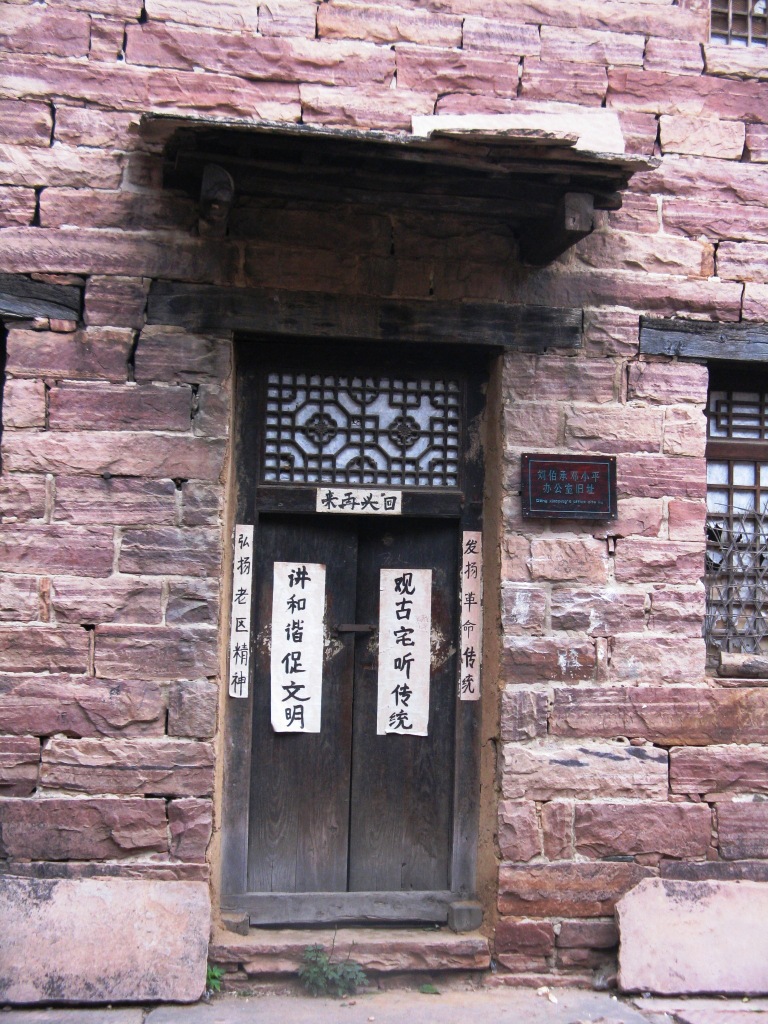
    The sign states that the room was Deng Xiaoping’s office.  There were many signs on walls signifying the presence of the communists.  I’m not sure if they visited when  they were fighting the Japanese or afterwards during the civil war with the Kuomintang.
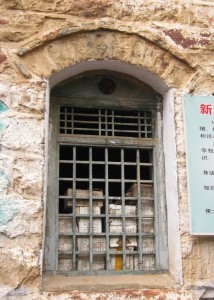
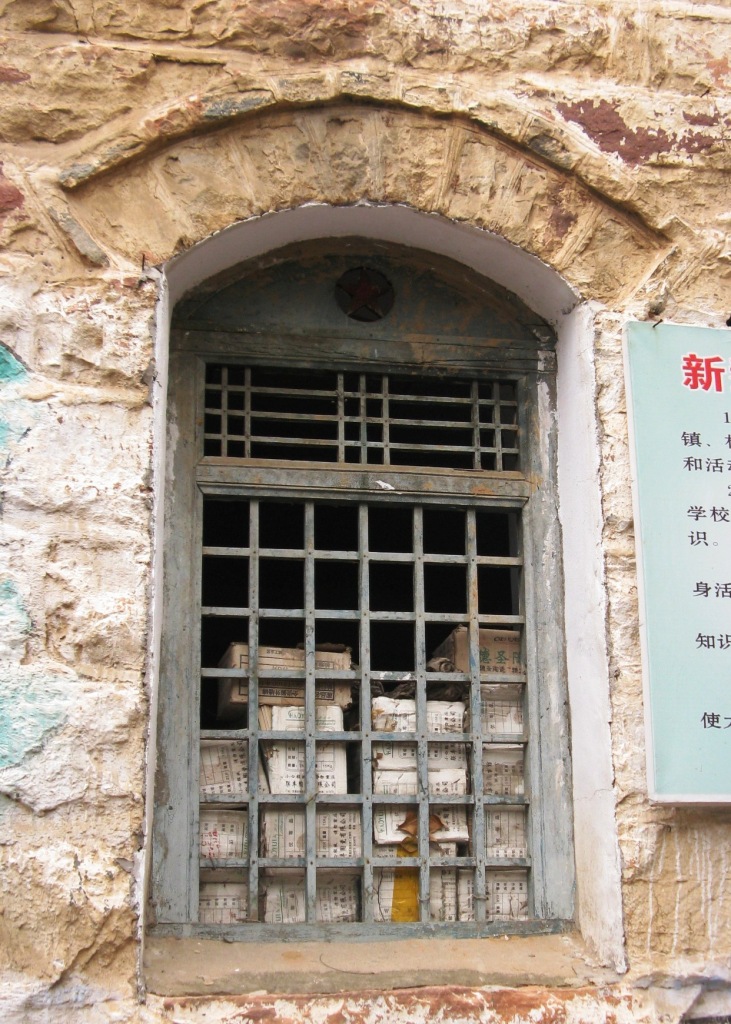
    The window has a red star under the arch.  There were a few windows like that.
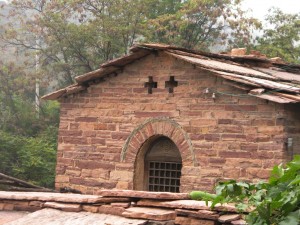
    Another window.  Some of the buildings had the decorative opening near the roof line. 
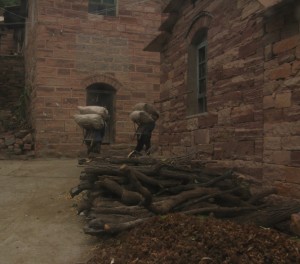
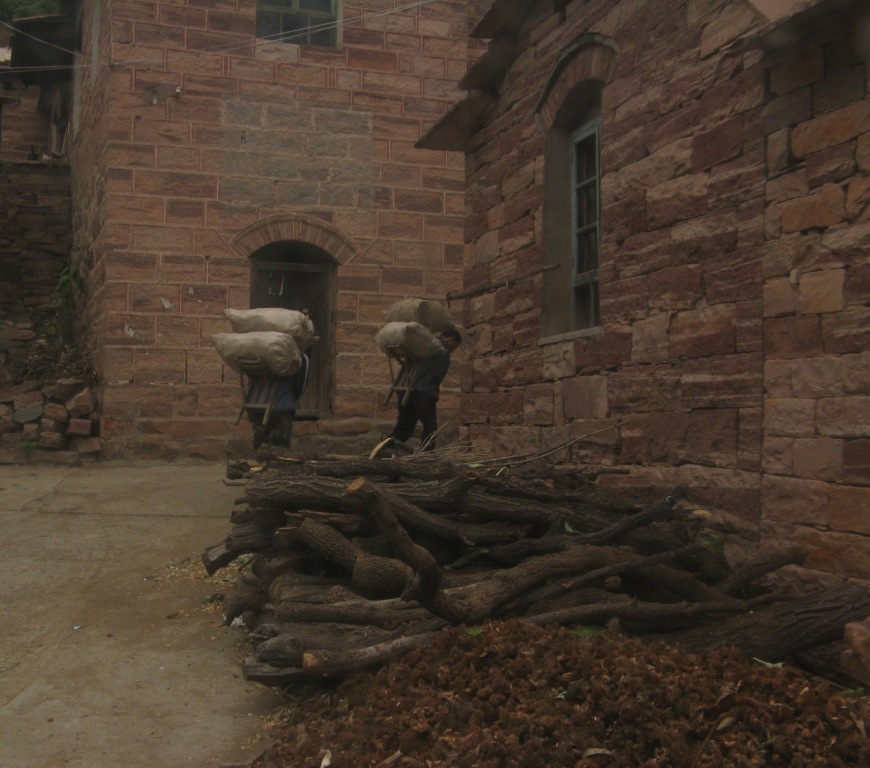
    The village version of a backpack.
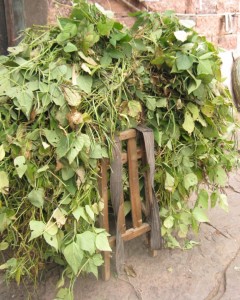
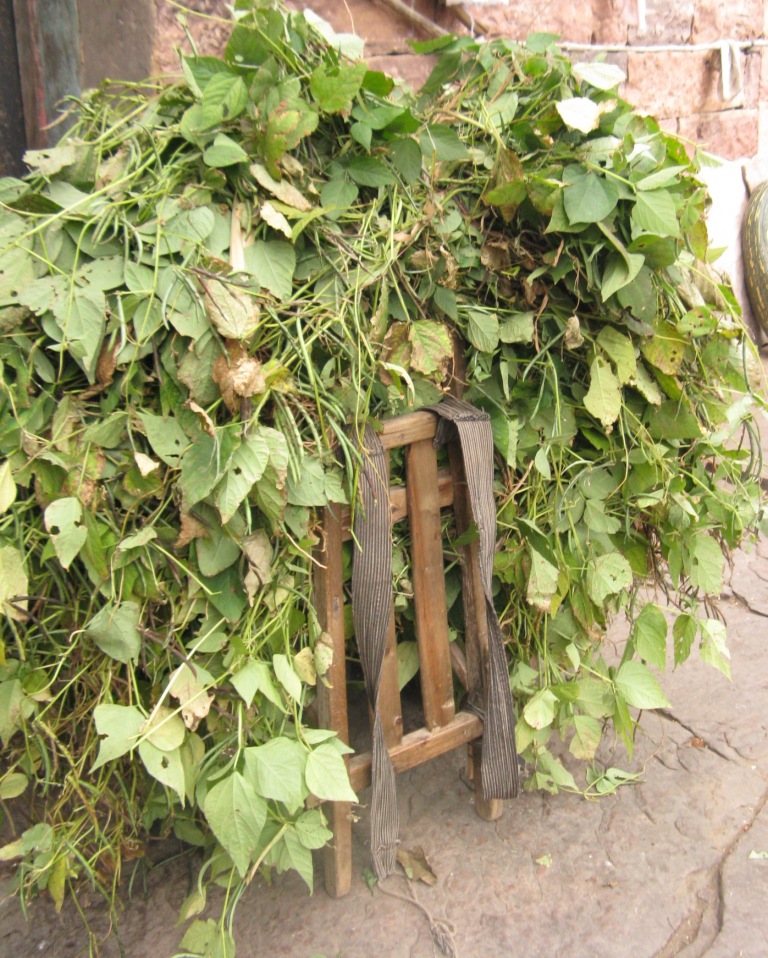
    Here’s one with what I think is soy bean as I saw a woman detaching soy bean pods from greenery with the same appearance.
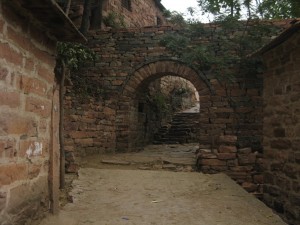
    A   wide village street.
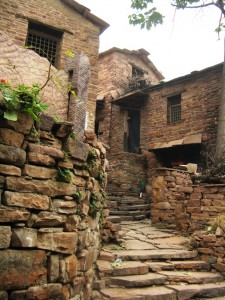
     Another one.  I don’t remember seeing any street lights.   Definitely not the kind of place where you want to be wandering about after dark unless your torch, eyesight and balance are impeccable.
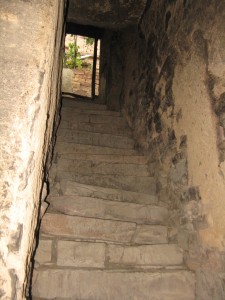
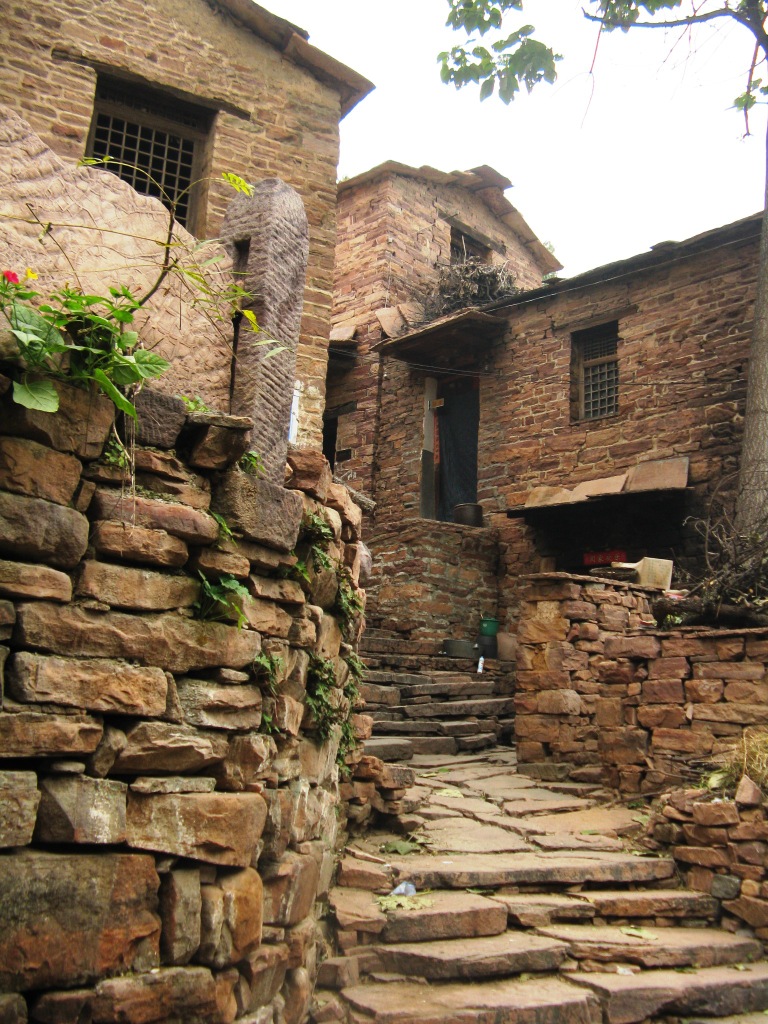
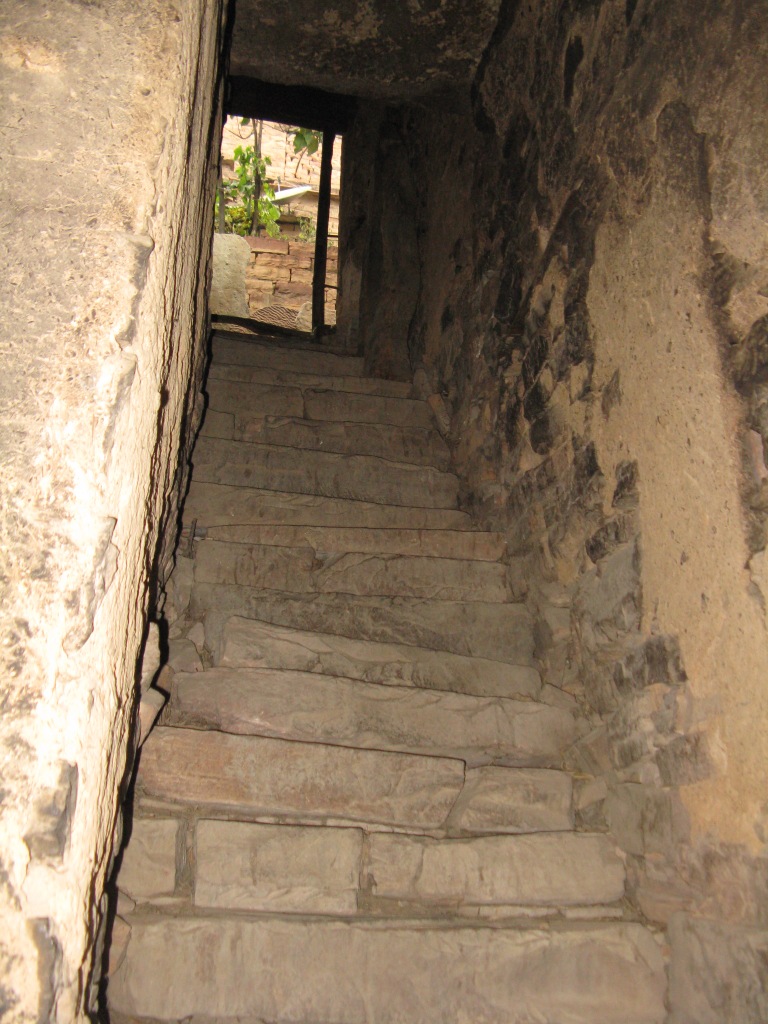
    Another traverse from one level to another.  We returned via a more meandering route.
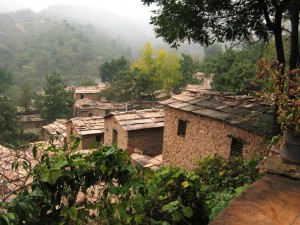
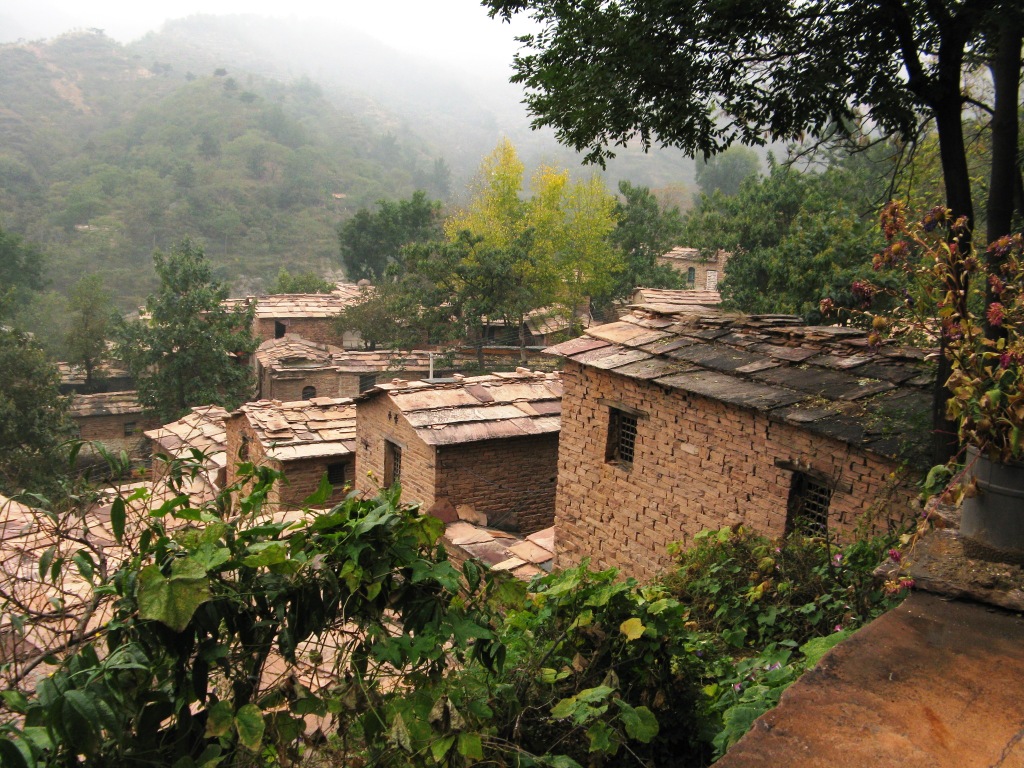
    View from the top.  The couple who owned the courtyard I took the photo from had a good spot.
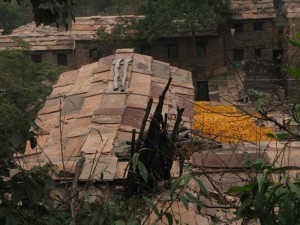
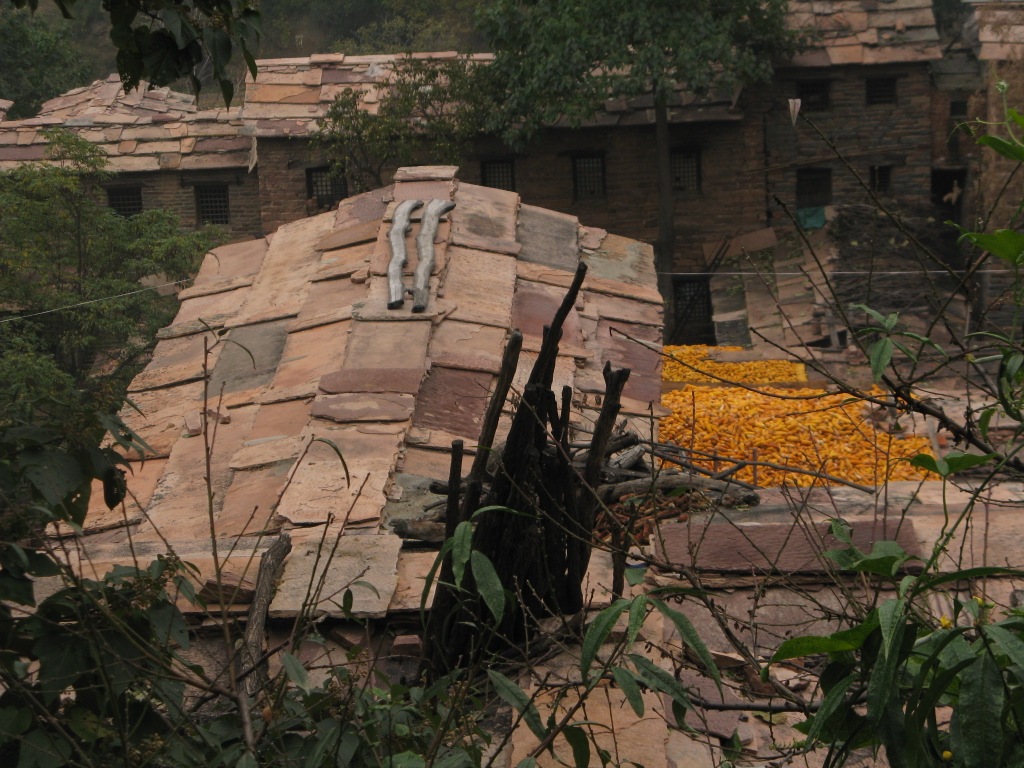
    Stone rooves and ubiquitous corn.
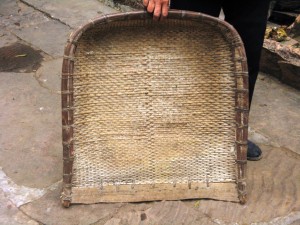
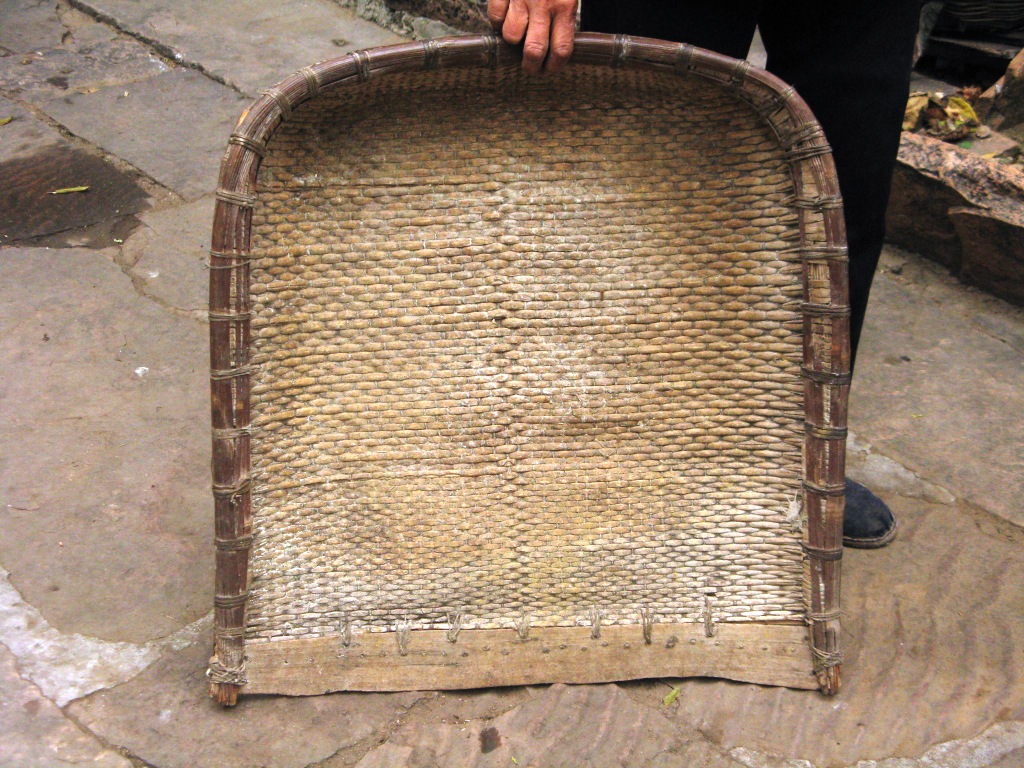
    A good looking hand shovel thingy no doubt useful with corn.  Some of the ones  available in hardware shops and stalls  are now  made from metal.
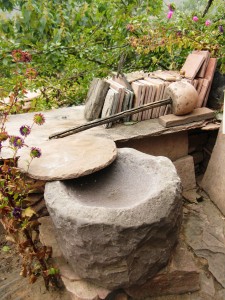
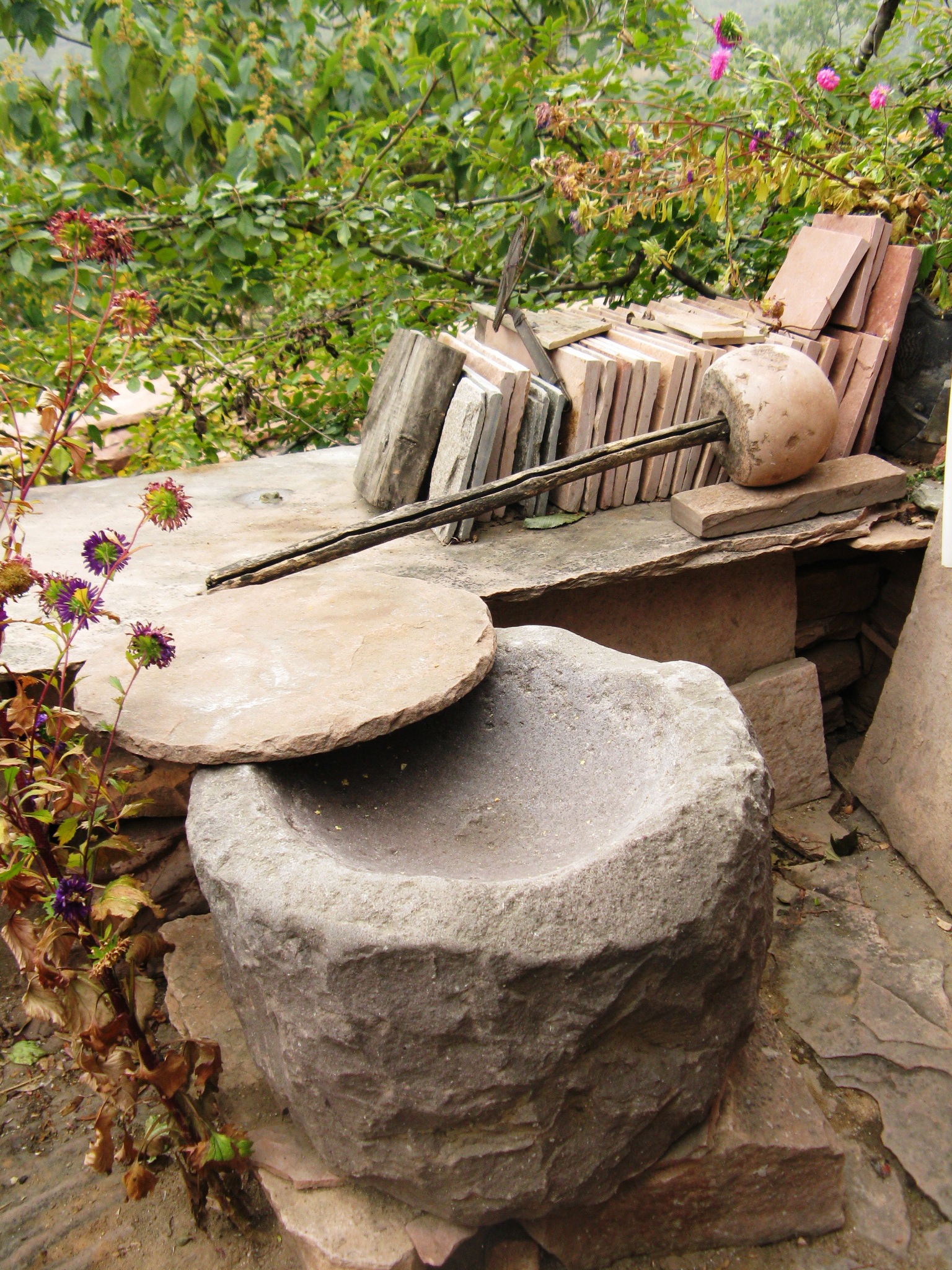
    A form of mortar and pestle.  Used for pulverising soy beans and there was a faint trace of soy in it.
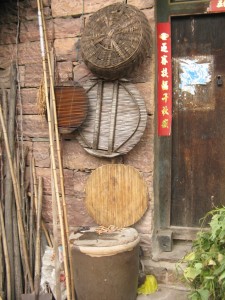
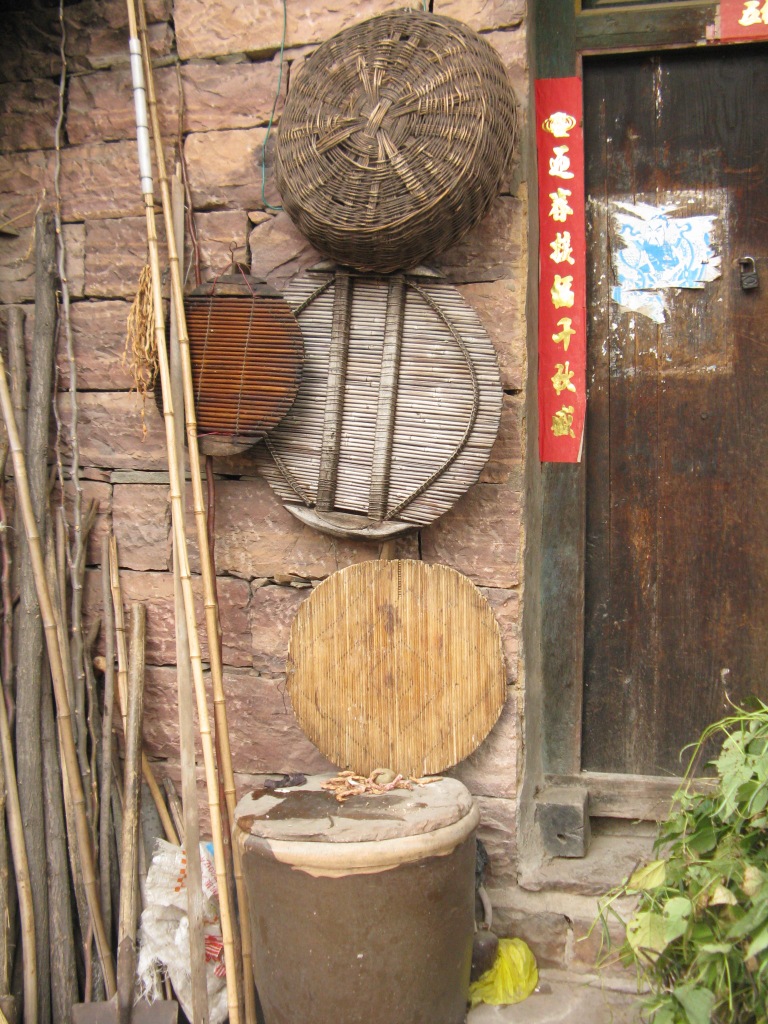
    Various lids and a pottery container.
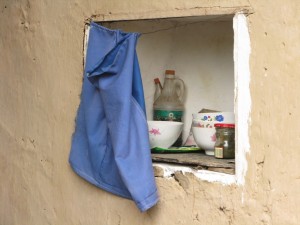
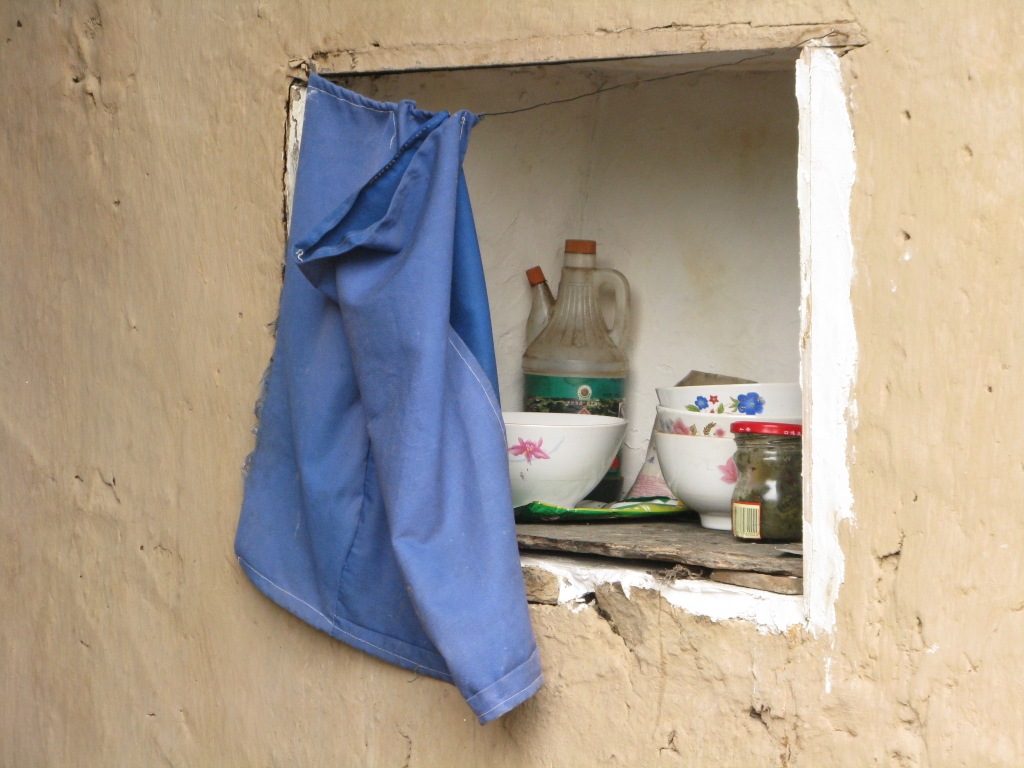
    Some one’s cupboard in a wall in a courtyard.
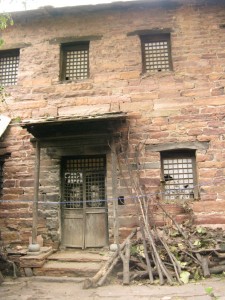
     

    Another courtyard with some firewood prepared.  The paper in the windows was damaged. Many of the courtyard houses seemed too big for the current population and locked doors were not uncommon. 
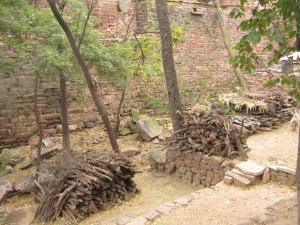
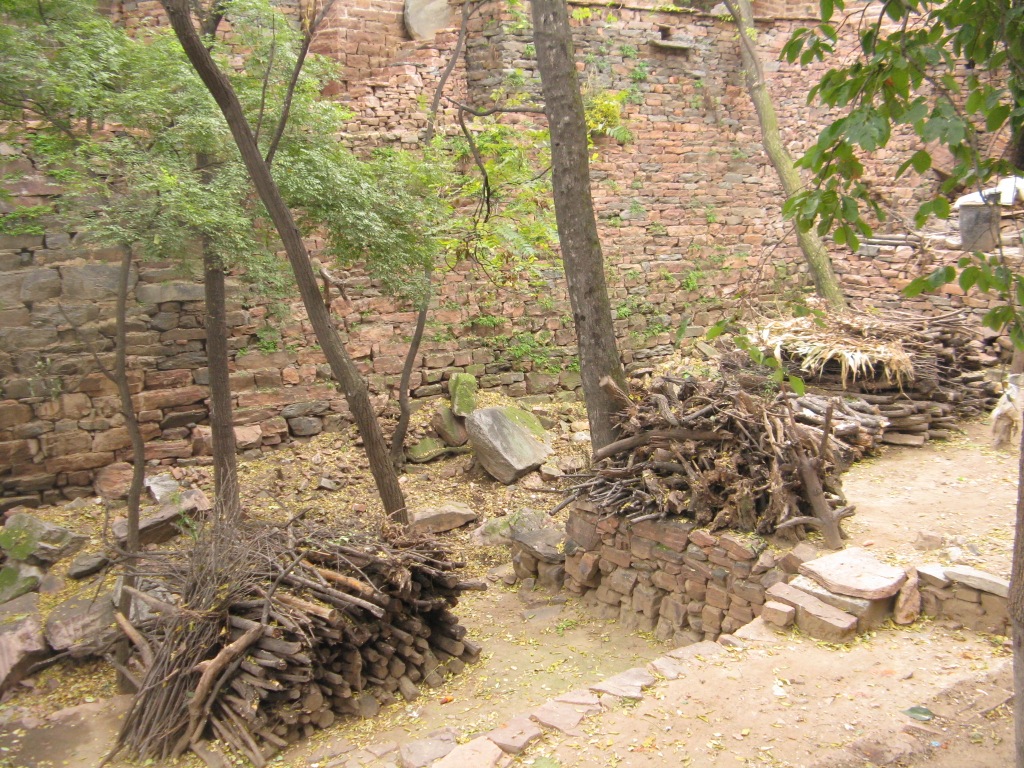
    More piles of firewood.
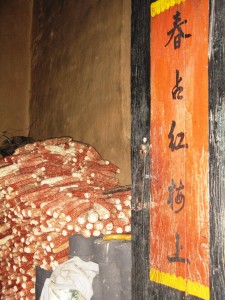
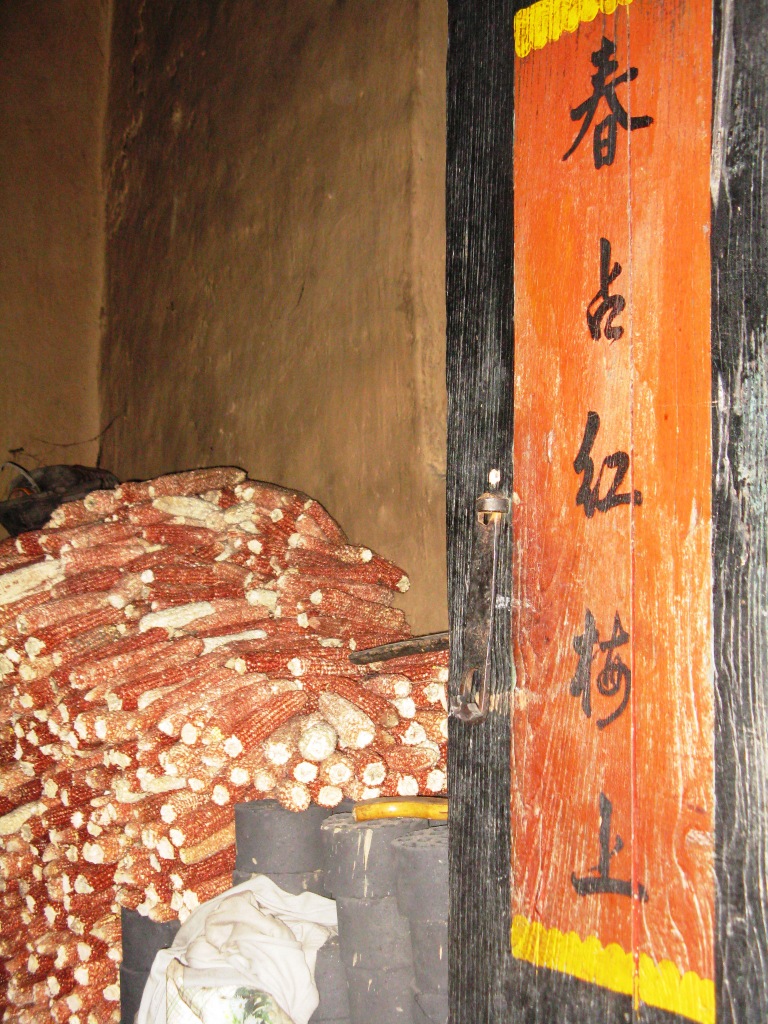
    Corn cobs as fuel and the black/grey  mass between the corn cobs and the red on the door are briquettes for fuel too. A stove is out of the picture to the right.
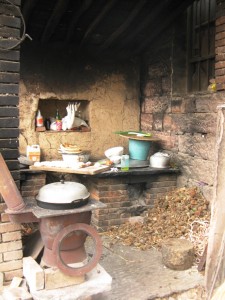
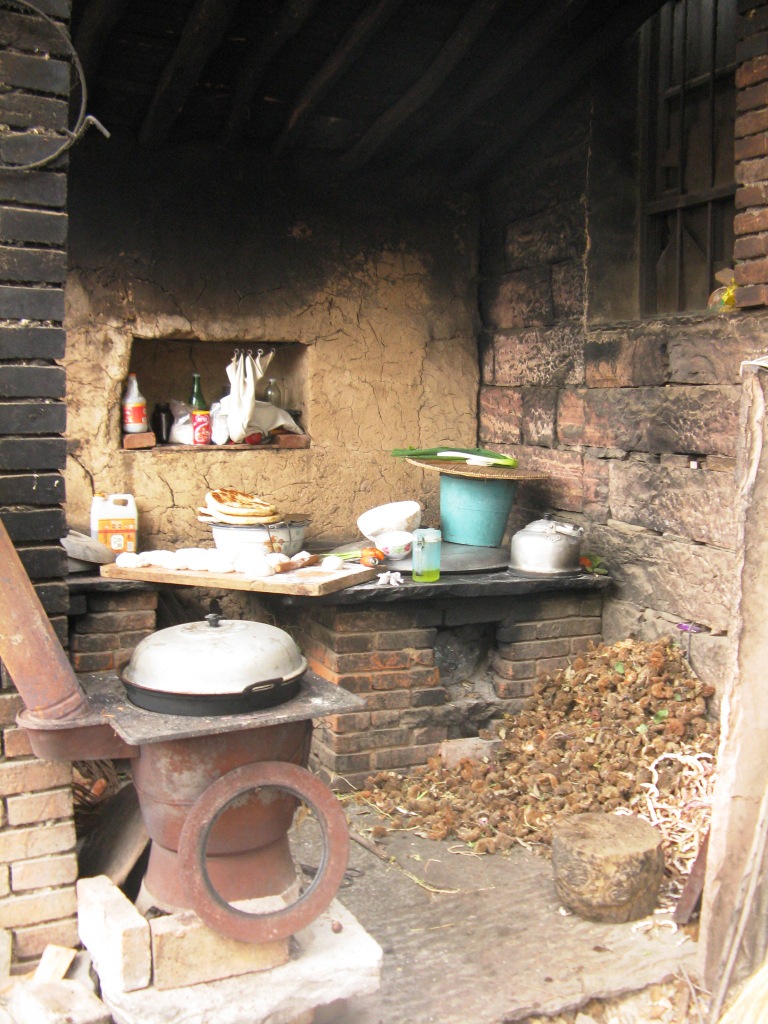
    An outside kitchen containing 3 stoves one of which is out of view.  The brown pile alongside the wall are chestnut burrs, the outer layer, and is used as fuel.  The front stove was soon used to cook large thick flat buns on a hot plate with oil.  We had some thrust on us and they were delicious  unlike the steamed bread, mantou, we had for lunch which I’d  once had from the canteen and is just plain boring.   Don’t think I  finished either one.
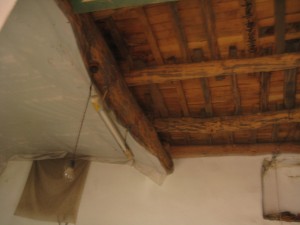
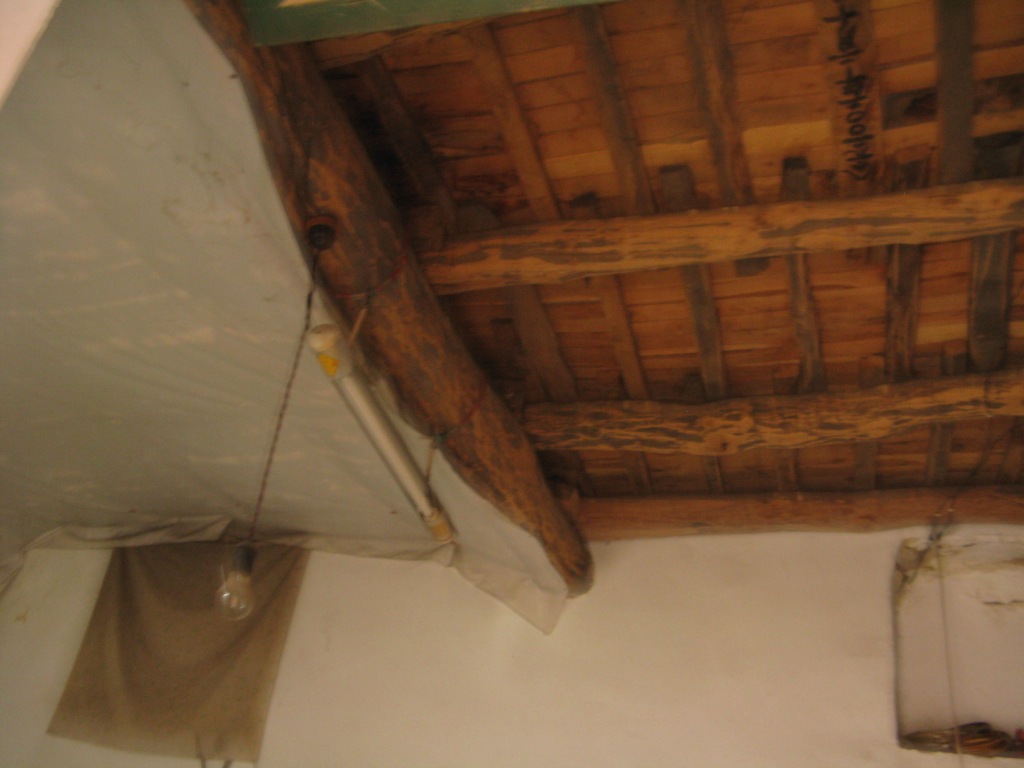
    We ate lunch under this ceiling looked on by  Chairman Mao who gazed on us from on an enormous poster.  We were served a bowl of vegetables and  clear noodles rather lacking in flavour.  A plate of tofu and vegetables was more tasty.
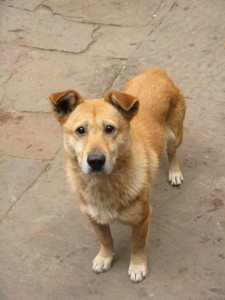
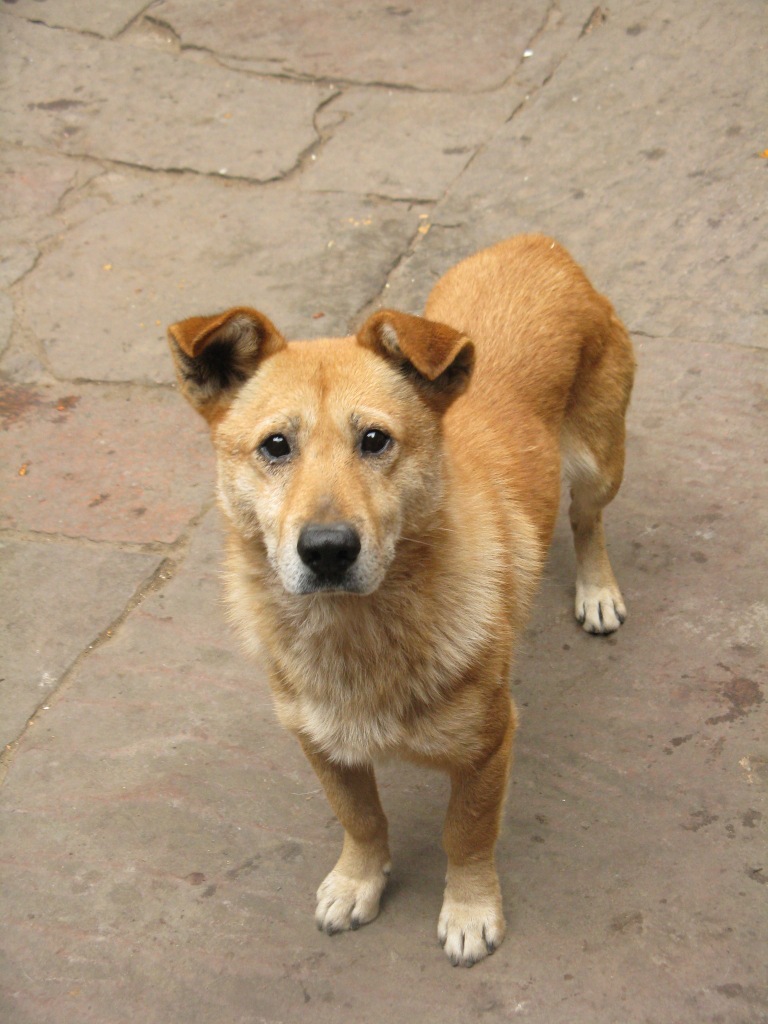
    One of the family wanted to enter but unlike the kitten who got thrown out by the owner, he knew his place and just looked wistful.
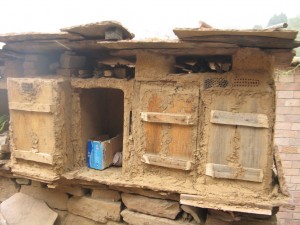
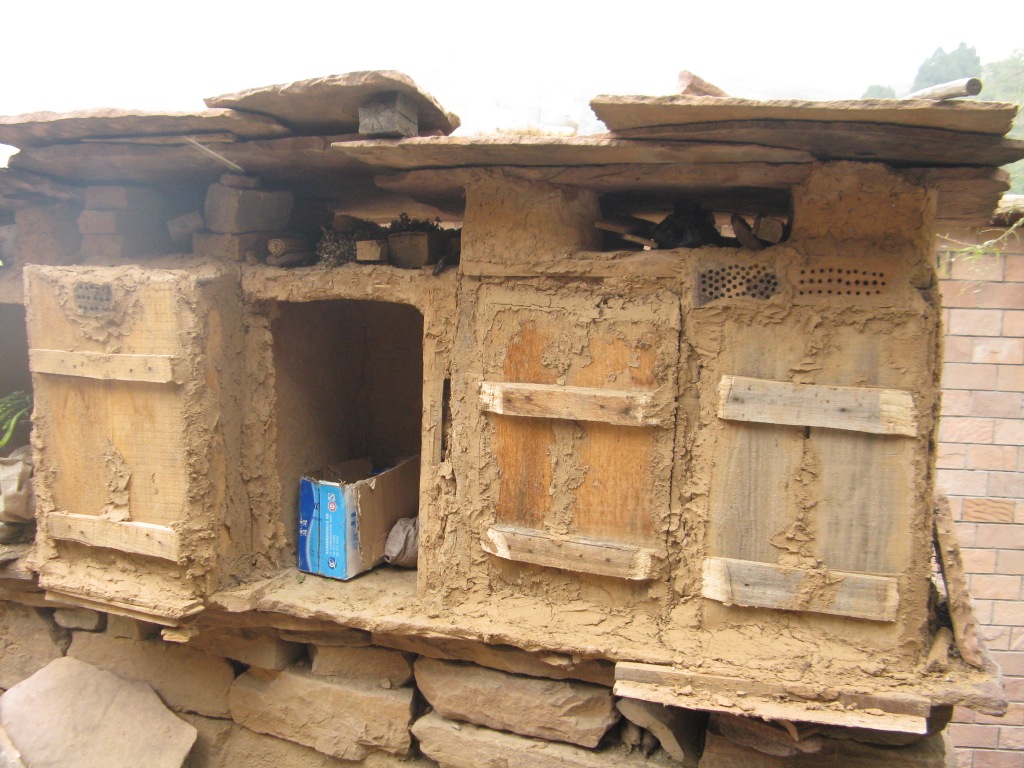
    Bee  hives in a courtyard.
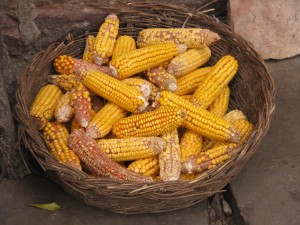
     

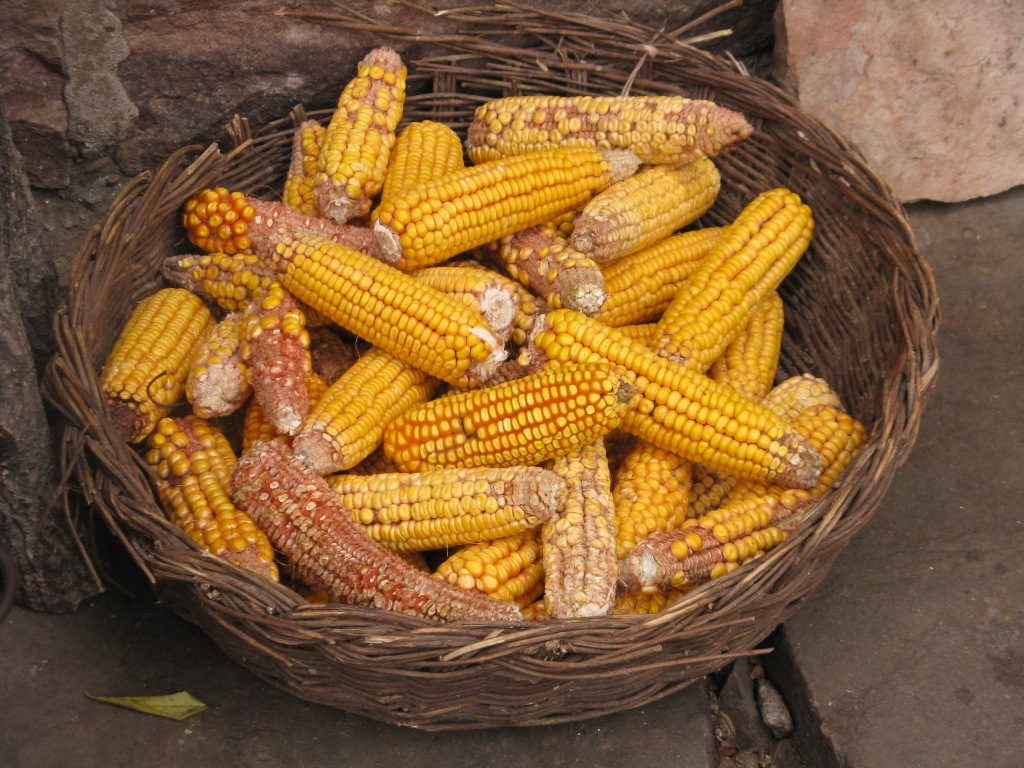
    Basket of corn.
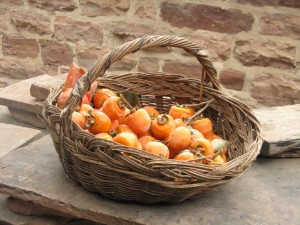
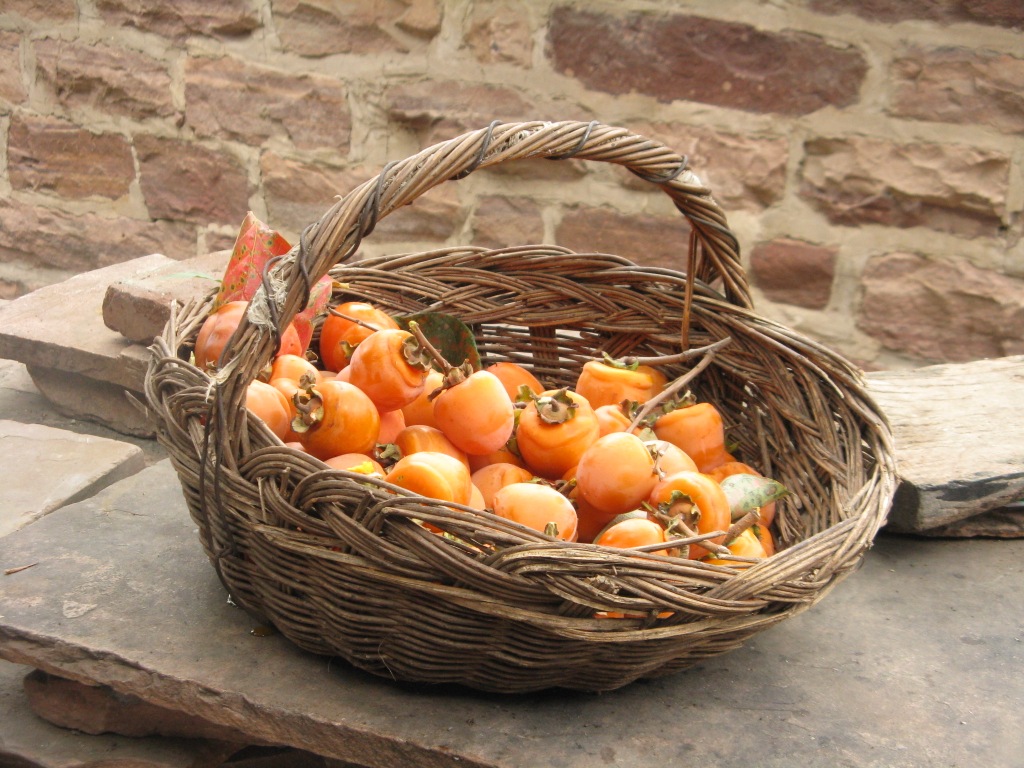
    Basket of persimmons.  We bought some and discovered they were very ripe.  The persimmon trees were enormous. Many were still sporting orange balls which I suspect will never be picked.  There is a long handled contraption available to snare persimmons yet the tree size would require some tree climbing agility too to reach ones higher up.  I saw few younger people and I don’t know if they were occupied elsewhere, at boarding school or nonexistent.
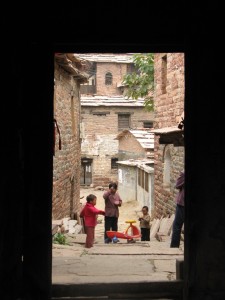
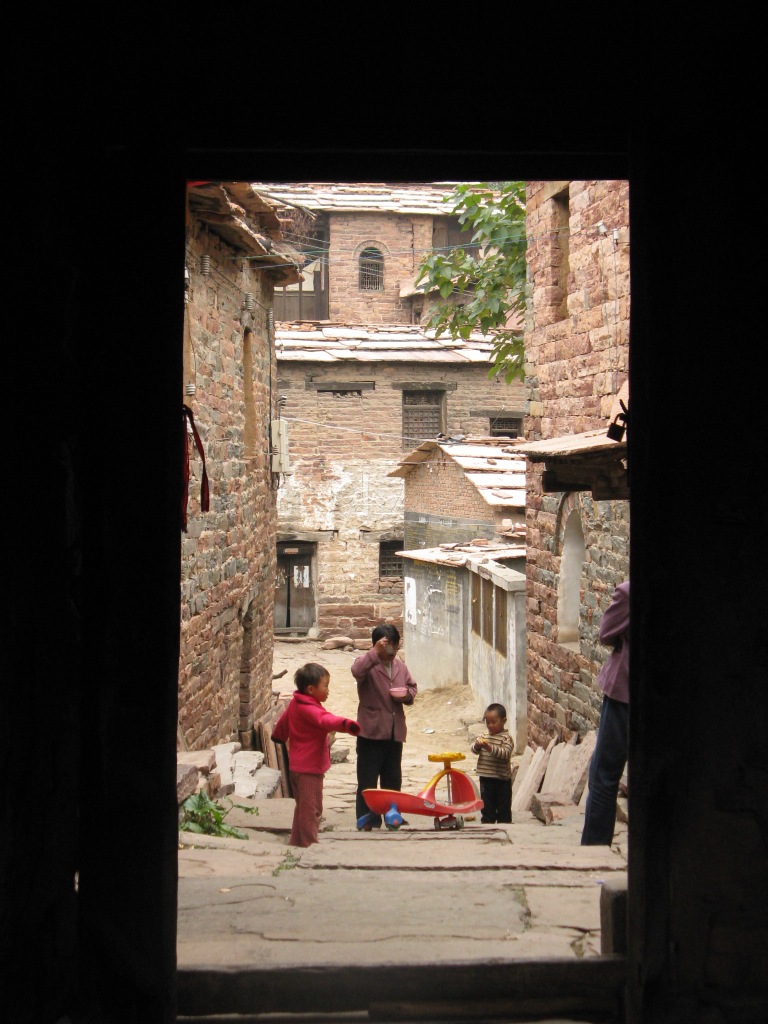
    Scene through a doorway.
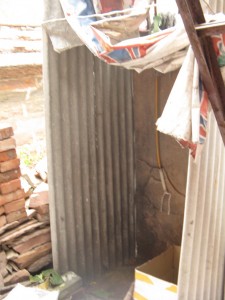
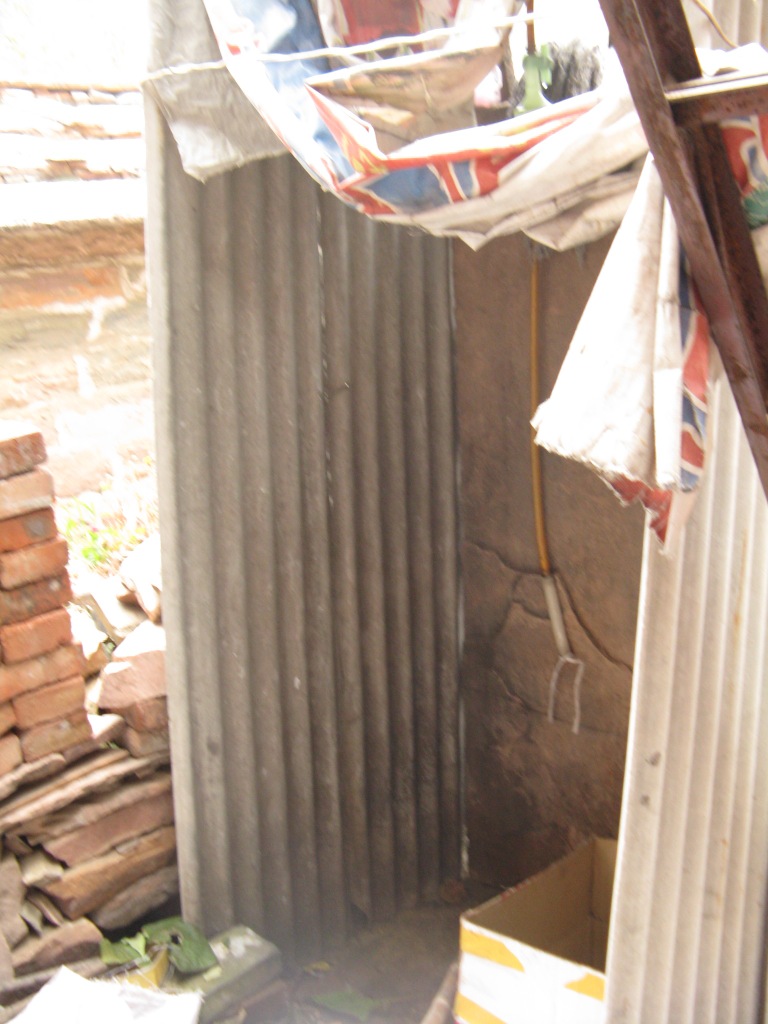
    An outside shower consisting of 2 sheets of corrugated sheeting with a back of solid stone and a plastic shower attachment.   No evidence of hot water.

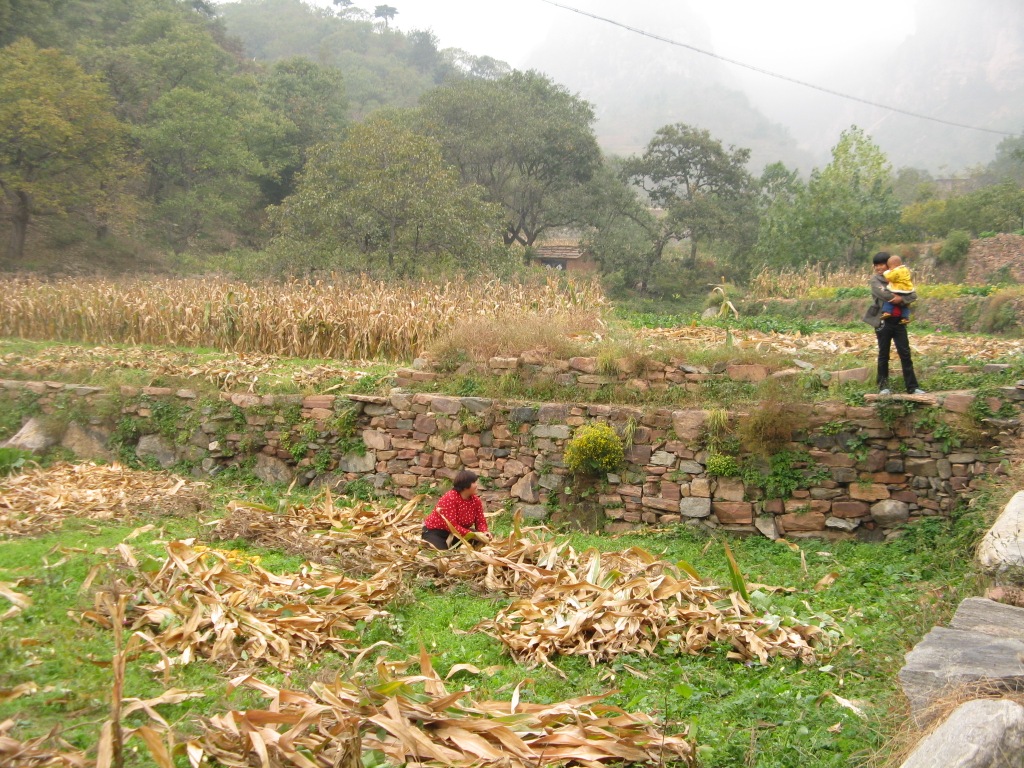
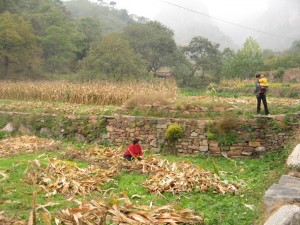
    Bringing in the corn and having a chat.
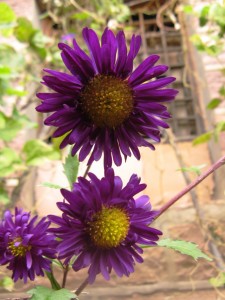
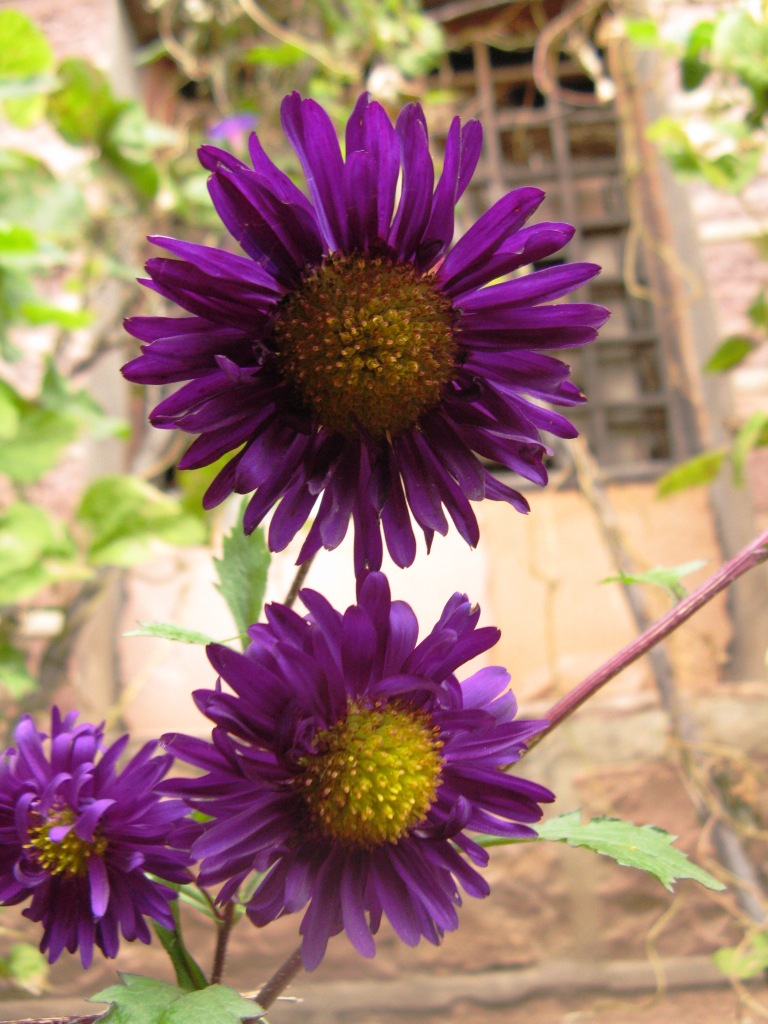
    Purple flowers.
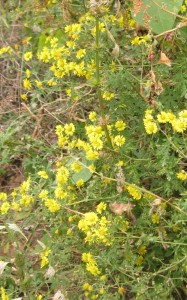
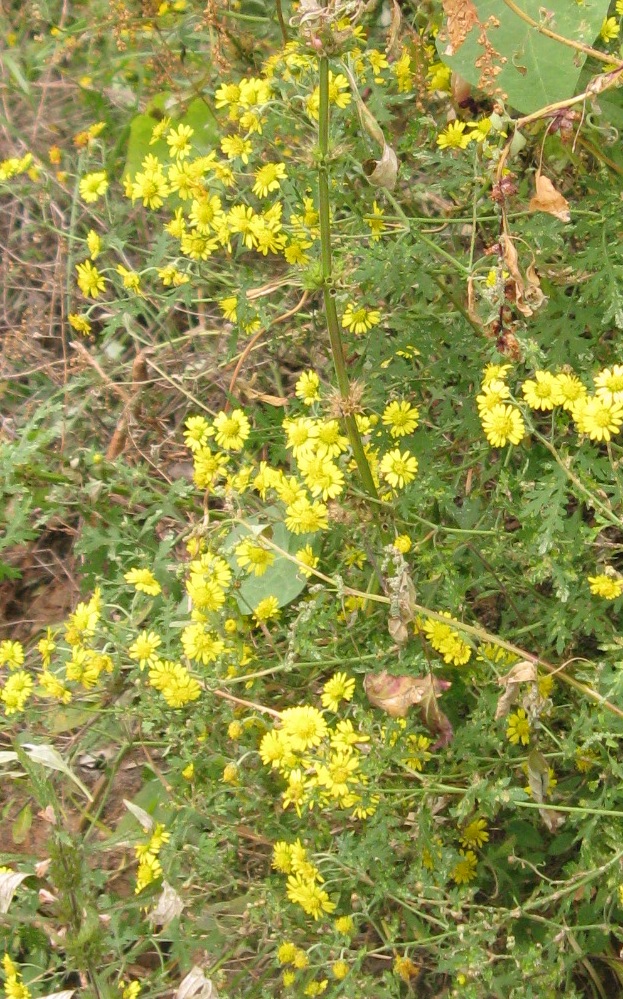
    These yellow flowers were very common on the hillsides.
    China, Xingtai

    agriculture, animals, architecture, bus, China, culture, dogs, Food, geology, stone village, transportation, Xingtai

  • A day of food

    Oct 26th 2010

    By: Kerry

    No comments

    A day of food

    Last Thursday I ate out many times, lunch with a friend, a cake from a roadside stall, dinner from a Peking Duck restaurant and tea from a tea house.

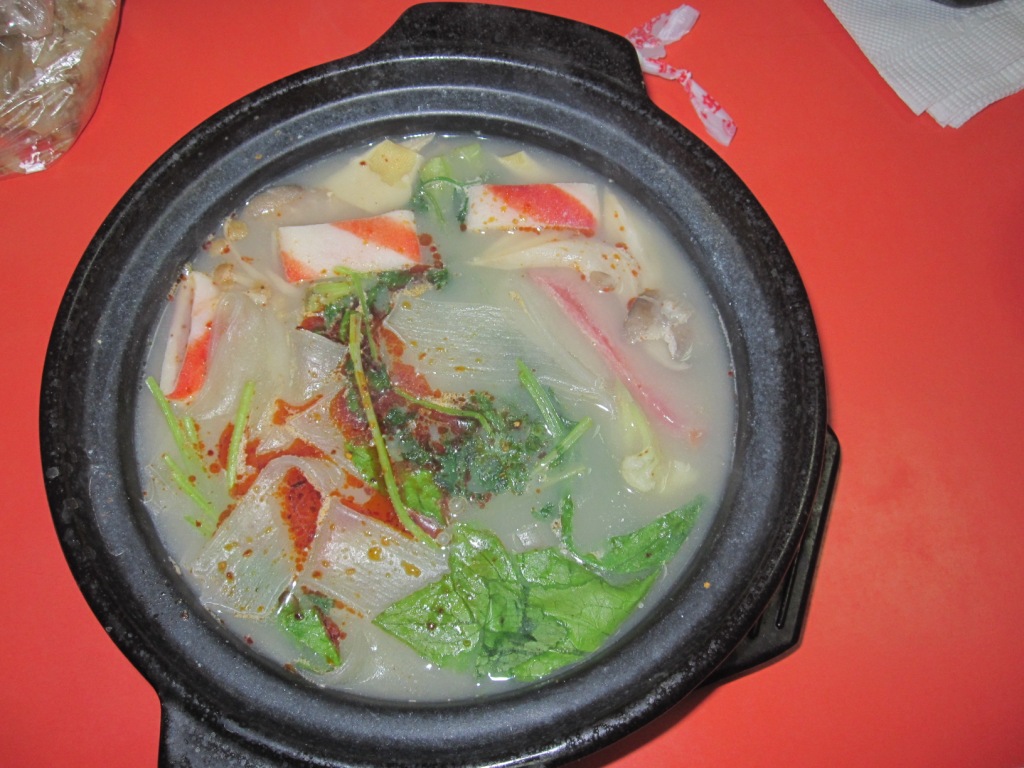
    At lunchtime we ended up at one of the small local restaurants near the college.  We chose our ingredients, vegetables, tofu or meat from a refrigerator, put them in a small basket and handed it over. They were then added to individual bowls of hot broth and served at the table.  We could have chosen additional ingredients had we wanted.   I found it quite good but my friend had no difficulty telling the cook that it was too salty.  

    Other forms of hotpot involve a boiling bowl of broth at the table into which you dunk your ingredients.  Bowls may be individual or shared depending on the establishment.

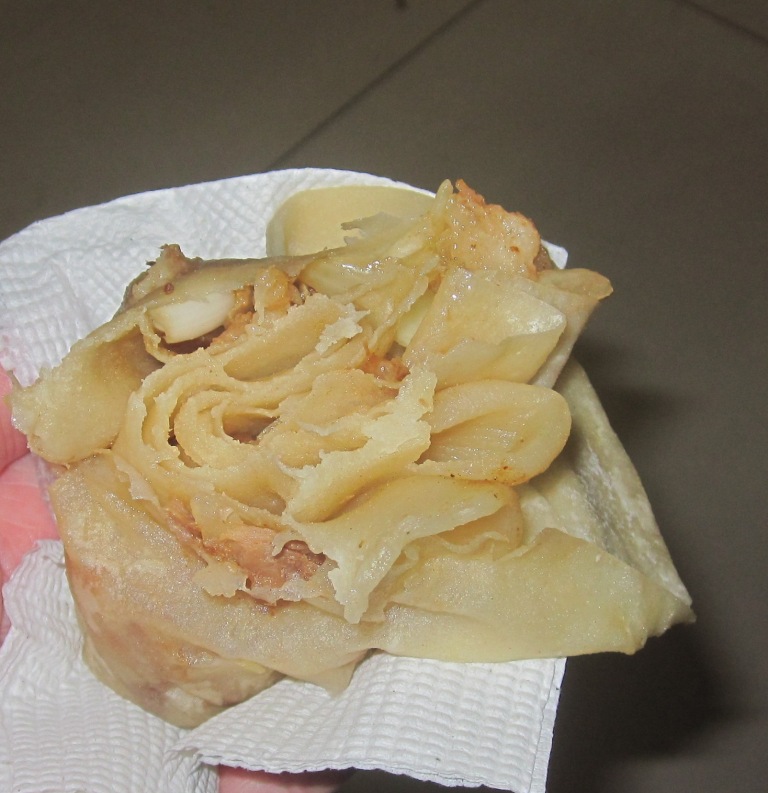
    My friend decided that I needed to try something else she’d been told was available nearby so she nipped out and soon returned with something like a rolled cut up pancake.  It contained some garlic, onions and some sort of sauce of which there are several kinds.  They are brushed over many  different kinds of buns or pancakes to provide additional flavour and nutrition.  While it didn’t look particularly interesting  it tasted good while still hot.  However it was rather difficult to eat with chopsticks.


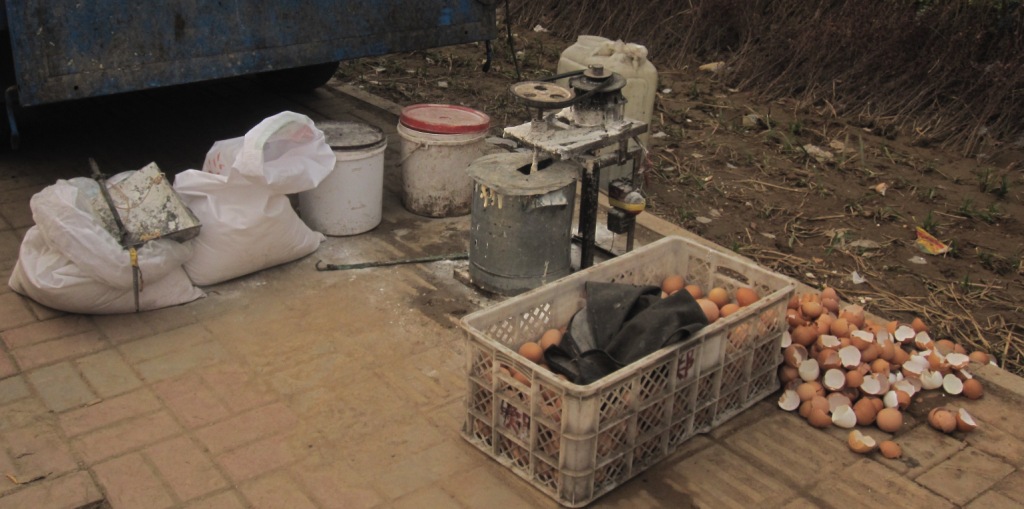
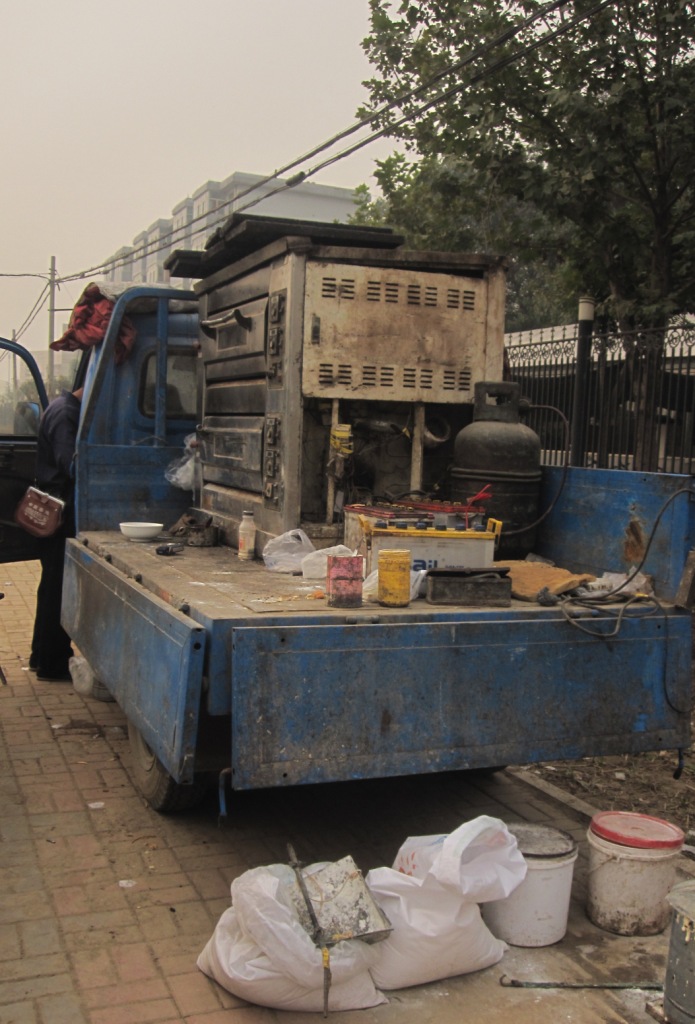
    On returning to college I spied the “cake man” on the footpath just outside the gate.  He’s there occasionally and I’ve bought the odd individual plain cake from him. The ones I buy have a couple of sunflower seeds on the top.  Sunflower seeds are an exceptionally popular snack item in China and people cracking open sunflowe seeds are a common sight.  He has other kinds but they don’t appeal.   He mixes and cooks on site.


    The mixing area.

    The truck and oven.  It’s possible that I have a better photo from before but this is the one I took on Thursday.

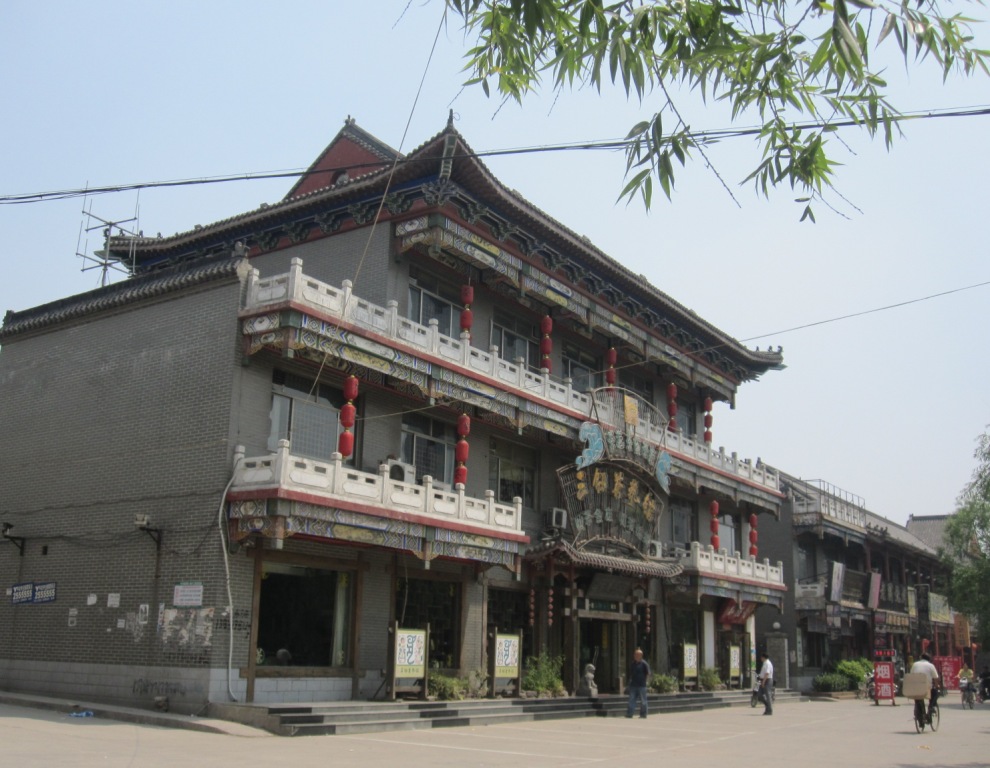
    It was the new teacher’s birthday so we went to out to dinner.   I discovered it was in an area I had visited  back in May and photographed some of the unusual buildings.  It is where the antique/old wares market is located so I imagine it is an area with some history.

    I think the first one is the tea house and the restaurant is a couple of shops along.

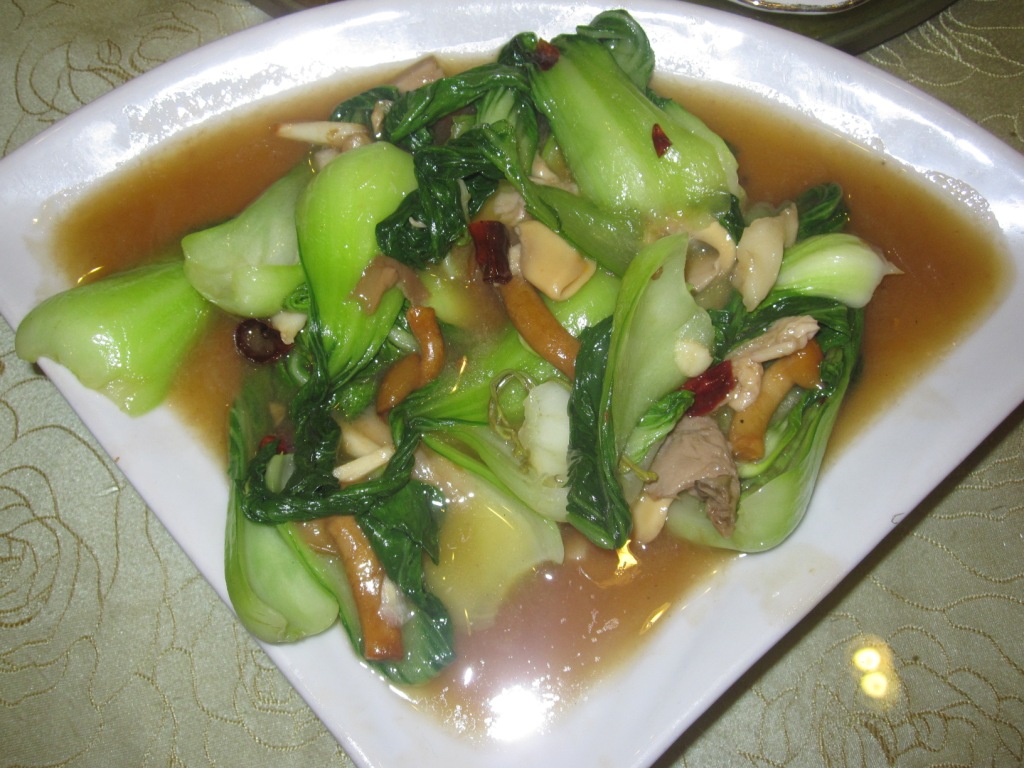
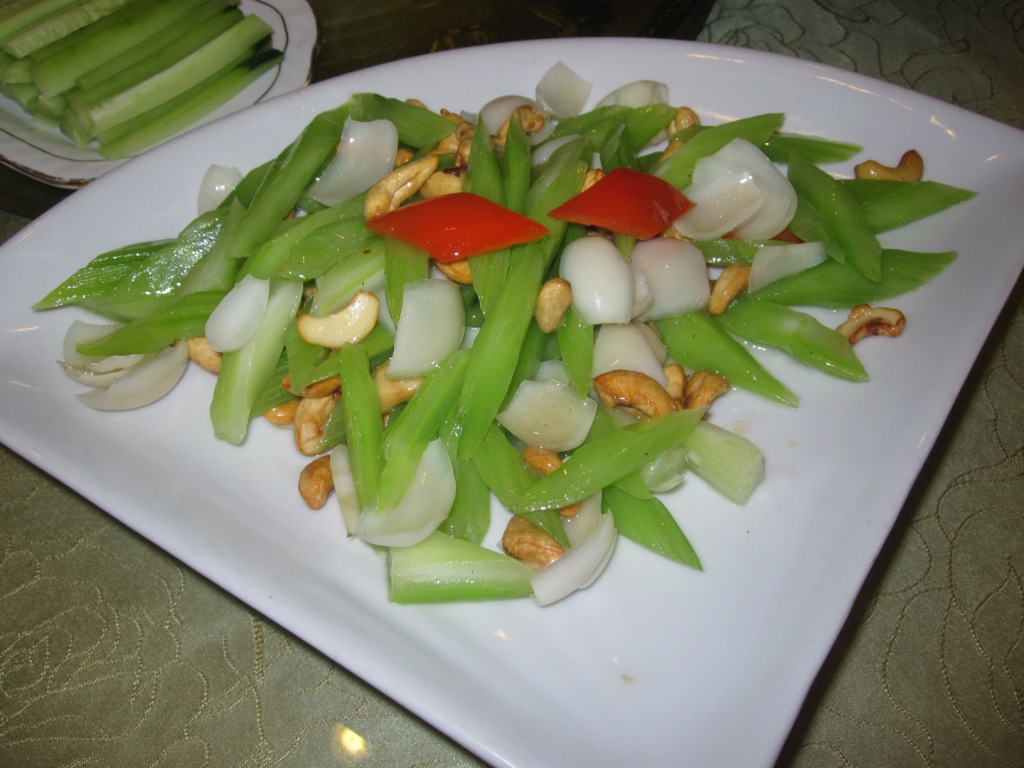
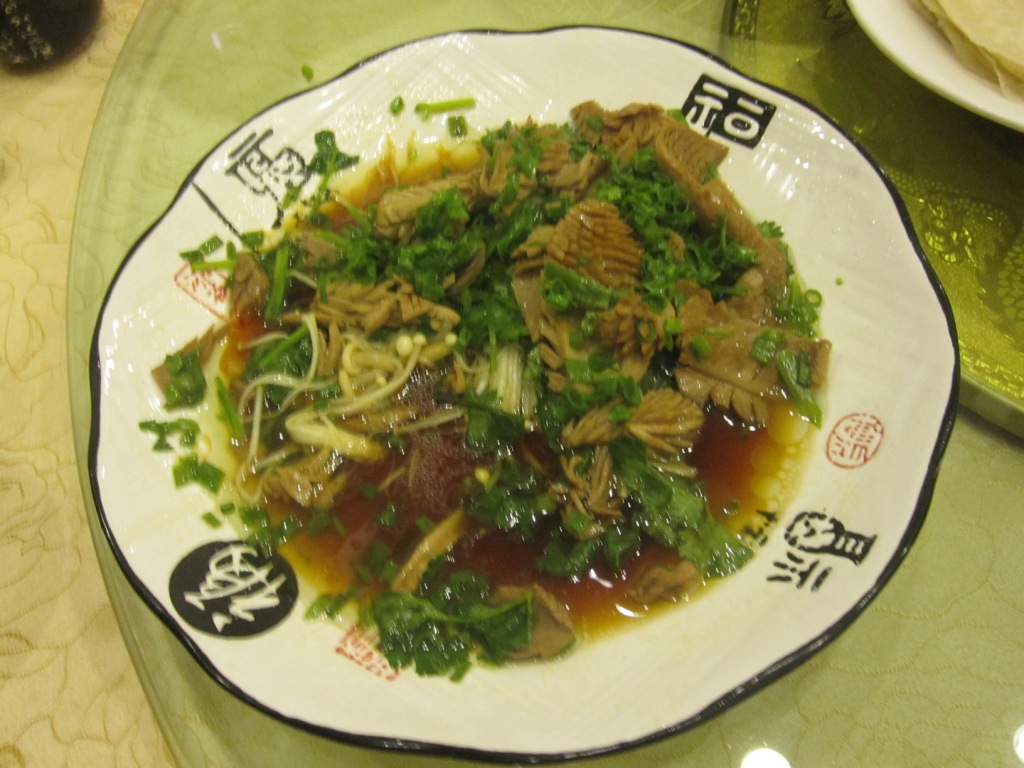
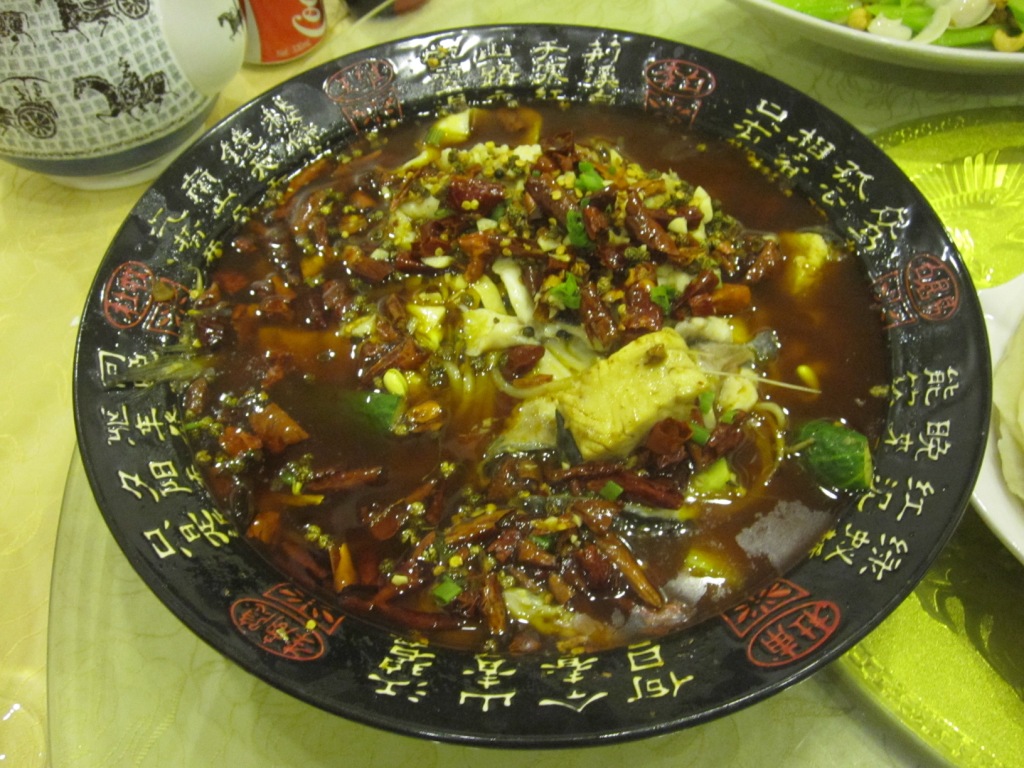
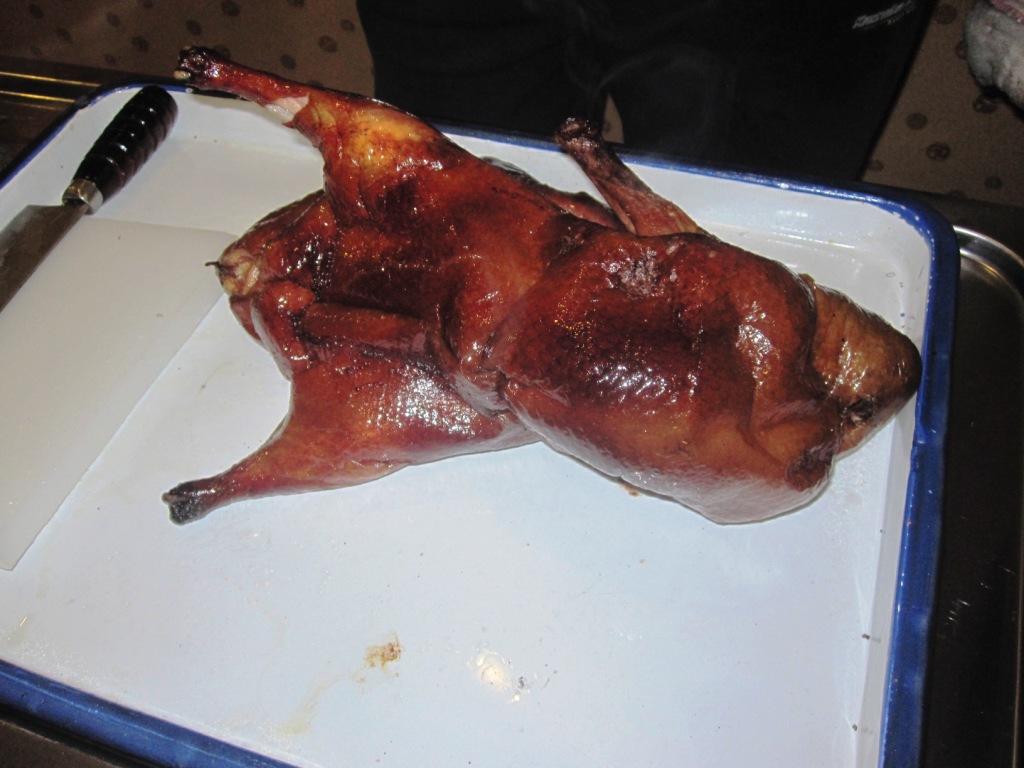
    We went to a restaurant specializing in Peking Duck.  I’d never had it before so I was keen to try.We were escorted upstairs to a private room which is the norm except in cheap restaurants.  We also ordered many other dishes, not all of which were photographed.  It was pretty good and worked out quite economical.

    Some sort of vegetable dish.

    Another one.  Its unusual to see such dishes around here so we really went for them.


    Kidneys.  I’m told it was tasty.

    A fish dish.  It tasted good but was too spicy and boney to attract  much of my interest.

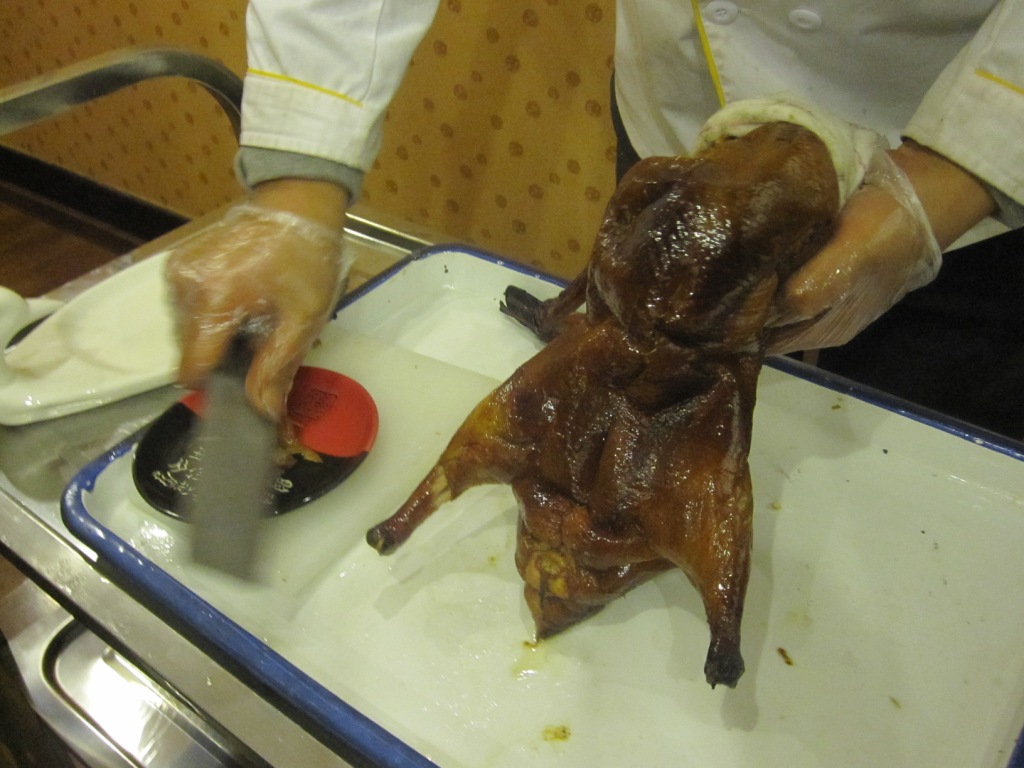
    The duck

    The duck having some skin removed by a chef at a table in the hallway.

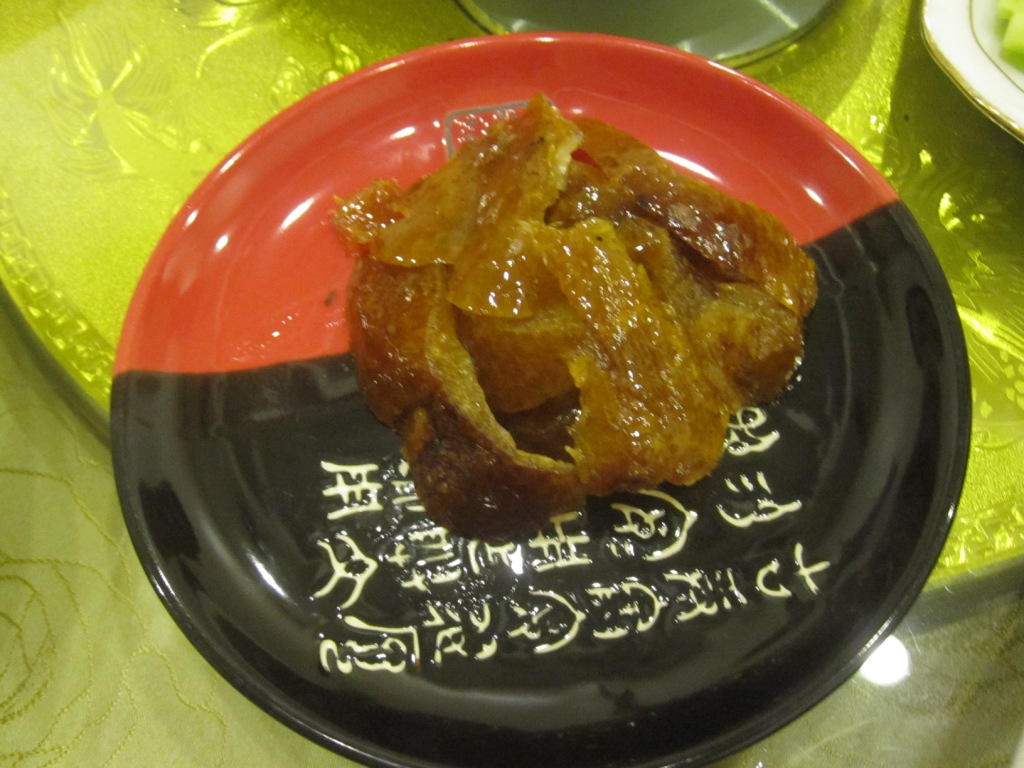
    Duck skin to eat as served.

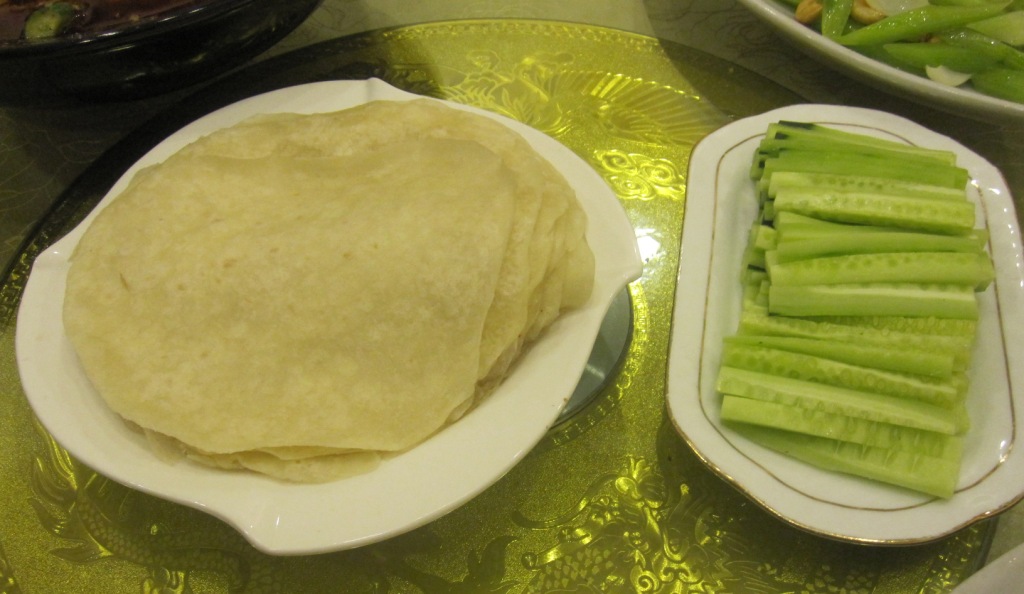
    Each of us had individual containers of a thick dipping sauce and shallots.  The idea was to place some duck meat, cucumber, shallot and sauce on a crepe, roll it up and eat.   It was quite good with the fresh vegetables offsetting the oily duck. 

    The remains of the duck was transformed into soup which was quite good.

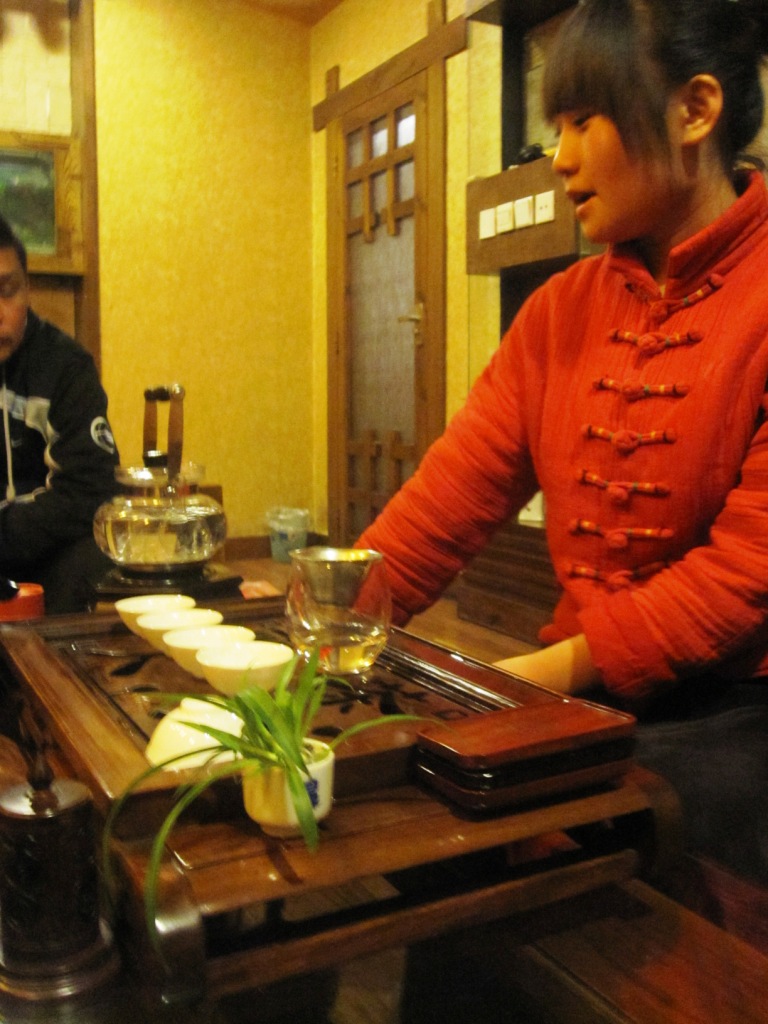
    After dinner we adjourned to a nearby establishment to have Chinese tea.  Again we were escorted upstairs and sat around a small table at with a staff member presided.  She boiled water, rinsed tiny cups, made tea and then served it.  We were offered snacks of seeds and packets of some sort of fruit wafer.

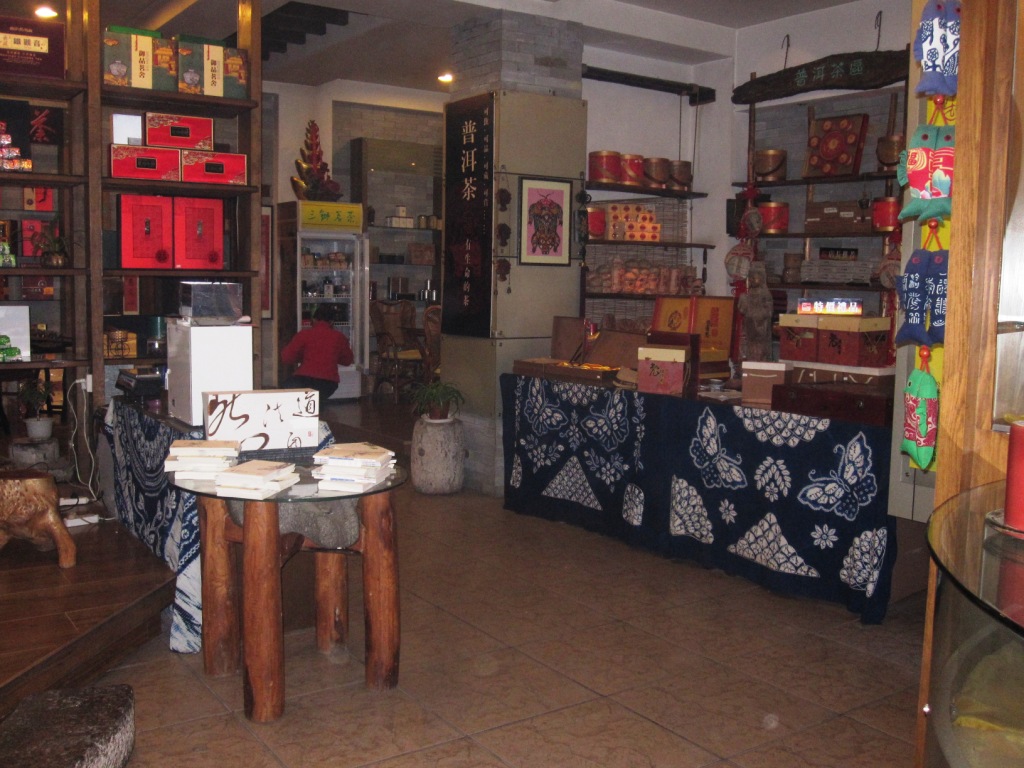
    The downstairs shop in the teahouse.

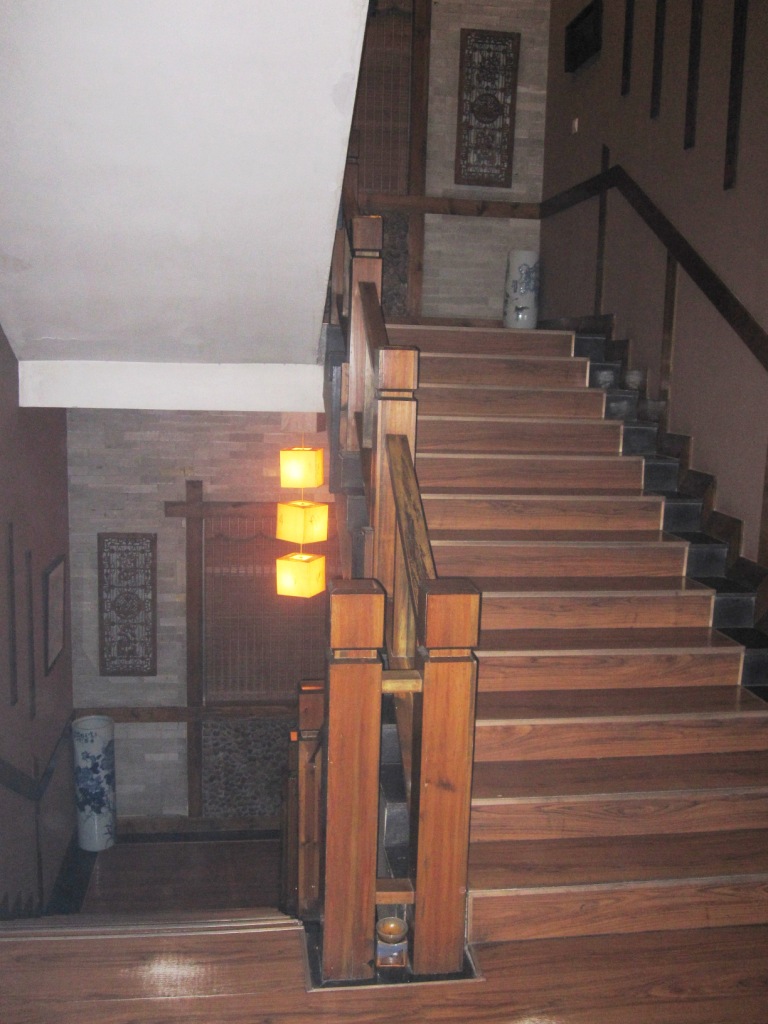
    The stairs.

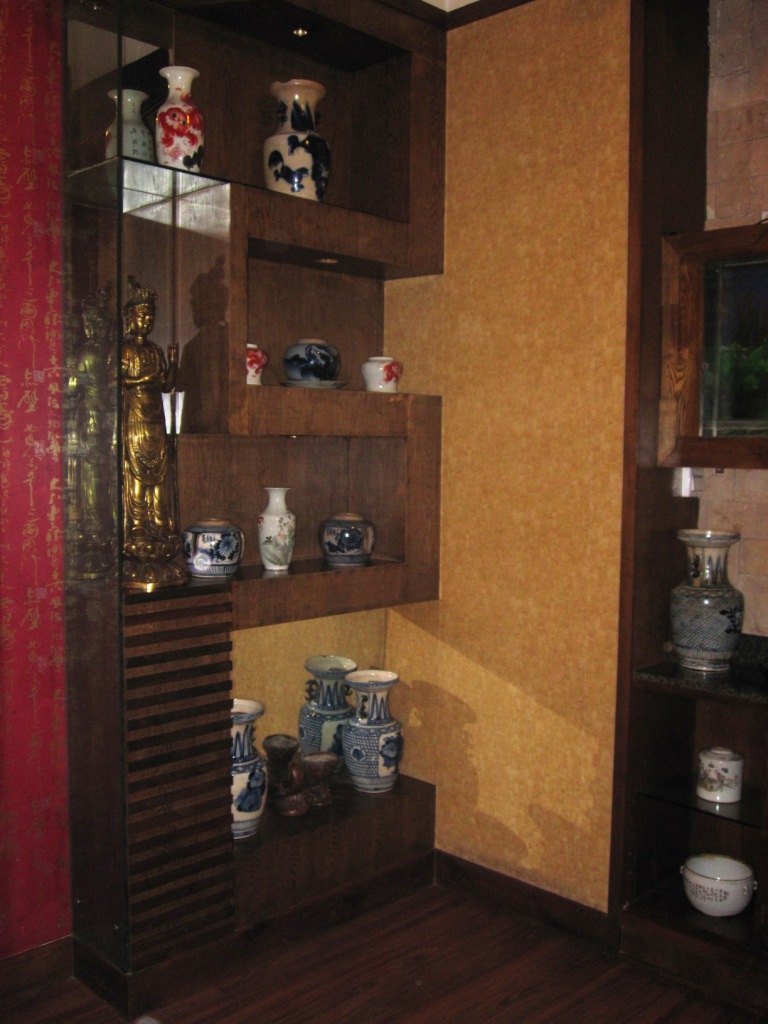
    Some of the decorations in the room.

    Our tea hostess and her equipment.  There is a real culture to tea drinking quite beyond the what westerners consider when we make a cup or pot of tea.

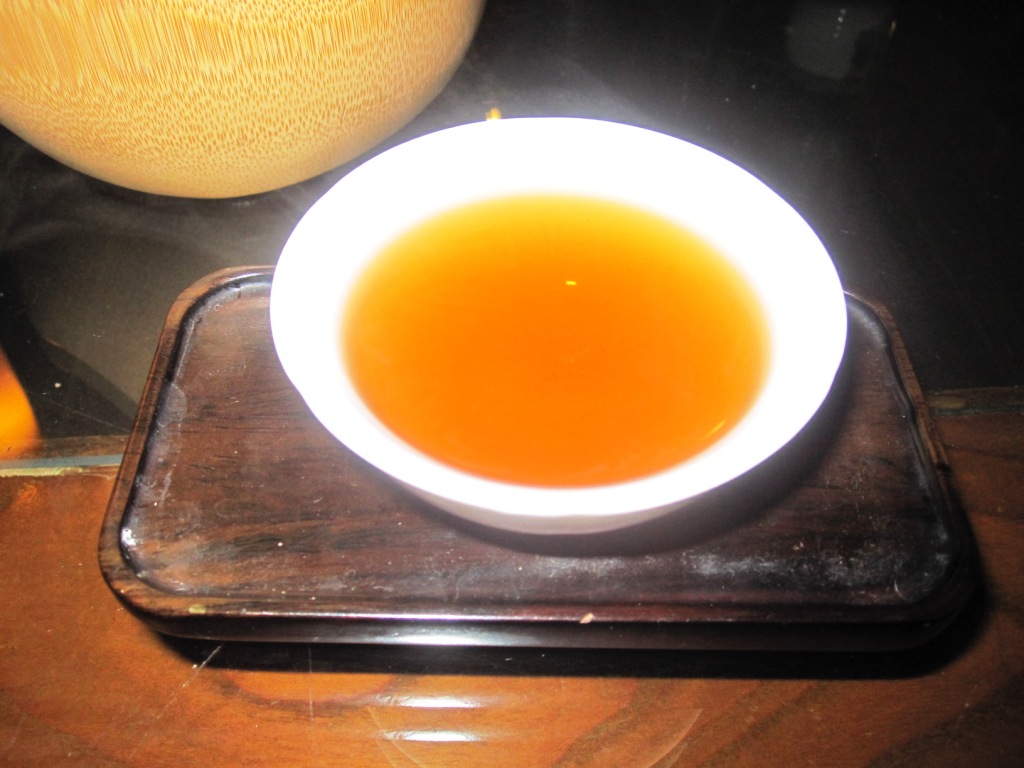
    My cup on its small wooden saucer.

    We neither saw nor heard any other customers at the restaurant or teahouse.

    China, Xingtai

    China, culture, Food, Xingtai

  • Qianmen and Dashalan Streets

    Oct 26th 2010

    By: Kerry

    No comments

    Qianmen and Dashalan Streets

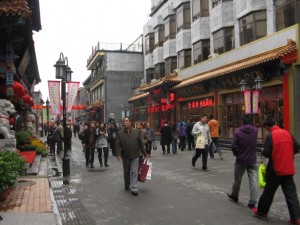
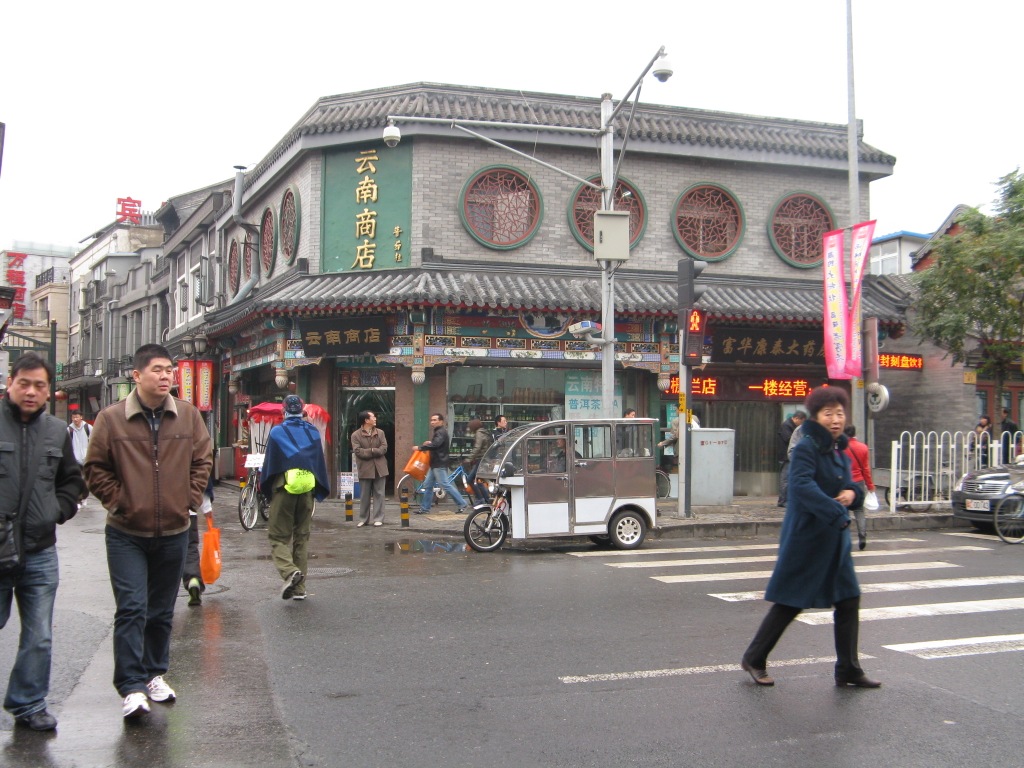
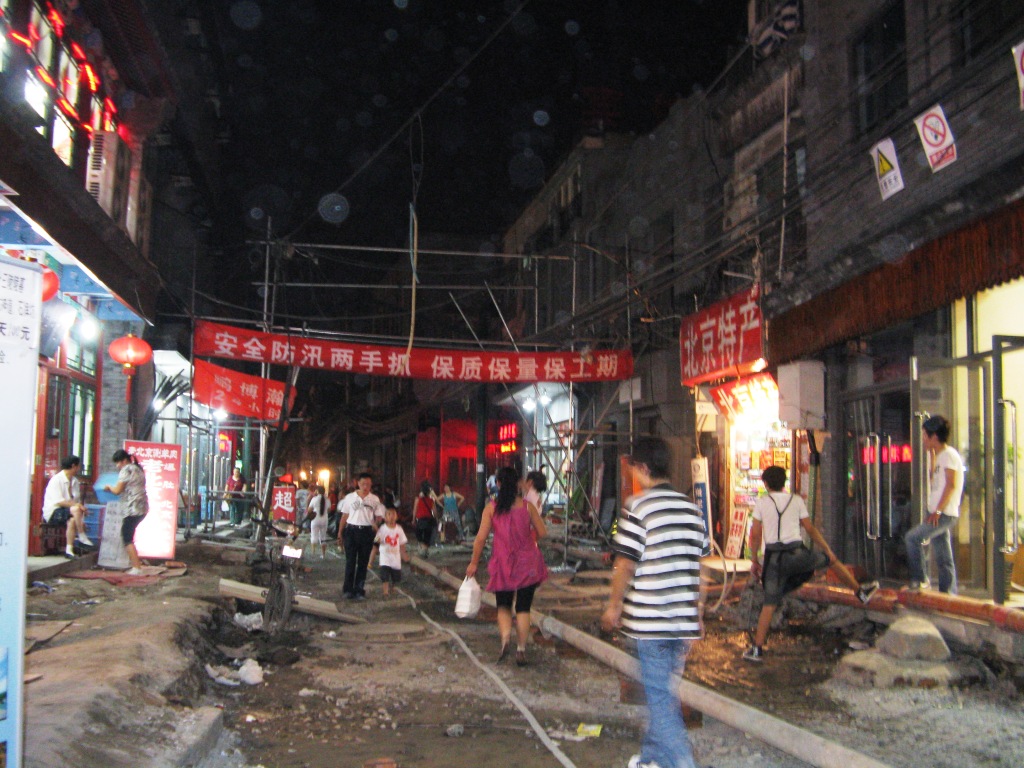
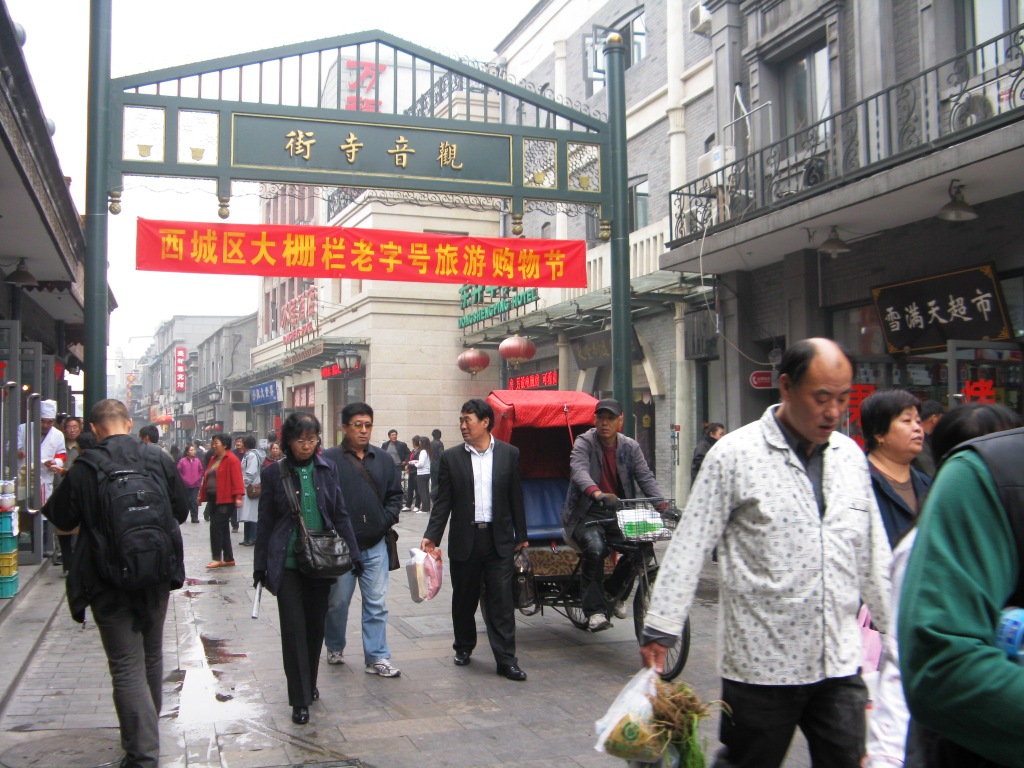
    Qianmen Street was a famous commercial area 600 years ago as was Dashalan Street running off it at right angles. Qianmen was renovated in recent times. I remember teetering on makeshift walkways and trying not to sink into damp cement as I walked through Dashalan West during its renovation phase about a year ago. Renovation is mostly finished and the cement and large uncovered manholes have pavers and covers. For various reasons I walked around these streets a few times during the weekend.
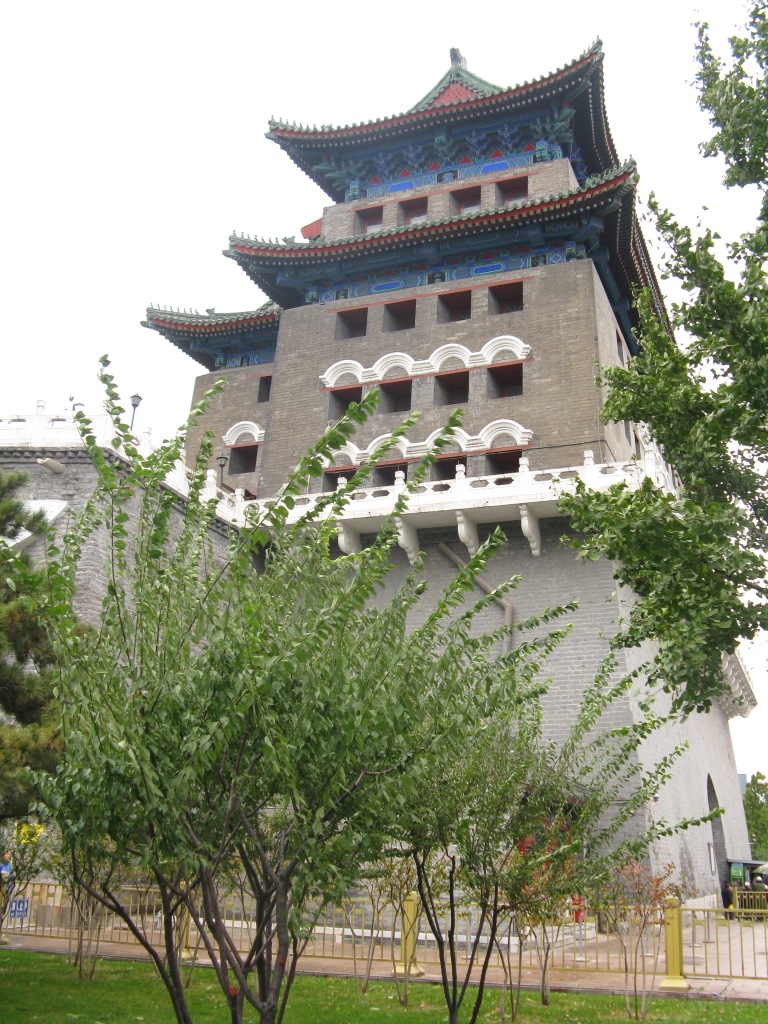
    This is Qianmen Gate, Jianlou,  at the head of Qianmen St.   Qianmen St is to the right with Zhengyangmen Gate, Chairman Mao’s mausoleum and Tianamen Square  behind it to the left. 

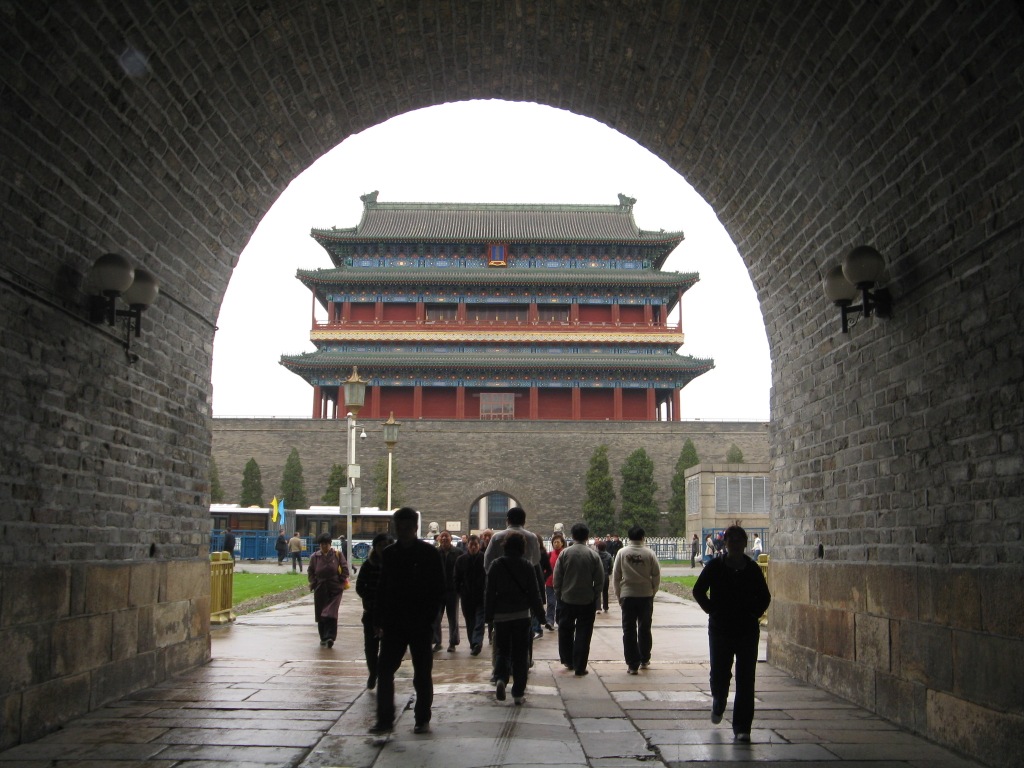
    This is Zhengyangmen Gate seen through Qianmen Gate

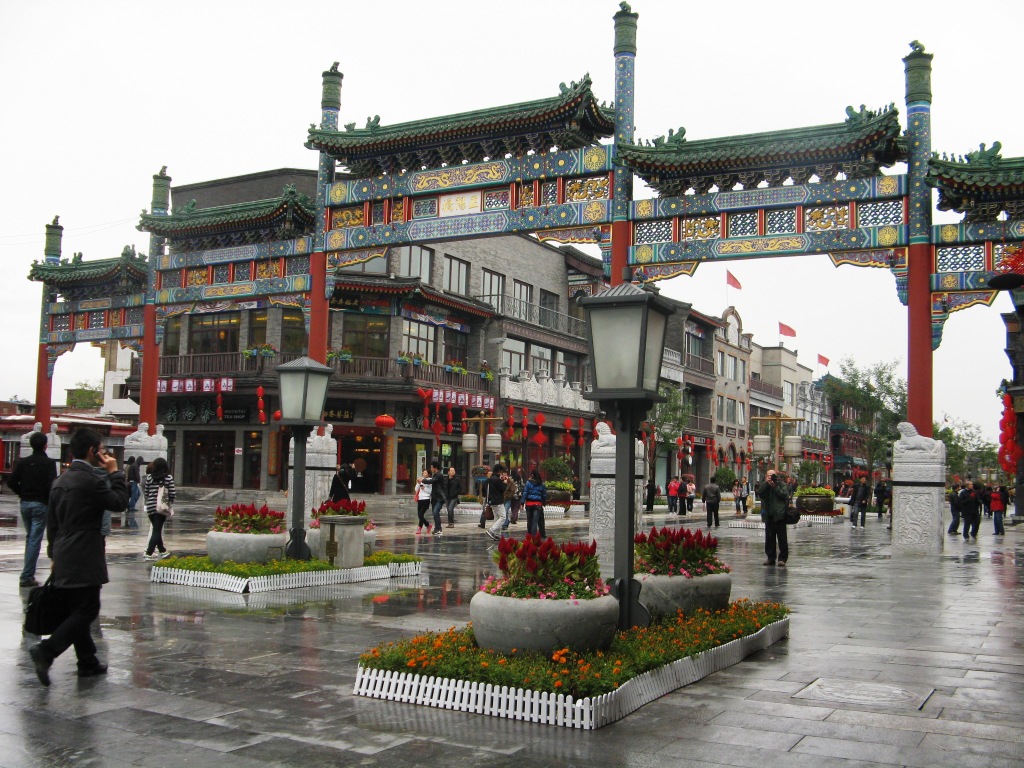
    The wooden gateway to Qianmen St and some of the shops.

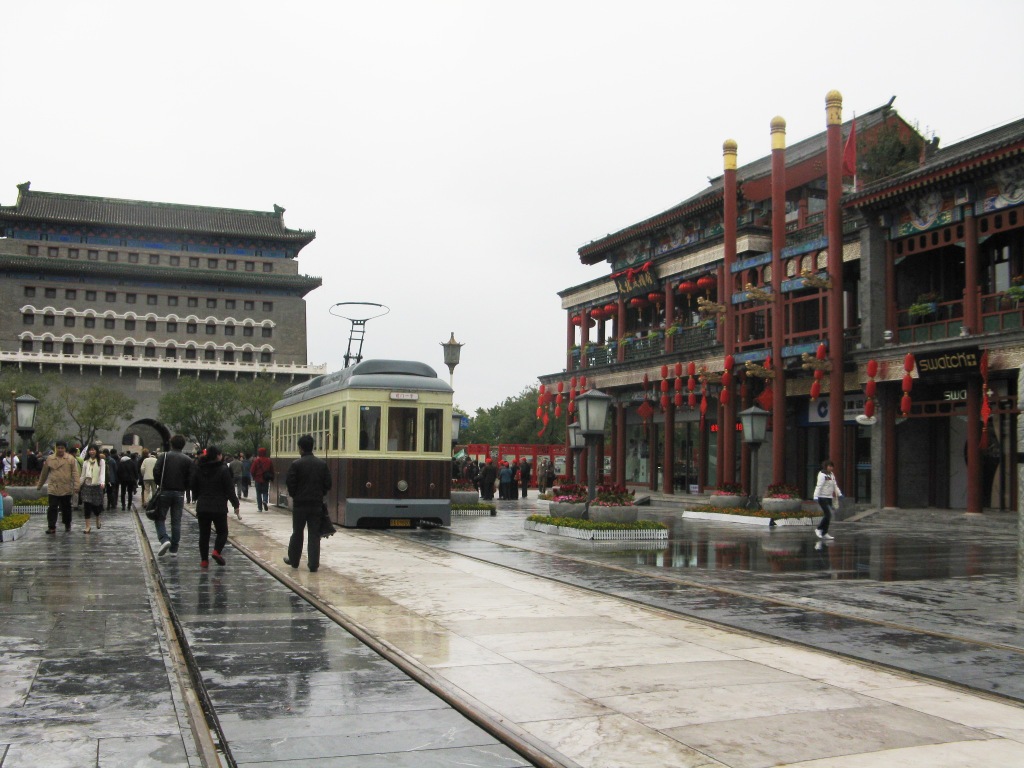
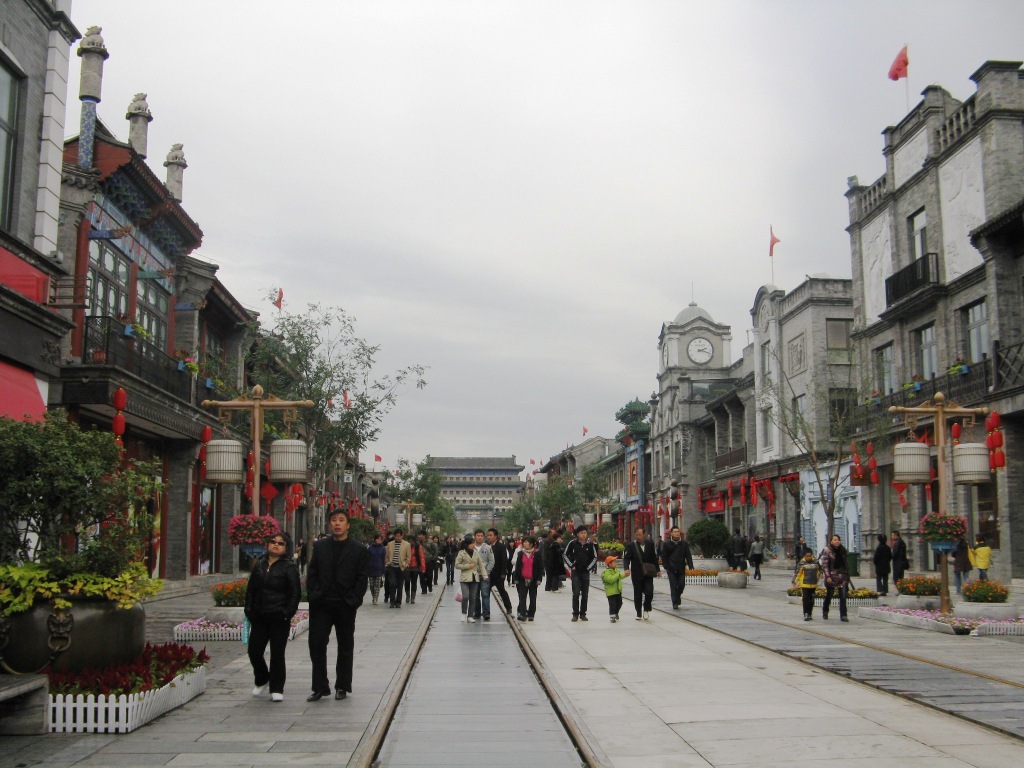
    Trams used to travel down this street during the first part of the 20th century and recently  2 were reintroduced. Qianmen Gate is seen at the head of the street.  There is now a Starbucks near the entrance and it is  just the place to rest  weary feet.

    Qianmen Street.  It contains many international and “Time Honoured Chinese Brands.”  There were many shops with the windows papered over and a notice stating that a new shop would open soon.  There appeared to be more than on previous occasions.  A set of bronze sculptures previously seen outside a shop had gone too. 

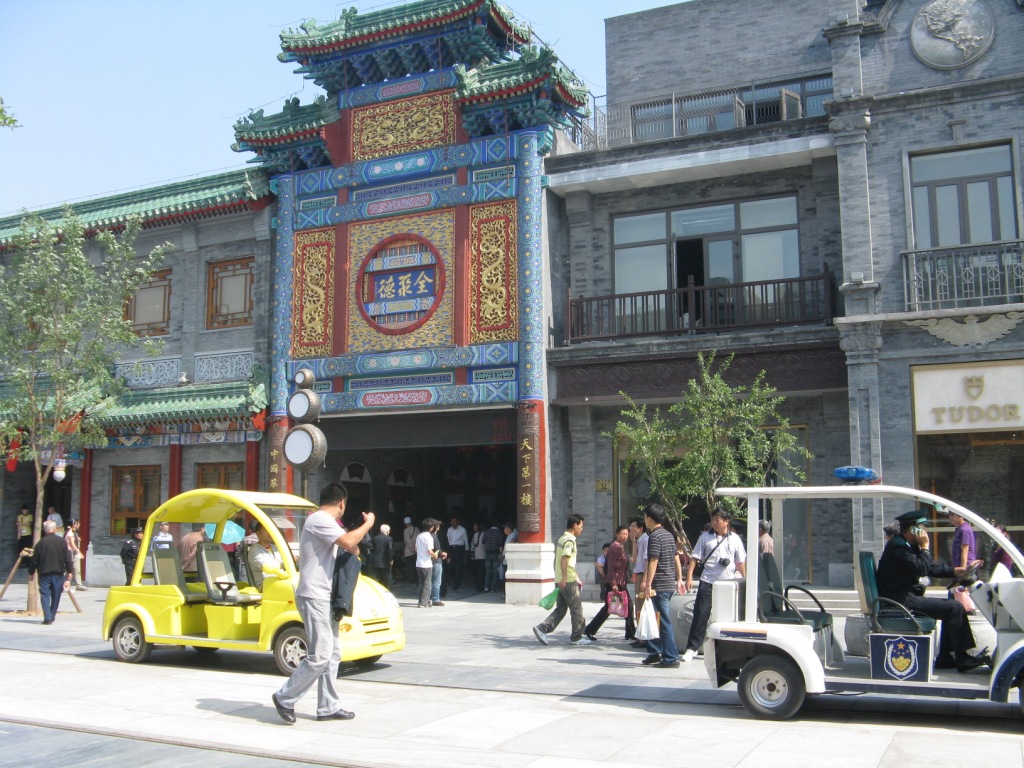
    This a famous Peking Duck restaurant and two electric cars, one being a police vehicle.  Not sure about the other as it is a pedestrian street.  This photo was taken in September last year.

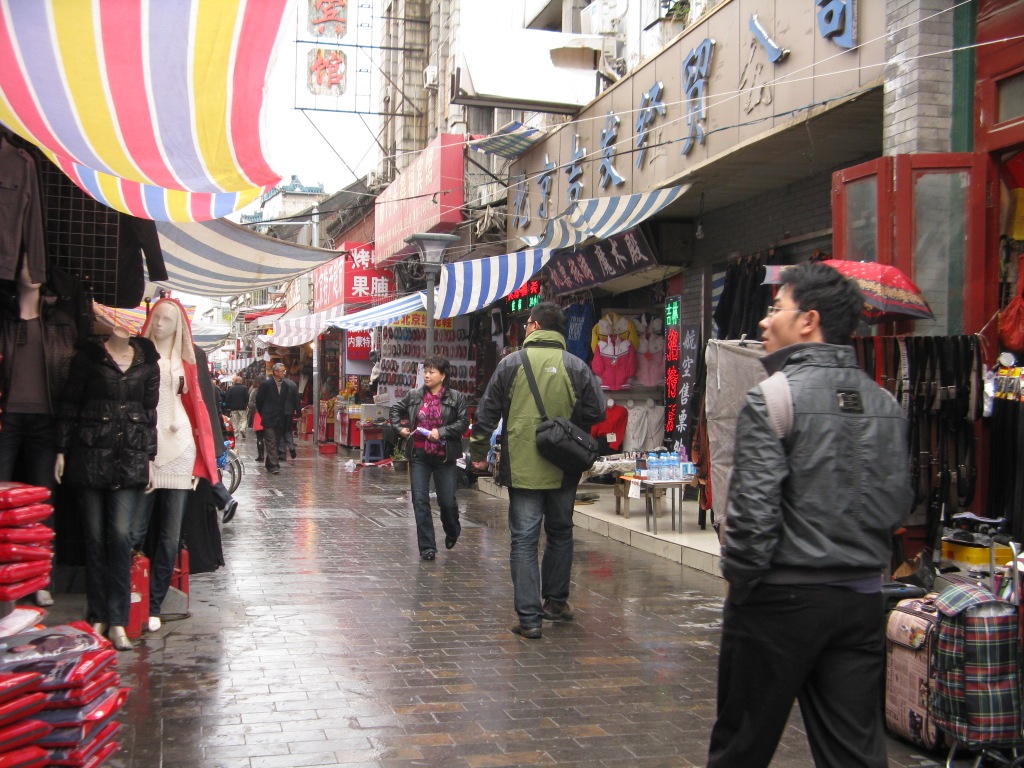
    There is a narrow street parallel to Qianmen and numerous tiny alleyways run from it.  This is one of them and they are filled with life, cater for tourists  without the “cleaned up for the tourists” appearance.

    East Dashalan St runs off Qianmen.  This is the entrance to a shop selling silk clothing and includes bronze sculptures of the silk making process and some antique furniture.

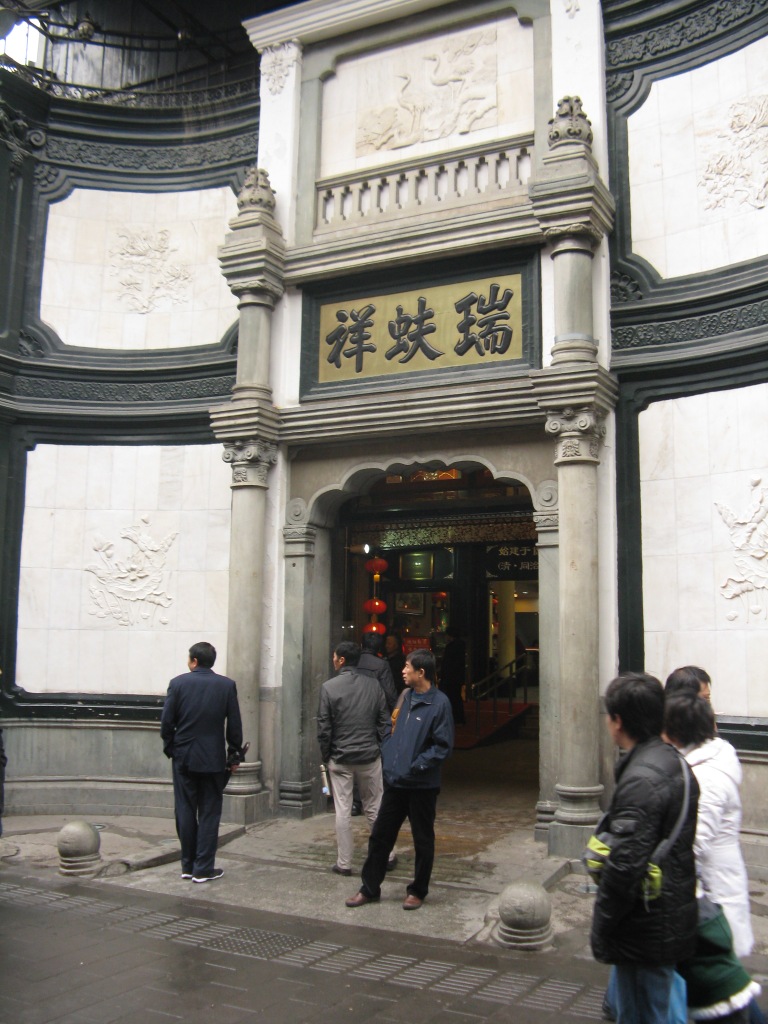
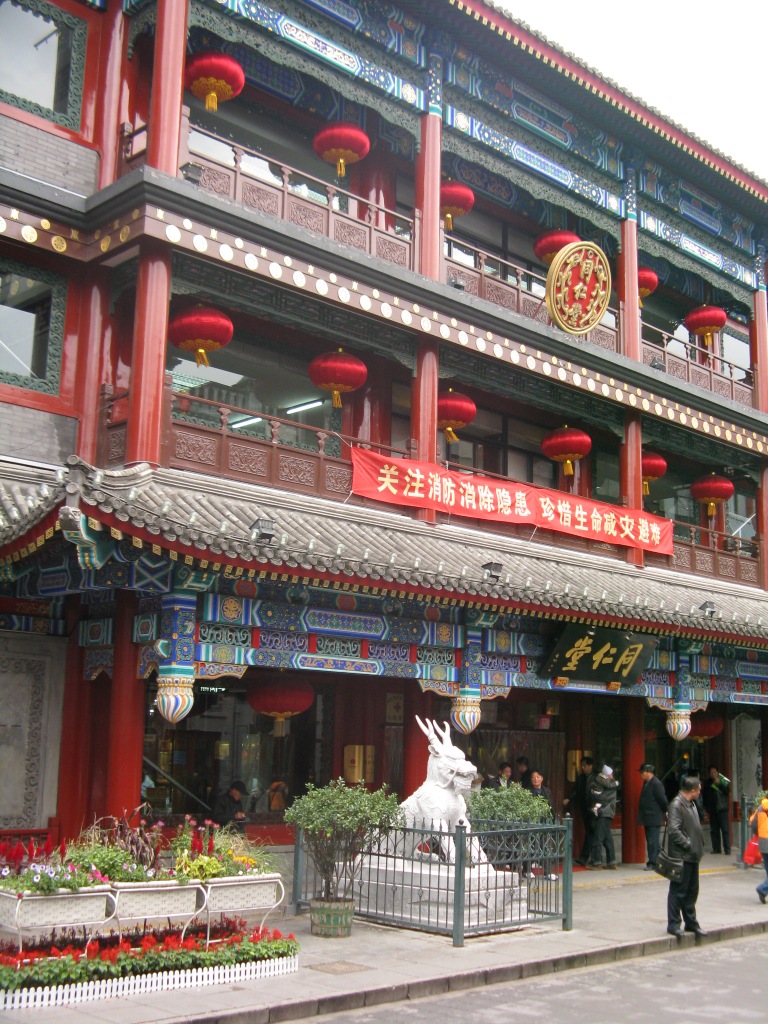
    This is part of an old  Chinese pharmecutical company.  It contains three floors of strange dried things considered beneficial to health.

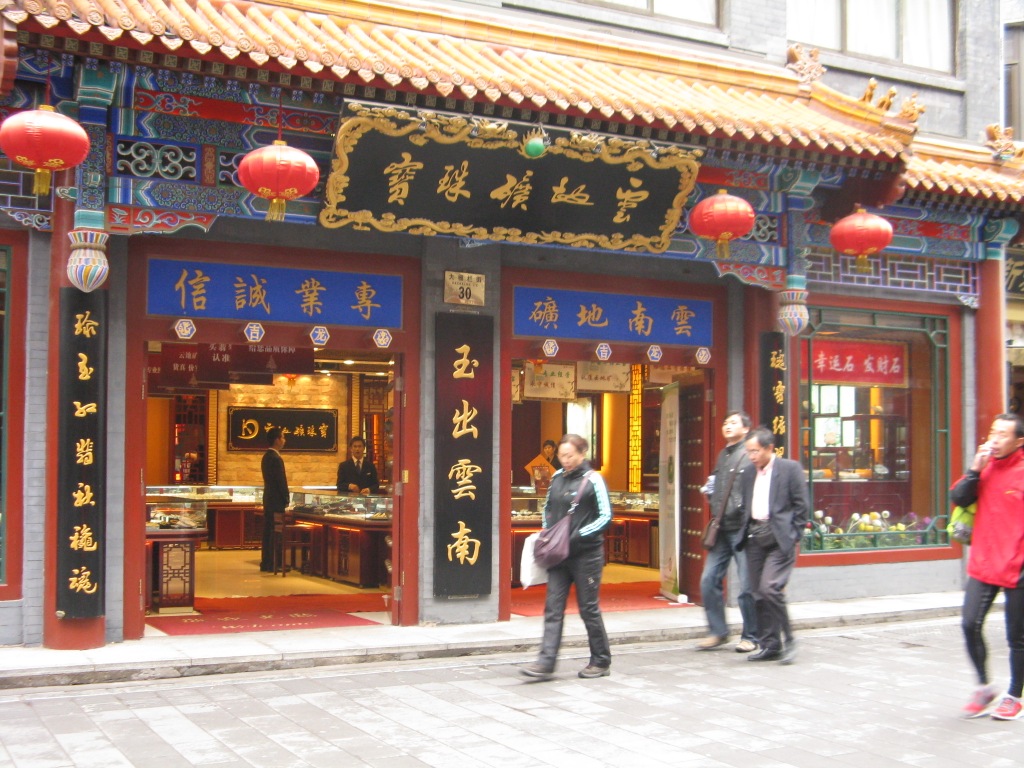
    A  jewellery shop.

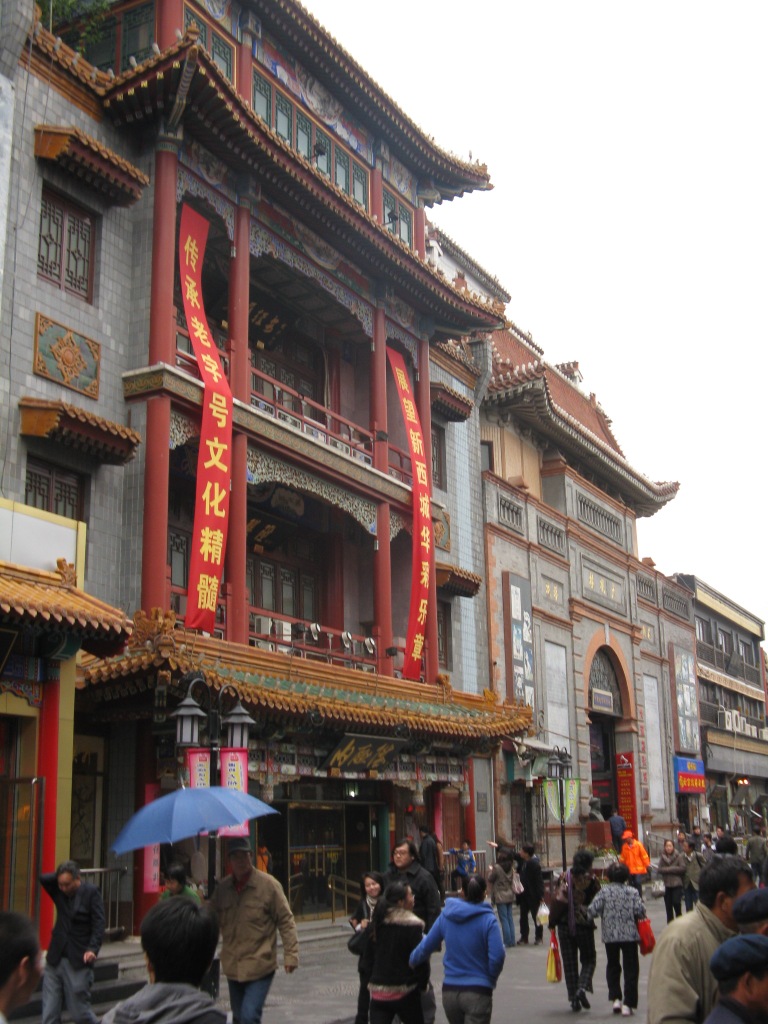
    The first building is a famous handmade cloth shoe business and the one beside it is an old cinema. Last year I bought some small torches from a shop in this street and I returned to buy some more.  The shop had disappeared.

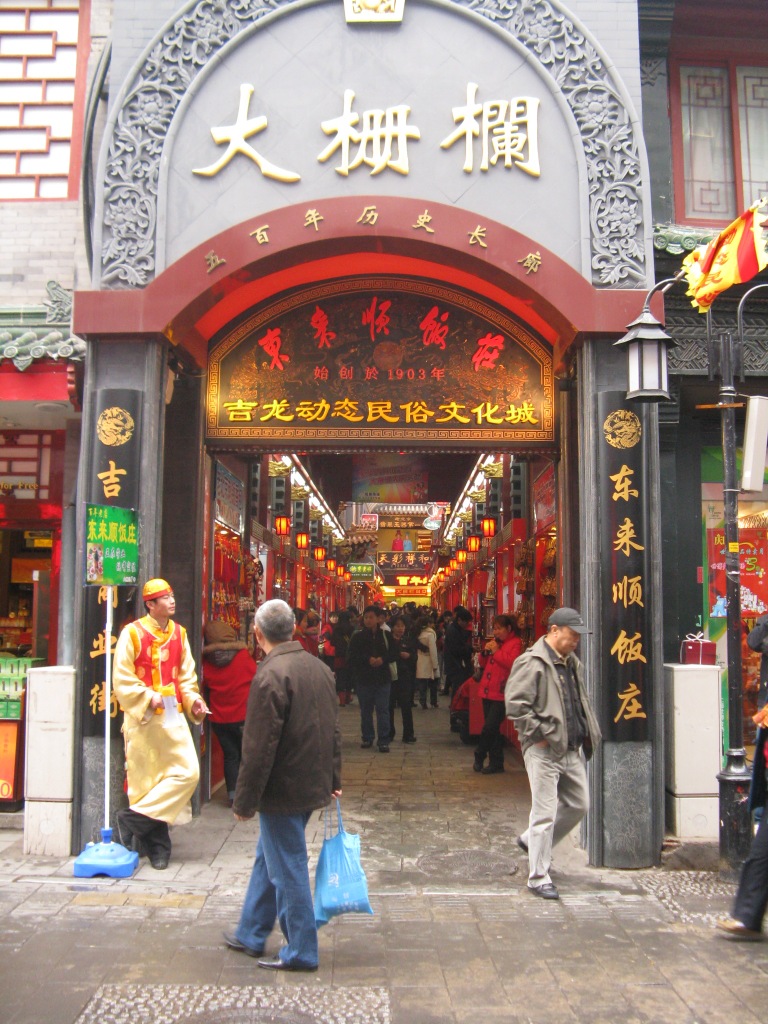
    This is the entrance to an alley way which looks like it has had a facelift since I visited it over a year ago.

    Shoppers in Dashalan East outside a famous dumpling restaurant.

    This is a road dividing the pedestrian East and West Dashalan Streets.  West Dashalan is to the top of the photo.  West Dashalan St has accommodation facilities, some locals and more muted tourist facilities.
    This is part of West  Dashalan in August last year when the street was safe enough for me to stop and photograph it.

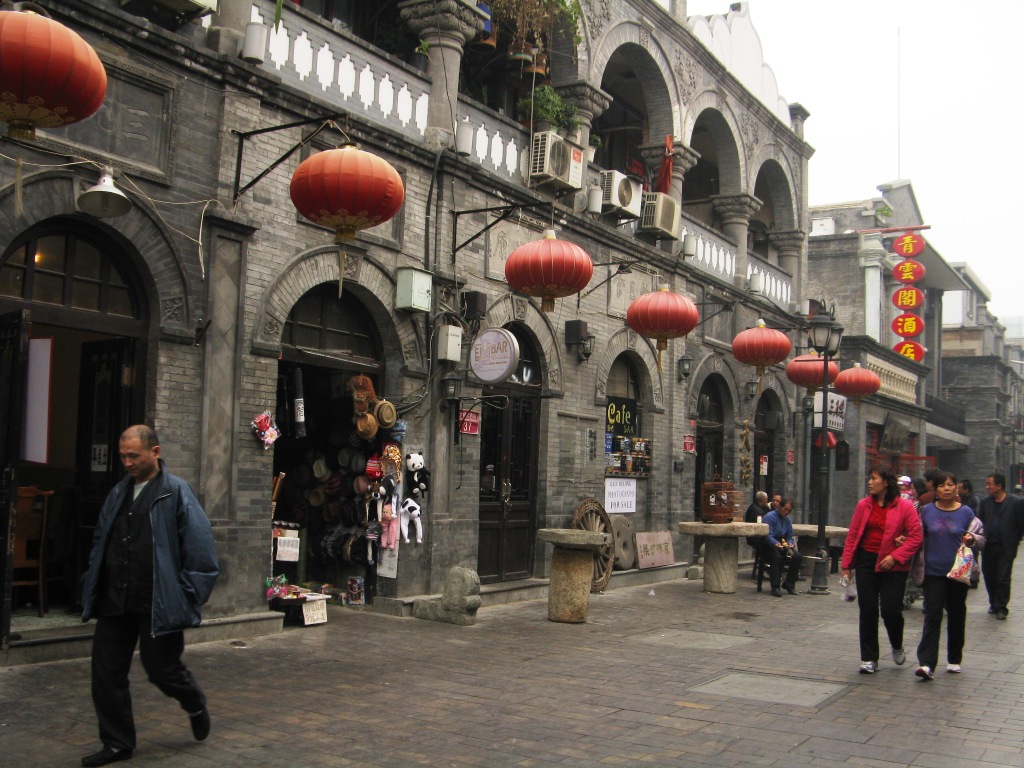
    This is West Dashalan St on Saturday morning.  I saw three or four people in night atire during the weekend.  Prior to the commencement of EXPO the authorities were trying to encourage the locals in Shanghai not wear pyjamas in the streets lest it give visitors a bad impression.

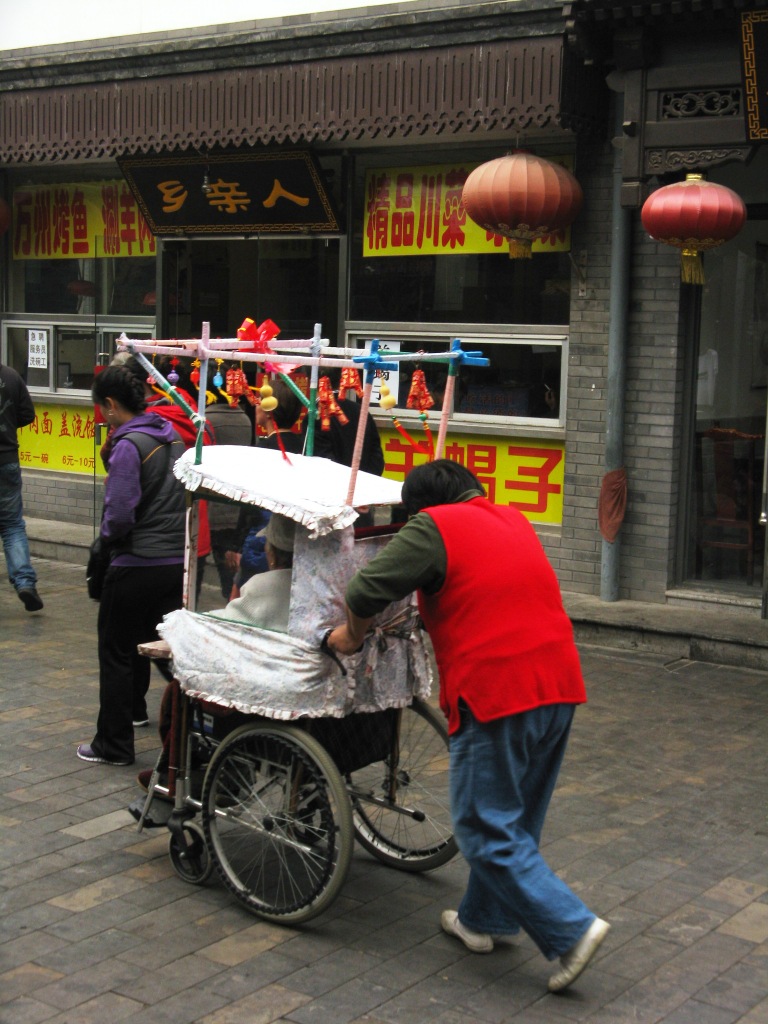
    This wheelchair wouldn’t become lost in a nursing home wheelchair parking area.  There is a demand for retirement services and nursing home placements  due to the same reasons that they exist in other countries.
    Street life.  There is a man sitting at a table. See what he has in the next photo.
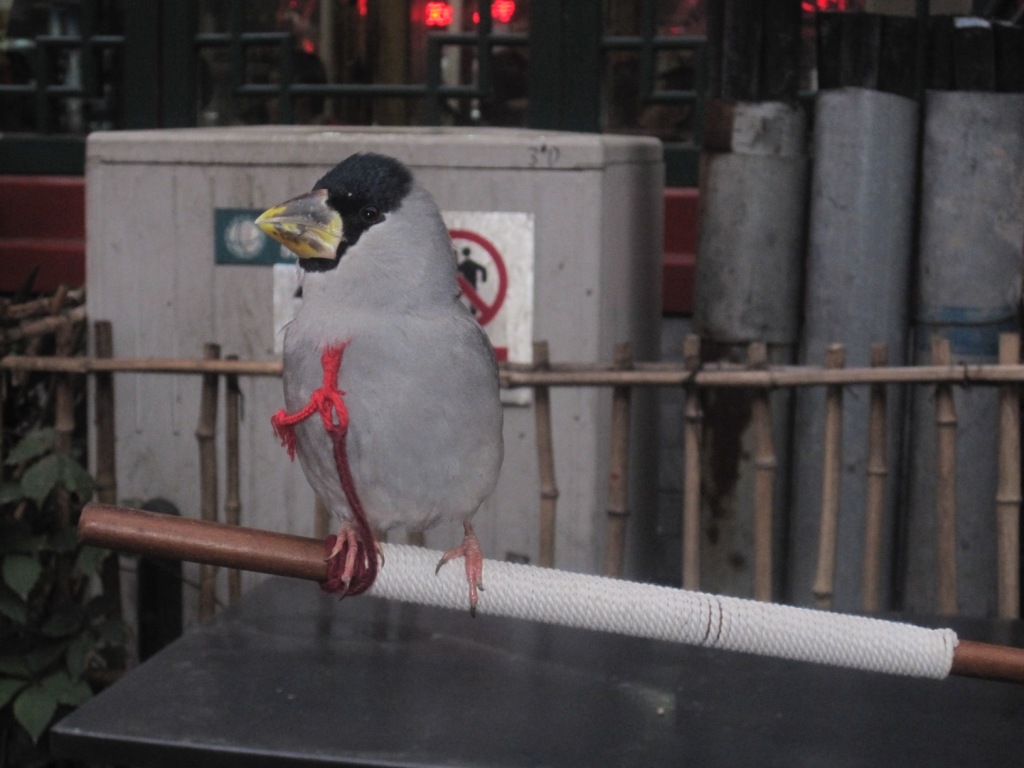
    This was taken the next day, but the man had a couple of little birds attached to sticks in addition to 2 cages containing a bird each.

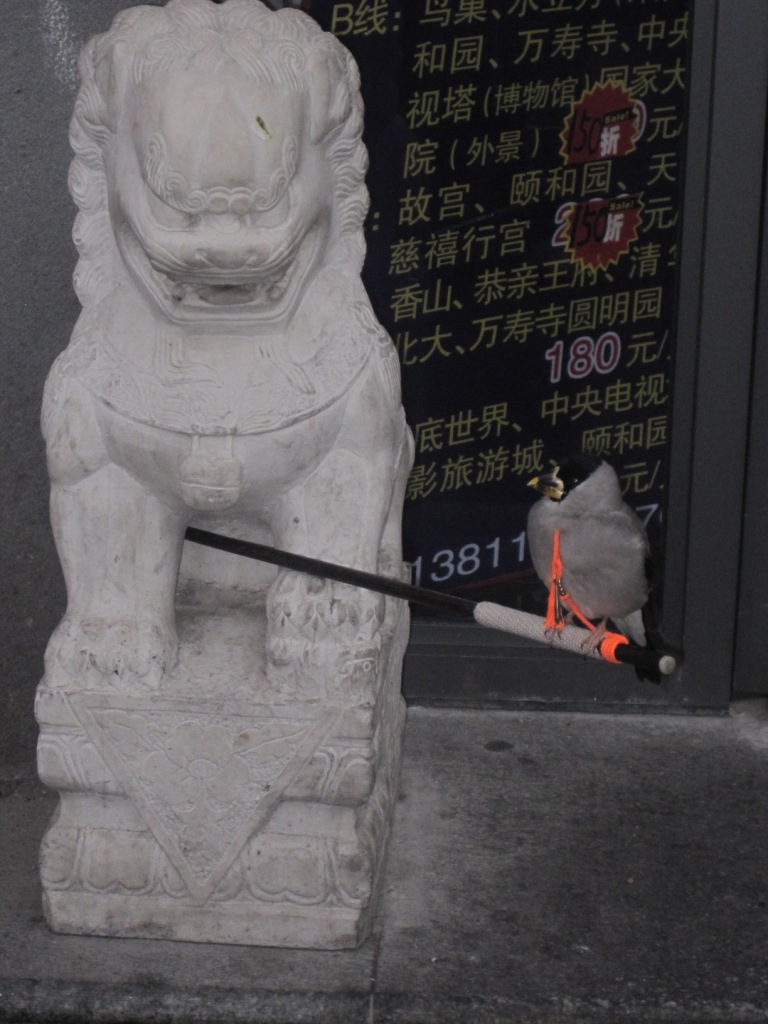
    Another bird parked in a statue.

    Dashalan became more ordinary, bifurcated and assumed a  local Chinese neighbourhood style.

    Beijing, China

    animals, architecture, Beijing, China, culture, Dashalan, Health, medicine, Qianmen, shops

    • <
    • 1
    • …
    • 18
    • 19
    • 20
    • 21
    • 22
    • …
    • 31
    • >

© Copyright Kerry's Blog. All rights reserved.